


Air pollution and risk of 32 health conditions: outcome-wide analyses in a population-based prospective cohort in Southwest China
- PMID: 39256817
- PMCID: PMC11389248
- DOI: 10.1186/s12916-024-03596-5
Air pollution and risk of 32 health conditions: outcome-wide analyses in a population-based prospective cohort in Southwest China
Abstract
Background: Uncertainty remains about the long-term effects of air pollutants (AP) on multiple diseases, especially subtypes of cardiovascular disease (CVD). We aimed to assess the individual and joint associations of fine particulate matter (PM2.5), along with its chemical components, nitrogen dioxide (NO2) and ozone (O3), with risks of 32 health conditions.
Methods: A total of 17,566 participants in Sichuan Province, China, were included in 2018 and followed until 2022, with an average follow-up period of 4.2 years. The concentrations of AP were measured using a machine-learning approach. The Cox proportional hazards model and quantile g-computation were applied to assess the associations between AP and CVD.
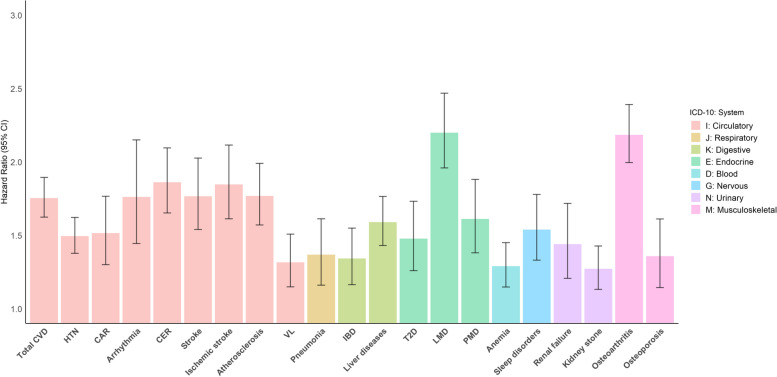
Results: Per interquartile range (IQR) increase in PM2.5 mass, NO2, O3, nitrate, ammonium, organic matter (OM), black carbon (BC), chloride, and sulfate were significantly associated with increased risks of various conditions, with hazard ratios (HRs) ranging from 1.06 to 2.48. Exposure to multiple air pollutants was associated with total cardiovascular disease (HR 1.75, 95% confidence intervals (CIs) 1.62-1.89), hypertensive diseases (1.49, 1.38-1.62), cardiac arrests (1.52, 1.30-1.77), arrhythmia (1.76, 1.44-2.15), cerebrovascular diseases (1.86, 1.65-2.10), stroke (1.77, 1.54-2.03), ischemic stroke (1.85, 1.61-2.12), atherosclerosis (1.77, 1.57-1.99), diseases of veins, lymphatic vessels, and lymph nodes (1.32, 1.15-1.51), pneumonia (1.37, 1.16-1.61), inflammatory bowel diseases (1.34, 1.16-1.55), liver diseases (1.59, 1.43-1.77), type 2 diabetes (1.48, 1.26-1.73), lipoprotein metabolism disorders (2.20, 1.96-2.47), purine metabolism disorders (1.61, 1.38-1.88), anemia (1.29, 1.15-1.45), sleep disorders (1.54, 1.33-1.78), renal failure (1.44, 1.21-1.72), kidney stone (1.27, 1.13-1.43), osteoarthritis (2.18, 2.00-2.39), osteoporosis (1.36, 1.14-1.61). OM had max weights for joint effects of AP on many conditions.
Conclusions: Long-term exposure to increased levels of multiple air pollutants was associated with risks of multiple health conditions. OM accounted for substantial weight for these increased risks, suggesting it may play an important role in these associations.
Keywords: Air pollution; Fine particulate matter components; Multiple exposure analysis; Outcome-wide analysis; Prospective cohort study.
© 2024. The Author(s).
Conflict of interest statement
The authors declare no competing interests.
Figures

References
-
- WHO. WHO global air quality guidelines: Particulate matter (PM2.5 and PM10), ozone, nitrogen dioxide, sulfur dioxide and carbon monoxide. Geneva: World Health Organization; 2021. - PubMed
-
- Schraufnagel DE, Balmes JR, Cowl CT, De Matteis S, Jung SH, Mortimer K, et al. Air pollution and noncommunicable diseases: a review by the forum of international respiratory societies’ environmental committee, Part 2: air pollution and organ systems. Chest. 2019;155(2):417–26. 10.1016/j.chest.2018.10.041 - DOI - PMC - PubMed
Publication types
MeSH terms
Substances
LinkOut - more resources
Full Text Sources
Medical
Molecular Biology Databases
