. 2024 Sep;29(9):e13434.
doi: 10.1111/adb.13434.

Sex differences in neural networks recruited by frontloaded binge alcohol drinking

Affiliations

Sex differences in neural networks recruited by frontloaded binge alcohol drinking

Cherish E Ardinger et al. Addict Biol. 2024 Sep.

Abstract

Frontloading is an alcohol drinking pattern where intake is skewed towards the onset of access. This study aimed to identify brain regions involved in frontloading. Whole brain imaging was performed in 63 C57Bl/6J (32 female, 31 male) mice that underwent 8 days of binge drinking using drinking-in-the-dark (DID). On Days 1-7 mice received 20% (v/v) alcohol or water for 2 h. Intake was measured in 1-min bins using volumetric sippers. On Day 8 mice were perfused 80 min into the DID session and brains were extracted. Brains were processed to stain for Fos protein using iDISCO+. Following light sheet imaging, ClearMap2.1 was used to register brains to the Allen Brain Atlas and detect Fos+ cells. For network analyses, Day 8 drinking patterns were used to characterize mice as frontloaders or non-frontloaders using a change-point analysis. Functional correlation matrices were calculated for each group from log10 Fos values. Euclidean distances were calculated from these R values and clustering was used to determine modules (highly connected groups of brain regions). In males, alcohol access decreased modularity (three modules in both frontloaders and non-frontloaders) as compared to water (seven modules). In females, an opposite effect was observed. Alcohol access (nine modules for frontloaders) increased modularity as compared to water (five modules). Further, different brain regions served as hubs in frontloaders as compared to control groups. In conclusion, alcohol consumption led to fewer, but more densely connected, groups of brain regions in males but not females and we identify several brain-wide signatures of frontloading.

Keywords: binge drinking; frontloading; iDISCO+.


Conflict of interest statement

The authors have no conflicts of interest to disclose.

Figures
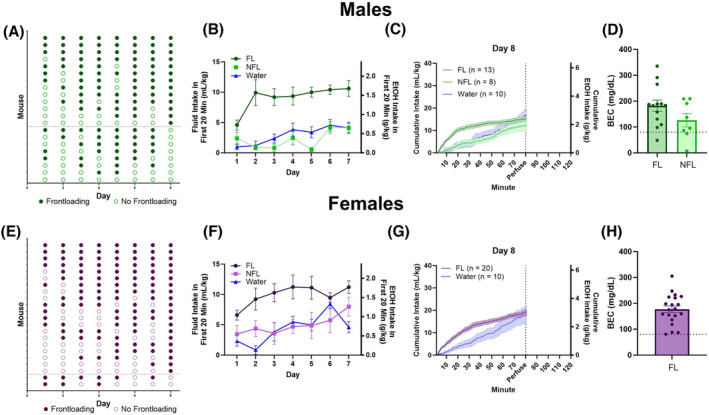
FIGURE 1
FIGURE 1
Frontloading classification across days for males (A) and females (E). Intakes in the first 20 min indicate that male (B) and female (F) frontloaders consumed more alcohol in the early part of the session. Intake patterns on Day 8 for males (C) and females (G) are displayed. There were no differences between male (D) and female (H) frontloaders and non‐frontloaders in blood ethanol concentration (BEC) when mice were sacrificed at 80 min on Day 8. The dashed line on Panels (D) and (H) represents 80 mg/dL, which is the NIAAA‐defined threshold for binge drinking.
FIGURE 2
FIGURE 2
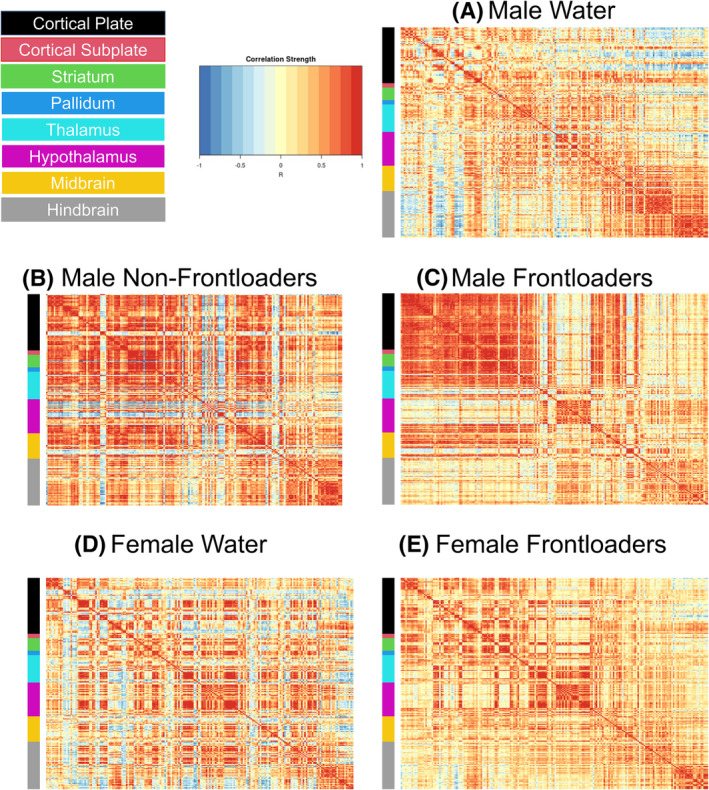
Functional correlation matrices organized using the Allen Brain Atlas. Males (A–C) and females (D, E) are represented. Note that there is no non‐frontloading group represented for females as there were only two female mice who did not frontload when brains were extracted on Day 8, which inhibits the ability to make meaningful conclusions about female non‐frontloaders in the current study.
FIGURE 3
FIGURE 3
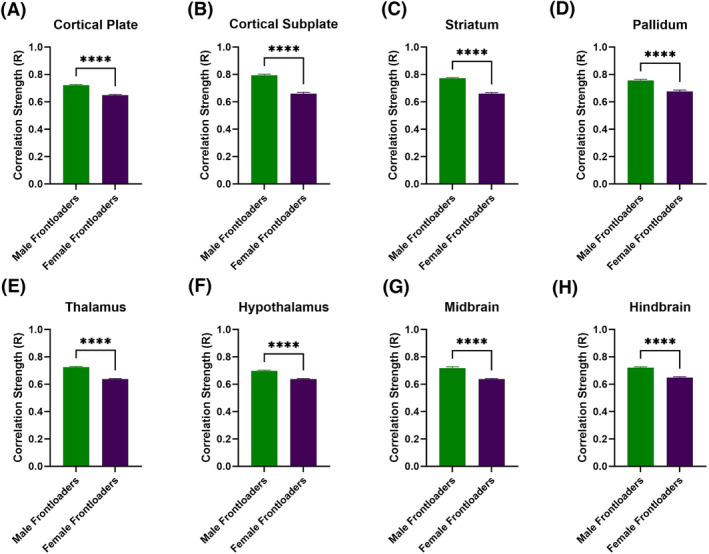
Correlation strength (R value) is compared across female and male frontloaders within anatomical subdivisions. Male frontloaders displayed higher R values in all anatomical divisions than female frontloaders. These results suggest that correlation strength is altered differently between sexes following alcohol frontloading.
FIGURE 4
FIGURE 4
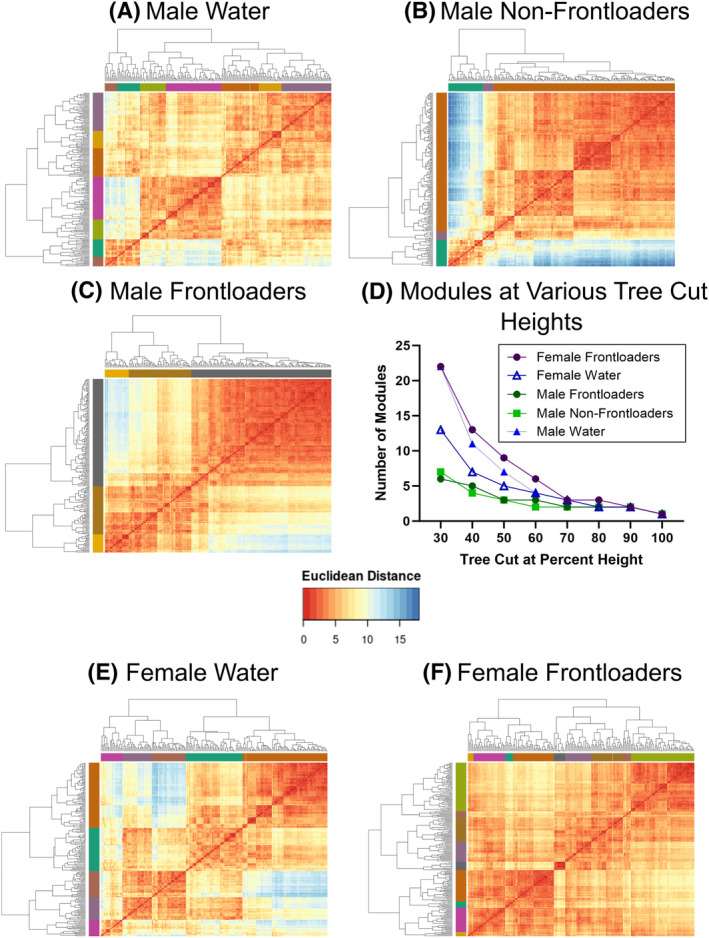
Hierarchical clustering of Euclidean distance matrices for each group. Modules for all groups were determined using a tree‐cut height of 50%. Colours on the sides of the graphs indicate where the modules are. In male water drinkers, seven modules were identified (A). In male non‐frontloaders, three modules were identified (B). In male frontloaders, three modules were identified (C). The decreased modularity in male alcohol drinking groups (i.e., non‐frontloaders and frontloaders) is observed regardless of tree cut percentage height chosen (with the exception of extreme cut off values) (D). In female water drinkers, five modules were identified (D). In female frontloaders, nine modules were identified (E). The increased modularity in frontloaders is observed regardless of tree cut percentage height chosen (with the exception of extreme cut off values) (D).
FIGURE 5
FIGURE 5
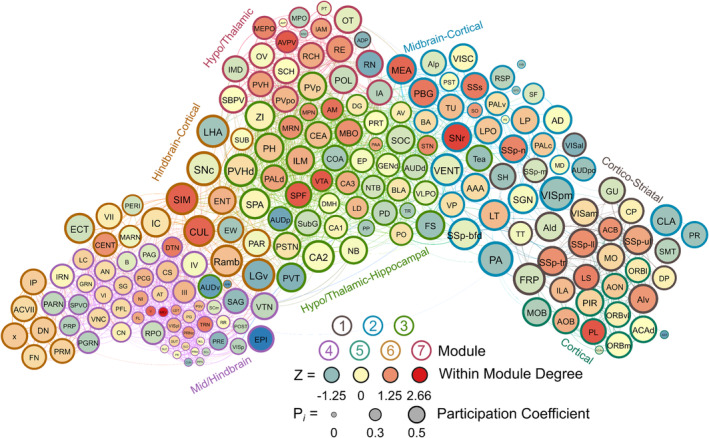
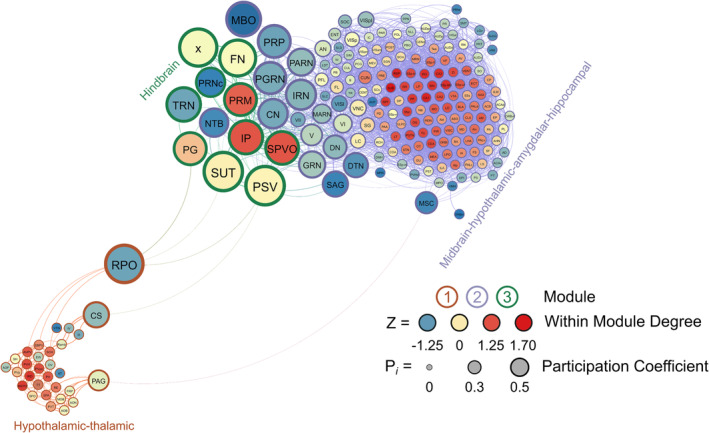
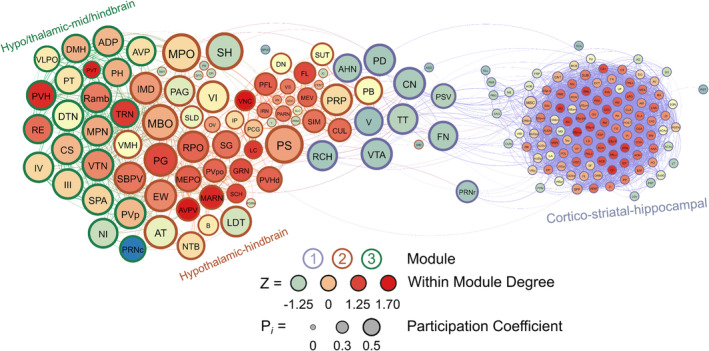
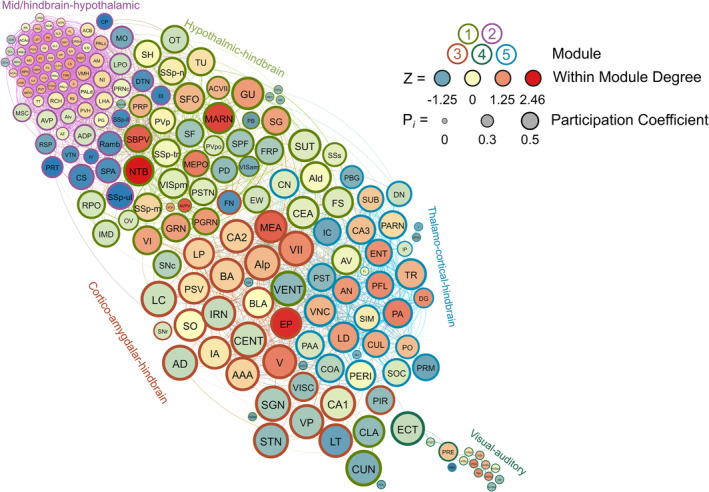
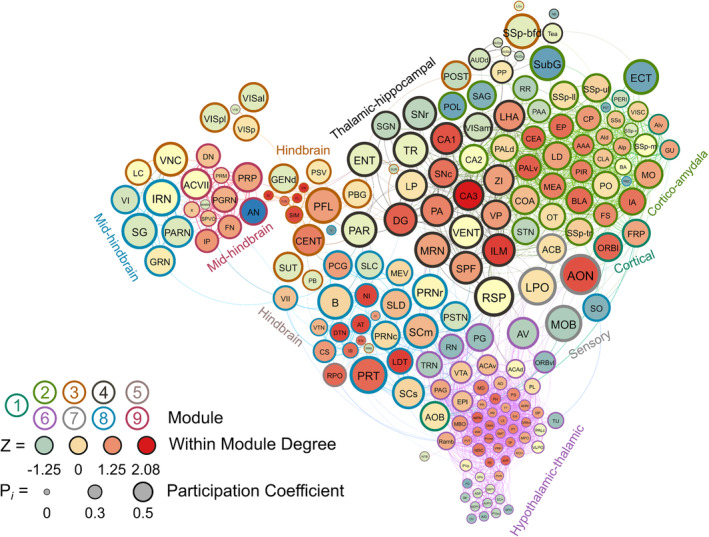
A visualized network of functional connectivity in male water drinkers. Each brain region is a circle. The size of the circle represents the participation coefficient. The colour inside the circle represents the WMDz. The colour on the outside of the circle represents the module. Seven distinct modules were identified using hierarchical clustering (Figure 4A) and each is represented by a different colour.
FIGURE 6
FIGURE 6
A visualized network of functional connectivity in male non‐frontloaders.
FIGURE 7
FIGURE 7
A visualized network of functional connectivity in male frontloaders.
FIGURE 8
FIGURE 8
A visualized network of functional connectivity in female water drinkers.
FIGURE 9
FIGURE 9
A visualized network of functional connectivity in female frontloaders.
FIGURE 10
FIGURE 10
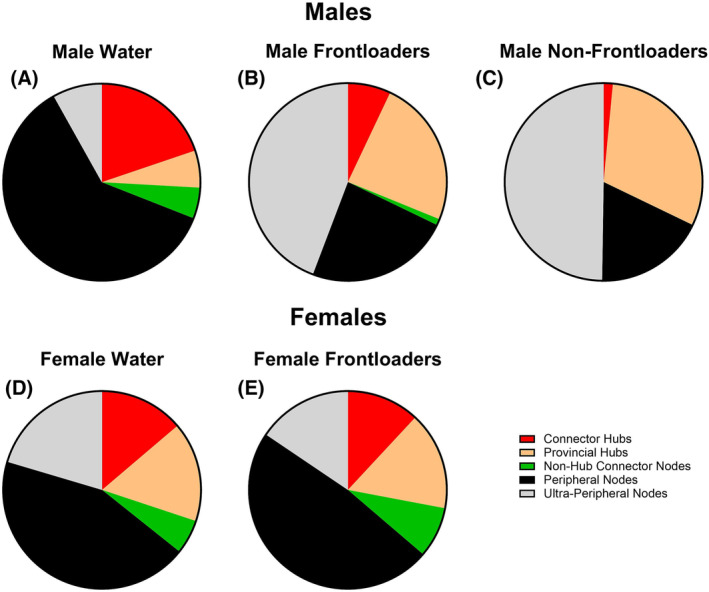
Network cartography. Male water drinkers (A) had more identified connector hubs and non‐hub connector nodes—and fewer ultra‐peripheral nodes—as compared to male non‐frontloaders (B) and male frontloaders (C). These results suggest that water drinking mice have a more globally connected brain network. Female water drinkers (D) and female frontloaders (E) displayed a similar breakdown of types of hubs and nodes within their respective network.
FIGURE 11
FIGURE 11
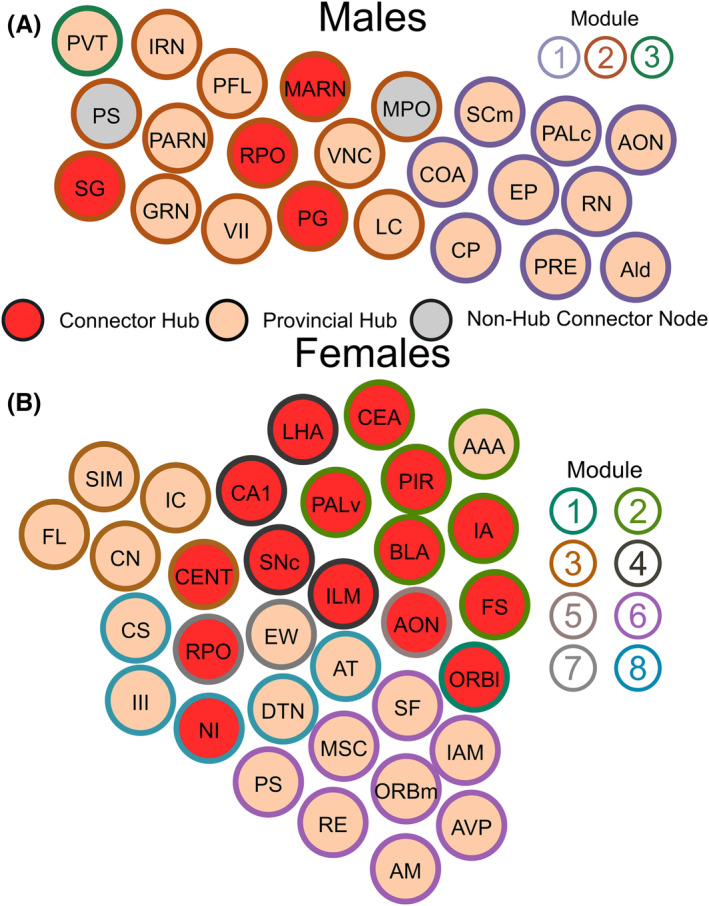
Connector hubs, provincial hubs and non‐hub connector nodes which were unique to male frontloaders (A) and female frontloaders (B). Each brain region is a circle. The colour inside the circle represents the role of the brain region in the male frontloader network. The colour on the outside of the circle represents the module. As these brain regions were not key brain regions in male non‐frontloaders or male water drinkers, they may play a unique role in alcohol frontloading.

Update of

References

    1. Ardinger CE, Lapish CC, Czachowski CL, Grahame NJ. A critical review of front‐loading: a maladaptive drinking pattern driven by alcohol's rewarding effects. Alcohol Clin Exp Res. 2022;46(10):1772‐1782. doi: 10.1111/acer.14924 - DOI - PMC - PubMed
    1. Simpson S, Chen Y, Wellmeyer E, et al. The hidden brain: uncovering previously overlooked brain regions by employing novel preclinical unbiased network approaches. Front Syst Neurosci. 2021;15:595507. doi: 10.3389/fnsys.2021.595507 - DOI - PMC - PubMed
    1. Smith LC, Kimbrough A. Leveraging neural networks in preclinical alcohol research. Brain Sci. 2020;10(9):578. doi: 10.3390/brainsci10090578 - DOI - PMC - PubMed
    1. Renier N, Adams EL, Kirst C, et al. Mapping of brain activity by automated volume analysis of immediate early genes. Cell. 2016;165(7):1789‐1802. doi: 10.1016/j.cell.2016.05.007 - DOI - PMC - PubMed
    1. Renier N, Wu Z, Simon David J, Yang J, Ariel P, Tessier‐Lavigne M. iDISCO: a simple, rapid method to Immunolabel large tissue samples for volume imaging. Cell. 2014;159(4):896‐910. doi: 10.1016/j.cell.2014.10.010 - DOI - PubMed

LinkOut - more resources