


Comparative Efficacy of Cognitive Training for Post-Stroke Aphasia: A Systematic Review and Network Meta-Analysis
- PMID: 39256985
- PMCID: PMC11566095
- DOI: 10.1177/15459683241274755
Comparative Efficacy of Cognitive Training for Post-Stroke Aphasia: A Systematic Review and Network Meta-Analysis
Abstract
Background: Although cognitive training has shown potential for treating post-stroke aphasia (PSA), its efficacy varies across studies, and the optimal training approaches remain unclear.
Objective: To evaluate and compare the effects of distinct cognitive training interventions, either combined with or independent of speech and language therapy (SLT), on language function in individuals with PSA.
Methods: A systematic search encompassing PubMed, Embase, Cochrane Library, China National Knowledge Infrastructure, Wanfang, VIP, and Chinese Biomedical Databases was conducted for randomized controlled trials (RCTs). A network meta-analysis evaluated interventions, including computer-assisted cognitive training (CCT), conventional cognitive training (CT), virtual reality (VR)-based cognitive training (vrCT), telerehabilitation computer-assisted cognitive training (tCCT), working memory (WM) training, and attention training (AT).
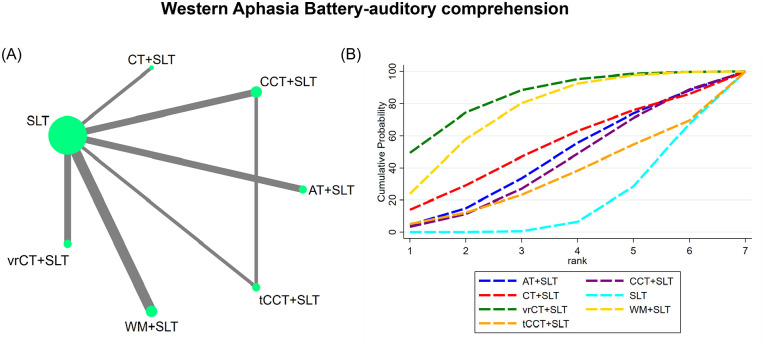
Results: Eleven RCTs comprising 501 participants were included. Individuals with PSA who underwent combined WM training with SLT led to significantly enhanced Western Aphasia Battery (WAB) Aphasia Quotient (AQ), as well as in spontaneous speech, auditory comprehension, repetition, and naming, compared to those receiving SLT alone. This combination was more effective than both CCT with SLT and tCCT with SLT in improving WAB AQ. Similarly, it outperformed both CCT with SLT and vrCT with SLT in enhancing WAB spontaneous speech. Additionally, both AT and CT combined with SLT were more effective than SLT alone in enhancing WAB spontaneous speech. Specifically, AT combined with SLT proved more effective than vrCT with SLT in this area. Moreover, vrCT combined with SLT significantly improved auditory comprehension compared with SLT alone.
Conclusions: Combining WM training and SLT and integrating vrCT with SLT both significantly enhance language function in individuals with PSA, compared with SLT alone. Our findings advocate for the use of these cognitive training approaches as promising strategies for language rehabilitation in this population. PROSPERO registration number: CRD42023462361.
Keywords: cognitive training; network meta-analysis; post-stroke aphasia; speech and language therapy.
Conflict of interest statement
Declaration of Conflicting InterestsThe author(s) declared no potential conflicts of interest with respect to the research, authorship, and/or publication of this article.
Figures




References
-
- Engelter ST, Gostynski M, Papa S, et al. Epidemiology of aphasia attributable to first ischemic stroke. Stroke. 2006;37:1379-1384. - PubMed
-
- Flowers HL, Skoretz SA, Silver FL, et al. Poststroke aphasia frequency, recovery, and outcomes: a systematic review and meta-analysis. Arch Phys Med Rehabil. 2016;97:2188-2201. - PubMed
-
- Stefaniak JD, Halai AD, Lambon Ralph MA. The neural and neurocomputational bases of recovery from post-stroke aphasia. Nat Rev Neurol. 2020;16:43-55. - PubMed
Publication types
MeSH terms
LinkOut - more resources
Full Text Sources
Medical
Research Materials
Miscellaneous
