


Grading of Balance Function in Subacute Stroke Patients by Using the Berg Balance Scale Together with Latent Rank Theory
- PMID: 39257524
- PMCID: PMC11382790
- DOI: 10.1298/ptr.E10282
Grading of Balance Function in Subacute Stroke Patients by Using the Berg Balance Scale Together with Latent Rank Theory
Abstract
Objectives: The Berg Balance Scale (BBS) is a core measure of balance function in patients with stroke. Latent rank theory (LRT) is a statistical method that enables the degree of functional impairment to be ranked from the sub-items of a rating scale; each rank can then be characterized. Identification of the characteristics of balance function by rank would be beneficial for interventions to improve balance function in patients with stroke. This study aims to use LRT to rank and characterize patients with stroke balance impairment.
Methods: This was a multicenter retrospective analysis of 293 patients with subacute stroke. We used LRT and the BBS to estimate the optimal rankings based on the goodness-of-fit index and the information criterion. We compared the obtained ranks with the level of walking independence for each rank.
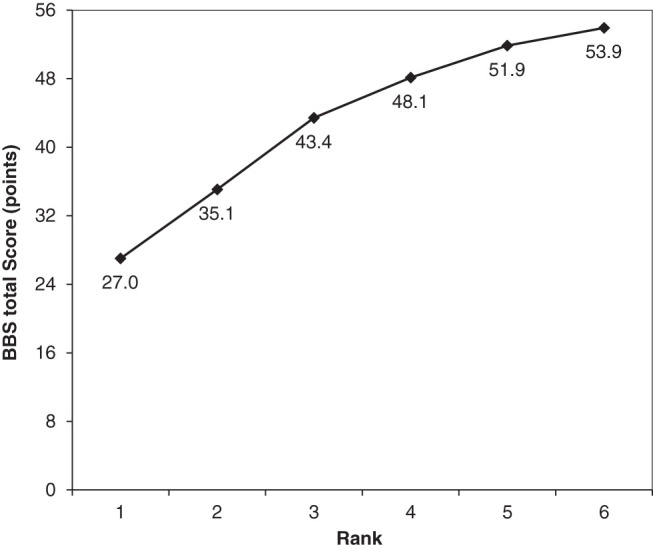
Results: The evaluation of the patient's BBS scores revealed that balance impairment could be divided into six ranks. The average BBS score for each rank rose from 27.1 for rank 1 to 53.9 for rank 6. The scores of the BBS sub-items for each rank also differed. The level of walking independence by rank ranged from rank 1 for assisted walking to rank 6 for independent outdoor walking.
Conclusions: Balance function in patients with subacute stroke was ranked sixth in the BBS, with varying characteristics identified for different ranks. This result helped to determine the therapy to improve the balance function of patients with stroke.
Keywords: Balance; Berg Balance Scale; Early subacute stroke; Latent rank theory; Outcome measure.
©2024 Japanese Society of Physical Therapy.
Conflict of interest statement
The authors declare no conflicts of interest.
Figures
References
-
- Preston E, Ada L, et al.: What is the probability of patients who are nonambulatory after stroke regaining independent walking? A systematic review. Int J Stroke. 2011; 6: 531–540. - PubMed
