[Preprint]. 2024 Aug 31:2024.08.30.610542.
doi: 10.1101/2024.08.30.610542.

Prodrug activation in malaria parasites mediated by an imported erythrocyte esterase, acylpeptide hydrolase (APEH)

Affiliations

Prodrug activation in malaria parasites mediated by an imported erythrocyte esterase, acylpeptide hydrolase (APEH)

S A Sundararaman et al. bioRxiv. .

Update in

Abstract

The continued emergence of antimalarial drug resistance highlights the need to develop new antimalarial therapies. Unfortunately, new drug development is often hampered by poor drug-like properties of lead compounds. Prodrugging temporarily masks undesirable compound features, improving bioavailability and target penetration. We have found that lipophilic diester prodrugs of phosphonic acid antibiotics, such as fosmidomycin, exhibit significantly higher antimalarial potency than their parent compounds (1). However, the activating enzymes for these prodrugs were unknown. Here, we show that an erythrocyte enzyme, acylpeptide hydrolase (APEH) is the major activating enzyme of multiple lipophilic ester prodrugs. Surprisingly, this enzyme is taken up by the malaria parasite, Plasmodium falciparum, where it localizes to the parasite cytoplasm and retains enzymatic activity. Using a novel fluorogenic ester library, we characterize the structure activity relationship of APEH, and compare it to that of P. falciparum esterases. We show that parasite-internalized APEH plays an important role in the activation of substrates with branching at the alpha carbon, in keeping with its exopeptidase activity. Our findings highlight a novel mechanism for antimicrobial prodrug activation, relying on a host-derived enzyme to yield activation at a microbial target. Mutations in prodrug activating enzymes are a common mechanism for antimicrobial drug resistance (2-4). Leveraging an internalized host enzyme would circumvent this, enabling the design of prodrugs with higher barriers to drug resistance.


Figures
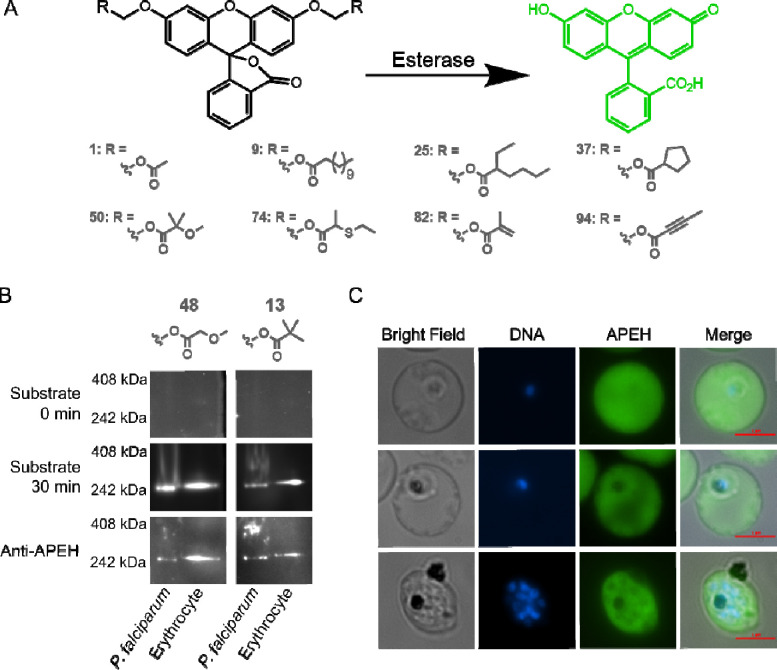
Figure 1.
Figure 1.. Human APEH is active in P. falciparum lysate and localizes to the cytoplasm of malaria parasites.
A) Schematic of the fluorescent substrate library used in this study. Reactive ester moieties (R) are added to fluorescein yielding substrates with masked fluorescence. Hydrolysis of the ester bond by an esterase produces a fluorescent signal. A subset of substrates, demonstrating the various substrate types found in the library, is shown here. The full 96 substrate library is shown in Fig. S2. B) Native in gel fluorescence and immunoblotting of P. falciparum or erythrocyte lysate using substrates 48 and 13 reveals a single prominent band of esterase activity corresponding to the human enzyme, APEH. Gels are shown prior to incubation with fluorescent substrate (0 min) and after 30 minutes of incubation. Proteins from each gel were then transferred nitrocellulose membranes for immunoblotting with anti-APEH. C) Immunofluorescence images of infected erythrocytes showing the cytoplasmic localization of APEH.
Figure 2.
Figure 2.. The human erythrocyte esterase APEH de-esterifies and activates POM-ERJ.
A) Schematic of linked enzyme activity assay. Intact POM-ERJ does not inhibit DXR. Hydrolysis of POM-ERJ by a prodrug activating enzyme (APEH) yields active ERJ inhibitor, leading to inhibition of DXR. Inhibition of the APEH by its own inhibitor (AA74–1) impedes POM-ERJ hydrolysis, rescuing DXR activity. B) POM-ERJ activation as measured by inhibition of DXR activity. Parasite lysate, erythrocyte lysate, recombinant APEH (rAPEH), or buffer were incubated for 12 hours at 37°C in the presence or absence of POM-ERJ and AA74–1, and then added to recombinant DXR. Residual DXR activity is shown for each condition. Fosmidomycin (Fsm) is included as a positive control for DXR inhibition. Slight DXR inhibition is observed when POM-ERJ is incubated with buffer, likely due to slow spontaneous hydrolysis. C) Change in POM-ERJ concentration upon incubation with rAPEH, rAPEH and 400 nM AA74–1, or buffer, as measured by LC-MS. Data in B and C represent the mean of three replicates, error bars show SEM. P-values were calculated using Welch’s t-test. ***: p<0.001, **: p<0.01, *: p<0.05, n.s. not significant.
Figure 3.
Figure 3.. Erythrocyte APEH is required for P. falciparum sensitivity to POM-ERJ.
(A, B) Effect of APEH inhibition on POM-ERJ activation. Active APEH (A) hydrolyzes POM-ERJ, leading to accumulation of active drug (ERJ) in P. falciparum and parasite death. APEH inhibition by AA74–1 (B) decreases POM-ERJ activation, decreasing ERJ accumulation and parasite death. C) EC50 values for POM-ERJ or Fsm against P. falciparum 3D7 grown in AA74–1 treated (APEH inhibited) or DMSO treated (APEH active) erythrocytes. Bar graphs (mean ± SEM) are representative of four biological replicates. Points represent EC50s for each replicate. For POM-ERJ, APEH active cultures have an EC50 of 31.0 ± 2.4 nM and APEH inhibited cultures an EC50 of 83.9 ± 14.7 nM. For Fsm, APEH active cultures have an EC50 of 0.62 ± 0.04 μM and APEH inhibited an EC50 of 0.69 ± 0.12 μM. P-values were calculated using Welch’s t-test. No statistical significance is denoted by n.s. (D) Representative dose-response curves for POM-ERJ and Fsm against P. falciparum 3D7. Data are representative of two technical replicates. Points represent mean growth ± SEM at each concentration.
Figure 4.
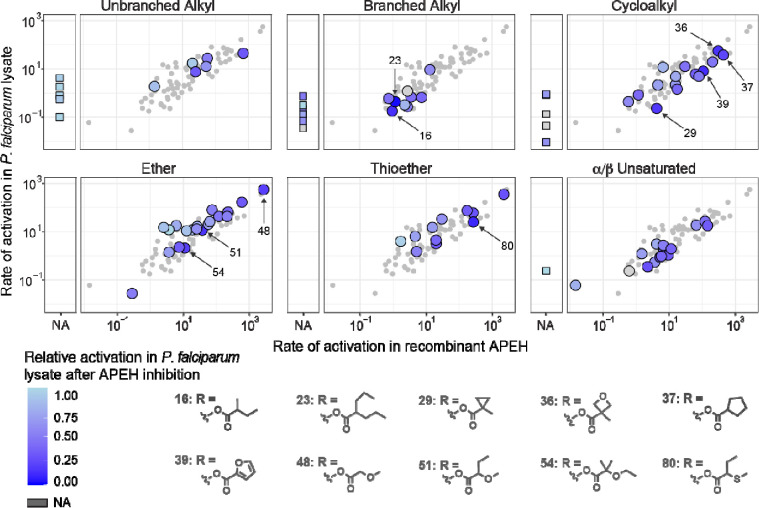
Figure 4.. Structure activity relationship of recombinant APEH and P. falciparum lysate with and without APEH inhibition.
Rates of fluorescent substrate activation (fM fluorescein produced per minute per ng protein) are shown for purified recombinant APEH (x-axis) and soluble parasite lysate (y-axis). Substrates are grouped by promoiety type, with large circles representing substrates within that type, and small circles representing the full library for comparison. Substrates with no detectable activation by APEH are shown as squares to the left of each main plot. Colors represent the relative rate of substrate activation in P. falciparum lysate after AA74–1 treatment (white: no change, dark blue: complete inhibition, dark gray: no data). The ten substrates with the highest decrease in activation after APEH inhibition are shown (activation rates for all individual substrates are presented in Table S2).

References

    1. Edwards R. L., et al. , MEPicides: potent antimalarial prodrugs targeting isoprenoid biosynthesis. Scientific reports 7, 8400 (2017). - PMC - PubMed
    1. Istvan E. S., et al. , Esterase mutation is a mechanism of resistance to antimalarial compounds. Nat Commun 8, 14240 (2017). - PMC - PubMed
    1. Sindhe K. M. V., et al. , Plasmodium falciparum resistance to a lead benzoxaborole due to blocked compound activation and altered ubiquitination or sumoylation. mBio 11, e02640–19 (2020). - PMC - PubMed
    1. Butler J. H., et al. , Resistance to some, but not other dimeric lindenane sesquiterpenoid esters is mediated by mutations in a Plasmodium falciparum esterase. Acs Infect Dis (2020). 10.1021/acsinfecdis.0c00487. - DOI - PMC - PubMed
    1. World Malaria Report 2023 (World Health Organization, 2023).

Publication types

LinkOut - more resources