This is a preprint.
MED13L-related disorder characterized by severe motor speech impairment
- PMID: 39257968
- PMCID: PMC11384029
- DOI: 10.21203/rs.3.rs-4790993/v1
MED13L-related disorder characterized by severe motor speech impairment
Update in
-
MED13L-related disorder characterized by severe motor speech impairment.J Neurodev Disord. 2025 Sep 24;17(1):56. doi: 10.1186/s11689-025-09645-1. J Neurodev Disord. 2025. PMID: 40993520 Free PMC article.
Abstract
Background: MED13L-related disorder is associated with intellectual disability, motor delay, and speech deficits. Previous studies have focused on broad clinical descriptions of individuals, but limited information regarding specific speech diagnoses and results of direct testing has been published to date. We conducted deep phenotyping to characterize the speech, language, motor, cognitive, and adaptive phenotypes of individuals with MED13L-related disorder.
Methods: In this cross-sectional study, we administered standardized articulation, language, motor, and cognitive testing to 17 children and adolescents (mean age 9y 9m; SD 4y 5m; range 4y 2m to 19y 7m). In-person testing was supplemented with broad developmental, medical, and behavioral information collected virtually from a cohort of 67 individuals.
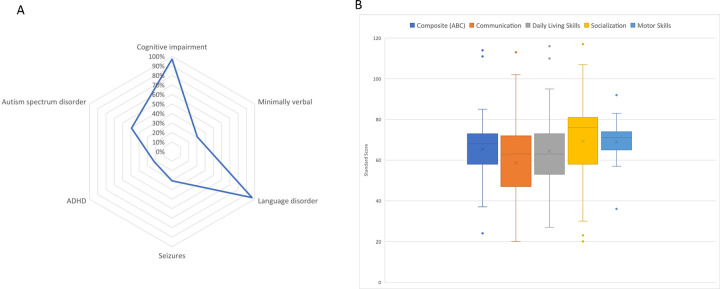
Results: All individuals who completed in-person articulation testing met diagnostic criteria for speech apraxia, dysarthria, or both. Language impairment was present in all of the in-person cohort and almost all (97%) of the virtual cohort. Those who were able to complete motor testing demonstrated significant deficits in visual motor integration (mean 57.08, SD 9.26). Full scale IQs fell in the borderline to intellectual disability range, consistent with reported cognitive impairment in 97% of the virtual cohort. Notable medical features included hypotonia (83%), vision problems (72%), recurrent otitis media (58%), gastrointestinal problems (57%), and seizures (31%).
Conclusions: MED13L-related disorder is characterized by a high rate of motor speech disorders that occur in the context of globally impaired motor, language, and cognitive skills. Children would benefit from intensive, individualized speech therapy and the early adoption of augmentative communication strategies.
Keywords: Apraxia of speech; Dysarthria; MED13L; Motor impairment; Speech disorders.
Conflict of interest statement
Declarations Competing interests The authors declare that they have no competing interests.
Figures

References
-
- Utami KH, Winata CL, Hillmer AM, Aksoy I, Long HT, Liany H, et al. Impaired development of neural-crest cell-derived organs and intellectual disability caused by MED13L haploinsufficiency. Hum Mutat. 2014;35(11):1311–20. - PubMed
-
- Muncke N, Jung C, Rüdiger H, Ulmer H, Roeth R, Hubert A, et al. Missense Mutations and Gene Interruption in PROSIT240, a Novel TRAP240-Like Gene, in Patients with Congenital Heart Defect (Transposition of the Great Arteries). Circulation. 2003;108(23):2843–50. - PubMed
-
- Asadollahi R, Zweier M, Gogoll L, Schiffmann R, Sticht H, Steindl K, et al. Genotype-phenotype evaluation of MED13L defects in the light of a novel truncating and a recurrent missense mutation. Eur J Med Genet. 2017;60(9):451–64. - PubMed
Publication types
Grants and funding
LinkOut - more resources
Full Text Sources
Miscellaneous