


A video intervention to improve patient understanding of tumor genomic testing in patients with cancer
- PMID: 39258462
- PMCID: PMC11387988
- DOI: 10.1002/cam4.70095
A video intervention to improve patient understanding of tumor genomic testing in patients with cancer
Abstract
Introduction: Tumor genomic testing (TGT) is standard-of-care for most patients with advanced/metastatic cancer. Despite established guidelines, patient education prior to TGT is frequently omitted. The purpose of this study was to evaluate the impact of a concise 4 min video for patient education prior to TGT.
Methods: Based on a quality improvement cycle, an animated video was created to be applicable to any cancer type, incorporating culturally diverse images, available in English and Spanish. Patients undergoing standard-of-care TGT were enrolled at a tertiary academic institution and completed survey instruments prior to video viewing (T1) and immediately post-viewing (T2). Instruments included: (1) 10-question objective genomic knowledge; (2) 10-question video message-specific knowledge; (3) 11-question Trust in Provider; (4) attitudes regarding TGT.
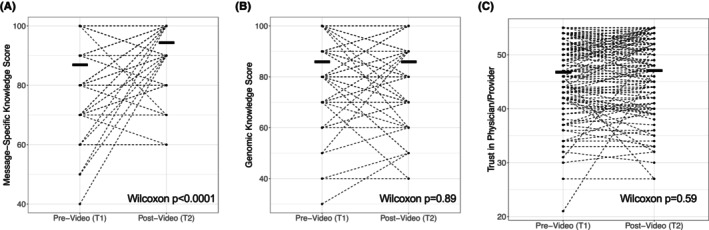
Results: A total of 150 participants were enrolled. For the primary objective, there was a significant increase in video message-specific knowledge (median 10 point increase; p < 0.0001) with no significant change in genomic knowledge/understanding (p = 0.89) or trust in physician/provider (p = 0.59). Results for five questions significantly improved, including the likelihood of TGT impact on treatment decision, incidental germline findings, and cost of testing. Improvement in video message-specific knowledge was consistent across demographic groups, including age, income, and education.
Conclusions: A concise, 3-4 min, broadly applicable video incorporating culturally diverse images administered prior to TGT significantly improved video message-specific knowledge across all demographic groups. This resource is publicly available at http://www.tumor-testing.com, with a goal to efficiently educate and empower patients regarding TGT while addressing guidelines within the flow of clinical practice.
Keywords: biomarkers; cancer education; cancer management; genomics.
© 2024 The Author(s). Cancer Medicine published by John Wiley & Sons Ltd.
Conflict of interest statement
HH is on the scientific advisory board for Invitae Genetics, Genome Medical, and Promega. She has stock/stock options in Genome Medical and GI OnDemand. LS is a consultant and speaker for AstraZeneca. DS served on an advisory board for Novartis. CJP received payment for patient education material development through Jazz Pharmaceuticals.
Figures
Update of
-
A Video Intervention to Improve Patient Understanding of Tumor Genomic Testing in Patients with Cancer.medRxiv [Preprint]. 2023 Dec 5:2023.12.05.23299443. doi: 10.1101/2023.12.05.23299443. medRxiv. 2023. Update in: Cancer Med. 2024 Sep;13(17):e70095. doi: 10.1002/cam4.70095. PMID: 38106014 Free PMC article. Updated. Preprint.
References
-
- Chakravarty D, Solit DB. Clinical cancer genomic profiling. Nat Rev Genet. 2021;22:483‐501. - PubMed
-
- Robson ME, Bradbury AR, Arun B, et al. American Society of Clinical Oncology policy statement update: genetic and genomic testing for cancer susceptibility. J Clin Oncol. 2015;33:3660‐3667. - PubMed
-
- DeLeonardis K, Hogan L, Cannistra SA, Rangachari D, Tung N. When should tumor genomic profiling prompt consideration of germline testing? J Oncol Pract. 2019;15:465‐473. - PubMed
-
- Daly MB, Pilarski R, Berry M, et al. NCCN guidelines insights: genetic/familial high‐risk assessment: breast and ovarian, version 2.2017. J Natl Compr Cancer Netw. 2017;15:9‐20. - PubMed
MeSH terms
Grants and funding
LinkOut - more resources
Full Text Sources
Medical
