Associations of screen time with symptoms of stress, anxiety, and depression in adolescents
- PMID: 39258642
- PMCID: PMC11385738
- DOI: 10.1590/1984-0462/2025/43/2023250
Associations of screen time with symptoms of stress, anxiety, and depression in adolescents
Abstract
Objective: To examine the associations between self-reported screen time and symptoms of stress, anxiety, and depression in adolescents.
Methods: A cross-sectional study was conducted with 982 adolescents aged between 12 and 15 years, enrolled in public schools in Jacarezinho (PR), Brazil. Screen time was assessed by the question "Considering a typical day, how much time do you spend watching TV, playing videogame, using computer or smartphone?" The DASS-21 questionnaire (short form) was used to assess symptoms of depression, anxiety, and stress. Crude and adjusted analyses (age, sex, and maternal level of education) between screen time and mental disorders symptoms were performed using general linear regression models, with Poisson distribution, with significance level at p<0.05.
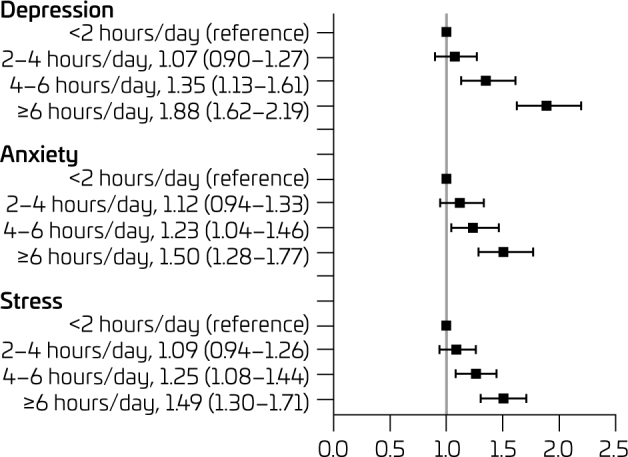
Results: Higher depressive symptoms were observed in adolescents who reported screen time of 4-6 hours/day (PR 1.35, 95%CI 1.13-1.61) and ≥6 hours/day (PR 1.88, 95%CI 1.62-2.19), compared with their pairs with <2 hours/day. The same was observed for anxiety symptoms with screen time of 4-6 hours/day (PR 1.23, 95%CI 1.04-1.46) and ≥6 hours/day (PR 1.50, 95%CI 1.28-1.77); and stress, with 4-6 hours/day (PR 1.25, 95%CI 1.08-1.44) and ≥6 hours/day (PR 1.49, 95%CI 1.30-1.71), also compared with their pairs with <2 hours/day.
Conclusions: Screen time was positively associated with depressive, anxiety, and stress symptoms in adolescents. Special attention should be given to those who spend more than four hours a day in front of a screen.
Objetivo:: Examinar a associação entre o tempo de tela autorreportado e os sintomas de estresse, ansiedade e depressão em adolescentes.
Métodos:: Foi realizado estudo com delineamento transversal com 982 adolescentes entre 12-15 anos, matriculados na rede pública de ensino da cidade de Jacarezinho (PR). Para mensurar o tempo de tela, os adolescentes responderam à pergunta: “Considerando um dia típico, quanto tempo você passa assistindo TV, jogando videogame, usando computador ou smartphone?”. O questionário DASS-21 (versão curta) foi utilizado para avaliar os sintomas de depressão, ansiedade e estresse. Análises brutas e ajustadas (idade, sexo e nível de escolaridade materna) entre tempo de tela e indicadores de saúde mental foram realizadas por meio do modelo de regressão linear generalizado, com distribuição de Poisson, adotando a significância de p<0,05.
Resultados:: Maiores sintomas depressivos foram observados em adolescentes com tempo de tela de 4–6 horas/dia (RP 1,35, IC95% 1,13–1,61) e ≥6 horas/dia (RP 1,88, IC95% 1,62–2,19) quando comparados com seus pares com ≤2 horas/dia. O mesmo foi observado para os sintomas de ansiedade com tempo de tela de 4–6 horas/dia (RP 1,23, IC95% 1,04–1,46) e ≥6 horas/dia (RP 1,50, IC95% 1,28–1,77); e estresse, com 4–6 horas/dia (RP 1,25, IC95% 1,08–1,44) e ≥6 horas/dia (RP 1,49, IC95% 1,30–1,71), também comparados com seus pares com ≤2 horas/dia.
Conclusões:: O tempo de tela foi associado positivamente com os sintomas de depressão, ansiedade e estresse em adolescentes. Atenção especial deve ser dada àqueles que passam mais de quatro horas por dia em frente a uma tela.
Conflict of interest statement
Figures
References
-
- Organización Mundial de la Salud . [homepage on the Internet]. Salud mental del adolescente. Ginebra: OMS; 2021. [[cited 2023 Dec 15]]. Available from: https://www.who.int/es/news-room/fact-sheets/detail/adolescent-mental-he... .
-
- We Are Social. Meltwater [homepage on the Internet]. Digital 2023 global overview report. The essential guide to the world’s connected behaviours. 2023. [[cited 2023 Dec 10]]. Available from: https://wearesocial.com/wp-content/uploads/2023/03/Digital-2023-Global-O... .
MeSH terms
LinkOut - more resources
Full Text Sources
Medical
Research Materials