


The origin and fate of organic carbon in graphite-manganese bearing rocks and implications for the Lomagundi-Jatuli Event
- PMID: 39261553
- PMCID: PMC11390714
- DOI: 10.1038/s41598-024-71877-3
The origin and fate of organic carbon in graphite-manganese bearing rocks and implications for the Lomagundi-Jatuli Event
Abstract
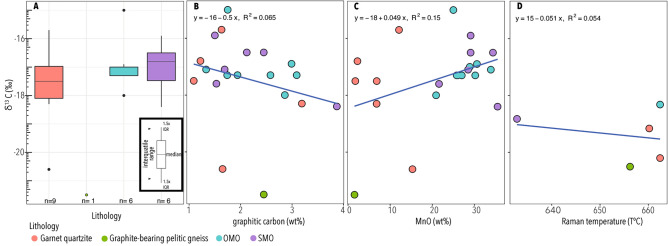
Our study helps to unravel the complexity of the Lomagundi-Jatuli event, the largest and longest positive carbon isotope excursion ever recorded on the Earth's surface, by providing a unique view of Paleoproterozoic graphitic rocks from the Borborema province of Northeastern Brazil. Through detailed mineralogical, textural, chemical and isotopic analyses, we bring a new perspective that provide support to elevated primary productivity and large-scale organic carbon burial during the Lomagundi-Jatuli event. Graphite crystals with distinctive textural features occur in association with silicate and oxidised manganese ores, manganese quartzites, garnetites, and gneisses. The graphites were crystallised at temperatures up to 634 °C, consistent with amphibolite facies metamorphism, according to Raman thermometry. An average total carbon content of 2.1 wt%, with δ13C values ranging from - 15.0 to - 21.5‰, is indicated by whole-rock geochemistry and carbon isotopic composition, respectively. Based on these results, our study proposes that these graphitic rocks may represent remnants of organic matter, possibly derived from bacterial biomass associated with manganese-rich sediments, preserved under reducing environmental conditions in a redox-stratified marine setting. Biological mediation on the origin of silicates is suggested by the close relationship between reduced manganese silicates and graphite. These constraints indicate that Paleoproterozoic graphite-rich rocks represent an important but overlooked reservoir of organic carbon that was partially degassed during the metamorphism of organic-rich sequences. Overall, this research provides new insights for the enigmatic emergence of the Lomagundi-Jatuli event, highlighting the intricate interplay among organic carbon, manganese-rich rocks and Earth's evolutionary processes during this period.
Keywords: Borborema Province; Carbon isotope; Organic matter; Paleoproterozoic era; Raman thermometry.
© 2024. The Author(s).
Conflict of interest statement
The authors declare no competing interests.
Figures




References
-
- Schidlowski, M., Eichmann, R. & Junge, C. E. Carbon isotope geochemistry of the Precambrian Lomagundi carbonate Province, Rhodesia. Geochim. Cosmochim. Acta40, 449 (1976). 10.1016/0016-7037(76)90010-7 - DOI
-
- Melezhik, V. A., Fallick, A. E., Medvedev, P. V. & Makarikhin, V. V. Extreme 13 C Enrichment in ca. 2.0 Ga carb magnesite-stromatolite-dolomite-’red beds’ association in a global context: A case for the world-wide signal enhanced by a local environment. Earth-Sci. Rev.48, 1 (1999). 10.1016/S0012-8252(99)00027-6 - DOI
-
- Bekker, A., Karhu, J. A. & Kaufman, A. J. Carbon isotope record for the onset of the Lomagundi carbon isotope excursion in the Great Lakes area, North America. Precamb. Res.148, 145–180 (2006). 10.1016/j.precamres.2006.03.008 - DOI
-
- Hodgskiss, M. S. W., Crockford, P. W. & Turchyn, A. V. Deconstructing the Lomagundi–Jatuli Carbon Isotope Excursion. 10.1146/annurev-earth-031621 (2023).
-
- Bekker, A. & Holland, H. D. Oxygen overshoot and recovery during the early Paleoproterozoic. Earth Planet Sci. Lett.317–318, 295–304 (2012). 10.1016/j.epsl.2011.12.012 - DOI
Grants and funding
LinkOut - more resources
Full Text Sources
