. 2024 Nov;39(13-14):461-469.
doi: 10.1177/08830738241279690. Epub 2024 Sep 12.

Evidence-Based Infant Assessment for Cerebral Palsy: Diagnosis Timelines and Intervention Access in a Newborn Follow-up Setting

Affiliations

Evidence-Based Infant Assessment for Cerebral Palsy: Diagnosis Timelines and Intervention Access in a Newborn Follow-up Setting

Ellen N Sutter et al. J Child Neurol. 2024 Nov.

Abstract

Evidence-based assessment pathways inform early detection of cerebral palsy and access to intervention. This study investigated the relationships between early evidence-based assessments, diagnosis timeline, and rehabilitation intervention access in a population of children with cerebral palsy who were seen between 2010 and 2022 at the University of Wisconsin Waisman Center Newborn Follow Up Clinic. Cerebral palsy-specific assessments were increasingly integrated after the publication of early detection guidelines by Novak et al. in 2017. Age at cerebral palsy first mention (high risk for cerebral palsy) decreased over time, although age at diagnosis remained similar. Infants who received multiple evidence-based assessments were diagnosed at a younger age. Ninety-nine percent of children were referred to rehabilitation therapies before diagnosis. Infant age at referral to outpatient therapies decreased over time. This study provides novel clinical data on diagnosis timelines and identifies remaining gaps related to implementation feasibility toward improved early diagnosis and intervention access.

Keywords: cerebral palsy; infant; neurodevelopment; rehabilitation.


Conflict of interest statement

Declaration of Conflicting InterestsThe authors declared no potential conflicts of interest with respect to the research, authorship, and/or publication of this article.

Figures
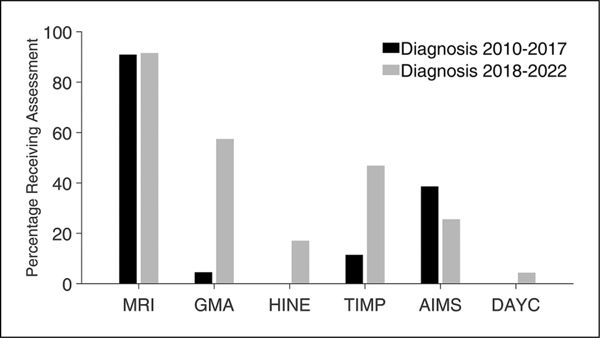
Figure 1.
Figure 1.
Assessments used before/after publication of early diagnosis guidelines (Novak 2017). 2010–2017 subgroup n = 44, 2018–2022 subgroup n = 47. AIMS, Alberta Infant Motor Scale; DAYC, Developmental Assessment of Young Children; GMA, General Movements Assessment; HINE, Hammersmith Infant Neurological Examination; MRI, Magnetic Resonance Imaging; TIMP, Test of Infant Motor Performance.
Figure 2.
Figure 2.
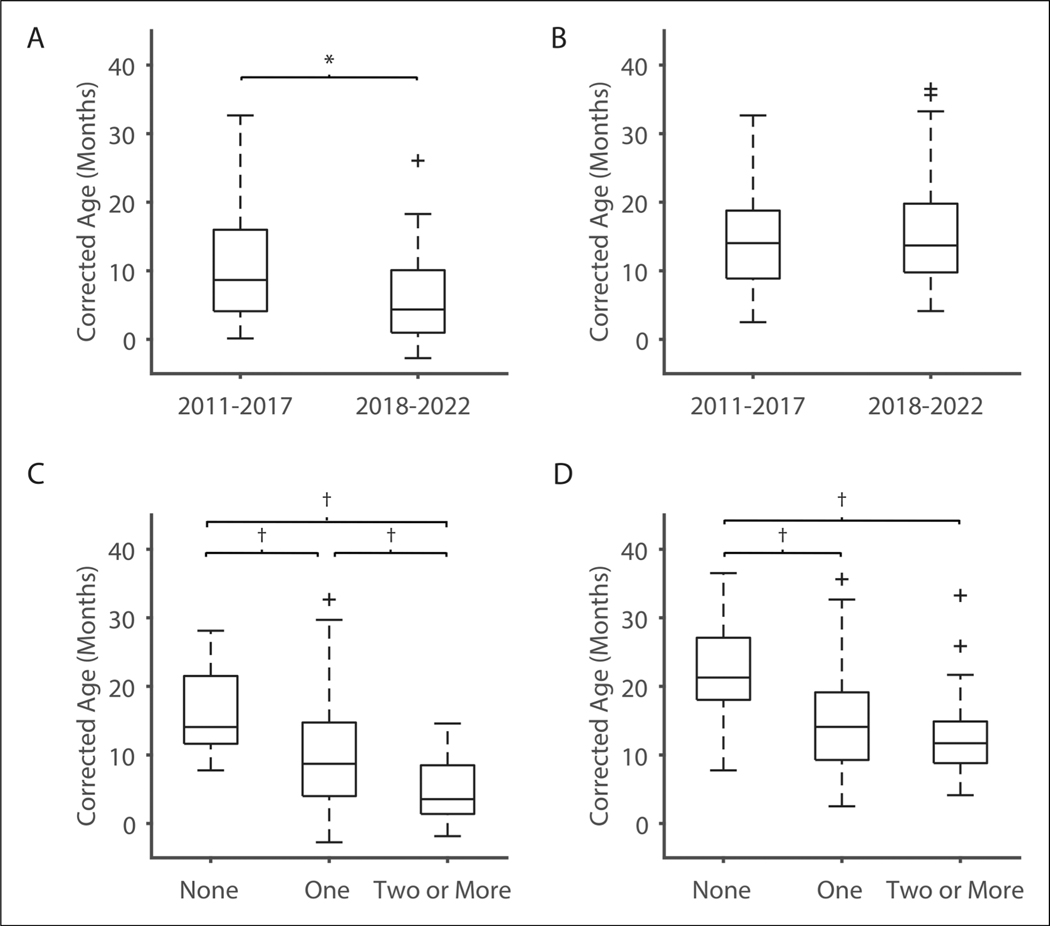
Age at cerebral palsy first mention and diagnosis. (A) Age at cerebral palsy first mention grouped by year of diagnosis; (B) age at diagnosis grouped by year of diagnosis; (C) age at cerebral palsy first mention grouped by number of evidence-based assessments received (of MRI, GMA, HINE); (D) age at diagnosis grouped by number of evidence-based assessments received (of MRI, GMA, HINE). *t test P < .05, 1-way analysis of variance, Tukey post hoc test, P <.05. GMA, General Movements Assessment; HINE, Hammersmith Infant Neurological Examination; MRI, Magnetic Resonance Imaging.
Figure 3.
Figure 3.
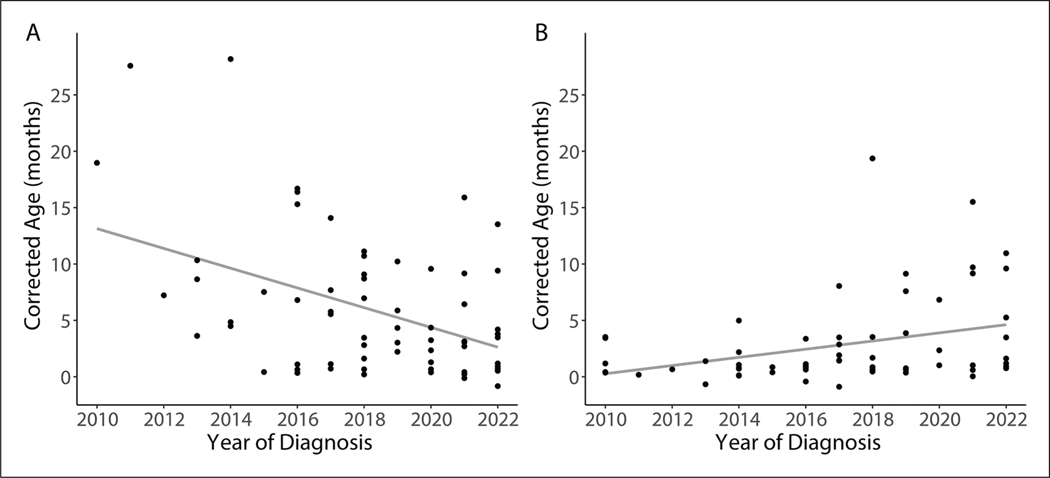
Age at referral to rehabilitation therapies (early intervention and outpatient). (A) Corrected age at referral to outpatient therapy (physical therapy, occupational therapy, or speech/language pathology) by year of diagnosis (r = −0.435, P < .001, n = 66). (B) Corrected age at referral to Early Intervention by year of diagnosis (r = 0.330, P = .009, n = 62). Gray lines represent linear regression fit lines.

References

    1. Novak I, Morgan C, Adde L, et al. Early, accurate diagnosis and early intervention in cerebral palsy: advances in diagnosis and treatment. JAMA Pediatr. 2017;171(9):897–907. doi:10.1001/jamapediatrics.2017.1689 - DOI - PMC - PubMed
    1. Williams SA, Alzaher W, Mackey A, et al. “It should have been given sooner, and we should not have to fight for it”: a mixed-methods study of the experience of diagnosis and early management of cerebral palsy. J Clin Med. 2021;10(7):1398. doi:10.3390/jcm10071398 - DOI - PMC - PubMed
    1. Guttmann K, Flibotte J, DeMauro SB. Parental perspectives on diagnosis and prognosis of neonatal intensive care unit graduates with cerebral palsy. J Pediatr. 2018;203:156–162. doi:10.1016/j.jpeds.2018.07.089 - DOI - PubMed
    1. Morgan C, Badawi N, Novak I. “A different ride”: a qualitative interview study of parents’ experience with early diagnosis and goals, activity, motor enrichment (GAME) intervention for infants with cerebral palsy. J Clin Med. 2023;12(2):583. doi:10.3390/jcm12020583 - DOI - PMC - PubMed
    1. Morgan C, Fetters L, Adde L, et al. Early intervention for children aged 0 to 2 years with or at high risk of cerebral palsy: international clinical practice guideline based on systematic reviews. JAMA Pediatr. 2021;175(8):846–858. doi:10.1001/jamapediatrics.2021.0878 - DOI - PMC - PubMed