Review
. 2024 Sep 12;11(1):8.
doi: 10.1186/s40348-024-00181-x.

Monogenic lupus - from gene to targeted therapy

Affiliations
Review

Monogenic lupus - from gene to targeted therapy

Katharina Menzel et al. Mol Cell Pediatr. .

Abstract

Systemic lupus erythematosus (SLE) is a prototypic autoimmune disease characterized by loss of tolerance to nuclear antigens. The formation of autoantibodies and the deposition of immune complexes trigger inflammatory tissue damage that can affect any part of the body. In most cases, SLE is a complex disease involving multiple genetic and environmental factors. Despite advances in the treatment of SLE, there is currently no cure for SLE and patients are treated with immunosuppressive drugs with significant side effects. The elucidation of rare monogenic forms of SLE has provided invaluable insights into the molecular mechanisms underlying systemic autoimmunity. Harnessing this knowledge will facilitate the development of more refined and reliable biomarker profiles for diagnosis, therapeutic monitoring, and outcome prediction, and guide the development of novel targeted therapies not only for monogenic lupus, but also for complex SLE.

Keywords: Autoimmunity; Cutaneous lupus erythematosus; Genetics; Nucleic acid immunity; Nucleic acid metabolism; Nucleic acid sensing; Pathogenesis; SLE; Systemic lupus erythematosus; Targeted therapy; Type I interferon.


Conflict of interest statement

The authors declare no competing interests.

Figures
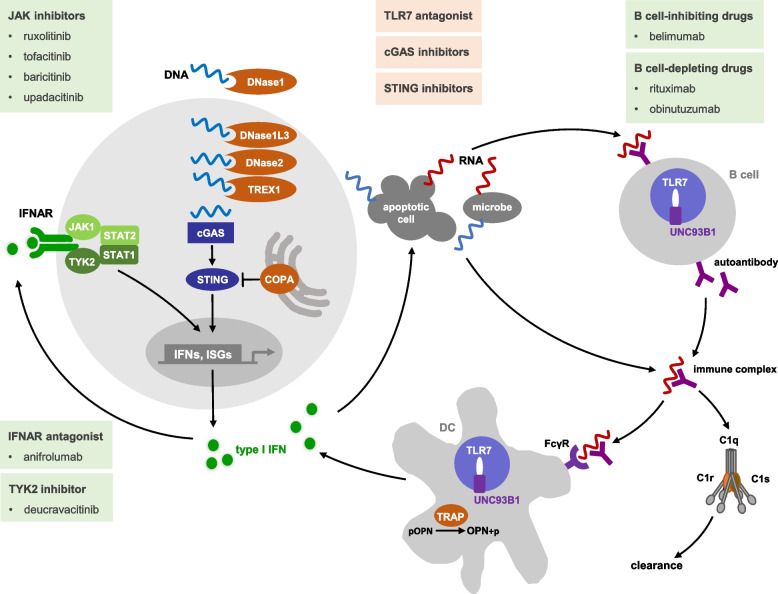
Fig. 1
Fig. 1
Pathogenetic principles of monogenic forms of lupus and therapeutic targets. Nucleases clear the extracellular space (DNase I) or the cytosol (DNase1L3, DNase2, TREX1) of DNA derived from pathogens or damaged cells or emanating from various metabolic processes to prevent aberrant immune recognition of self-DNA by the DNA sensor cGAS. Ligand binding of cGAS triggers activation of the STING signaling adaptor, resulting in transcriptional induction of type I IFN and IFN-stimulated genes (ISGs). Secreted type I IFN binds to the IFN receptor (IFNAR) which induces JAK/STAT signaling resulting in activation of IFN and ISG transcription. STING trafficking via COPI vesicles to the endoplasmic reticulum or into the autophagy pathway is required for termination of STING signaling. Gain-of-function mutations in STING or loss-of-function mutations in COPA result in ligand-independent cGAS activation with uncontrolled type I IFN activation. Gain-of-function mutations in the single-stranded RNA sensor TLR7 or its chaperone UNC93B1 result in constitutive type I IFN signaling and promote the proliferation of autoreactive B cells. Secreted autoantibodies form immune complexes that are cleared by complement activation. Loss-of-function mutations in the subunits encoding complement component 1 impair clearance of RNA autoantigen-containing immune complexes, which subsequently stimulate increased type I IFN production by dendritic cells (DC) after Fc gamma receptor (FcγR)-mediated internalization in a TLR7-dependent manner. TRAP dephosphorylates and thereby inactivates osteopontin (OPN), which promotes type I IFN production in plasmacytoid dendritic cells. Loss-of-function mutations in TRAP result in constitutively active OPN. Drugs that target specific molecules or pathways are shown in boxes. Green boxes indicate approved drugs, orange boxes indicate drugs in preclinical development or clinical trials

References

    1. Kaul A, Gordon C, Crow MK, Touma Z, Urowitz MB, van Vollenhoven R, Ruiz-Irastorza G, Hughes G (2016) Systemic lupus erythematosus. Nat Rev Dis Primer 2:16039. 10.1038/nrdp.2016.3910.1038/nrdp.2016.39 - DOI - PubMed
    1. Marshak-Rothstein A (2006) Toll-like receptors in systemic autoimmune disease. NatRevImmunol 6:823–835 - PMC - PubMed
    1. Ivashkiv LB, Donlin LT (2014) Regulation of type I interferon responses. NatRevImmunol 14:36–49 - PMC - PubMed
    1. Lovgren T, Eloranta ML, Bave U, Alm GV, Ronnblom L (2004) Induction of interferon-alpha production in plasmacytoid dendritic cells by immune complexes containing nucleic acid released by necrotic or late apoptotic cells and lupus IgG. Arthritis Rheum 50:1861–1872 10.1002/art.20254 - DOI - PubMed
    1. Guga S, Wang Y, Graham DC, Vyse TJ (2023) A review of genetic risk in systemic lupus erythematosus. Expert Rev Clin Immunol 19:1247–1258. 10.1080/1744666X.2023.2240959 10.1080/1744666X.2023.2240959 - DOI - PubMed

LinkOut - more resources
