Review
. 2024 Sep;10(9):001290.
doi: 10.1099/mgen.0.001290.

Towards quantifying plasmid similarity

Affiliations
Review

Towards quantifying plasmid similarity

William Matlock et al. Microb Genom. 2024 Sep.

Erratum in

  • Erratum: Towards quantifying plasmid similarity.
    Matlock W, Shaw LP, Sheppard SK, Feil E. Matlock W, et al. Microb Genom. 2024 Dec;10(12):001329. doi: 10.1099/mgen.0.001329. Microb Genom. 2024. PMID: 39670993 Free PMC article. No abstract available.

Abstract

Plasmids are extrachromosomal replicons which can quickly spread resistance and virulence genes between clinical pathogens. From the tens of thousands of currently available plasmid sequences we know that overall plasmid diversity is structured, with related plasmids sharing a largely conserved 'backbone' of genes while being able to carry very different genetic cargo. Moreover, plasmid genomes can be structurally plastic and undergo frequent rearrangements. So, how can we quantify plasmid similarity? Answering this question requires practical efforts to sample natural variation as well as theoretical considerations of what defines a group of related plasmids. Here we consider the challenges of analysing and rationalising the current plasmid data deluge to define appropriate similarity thresholds.

Keywords: antimicrobial resistance; genomic epidemiology; mobile genetic elements.


Conflict of interest statement

The authors have no conflicts of interest.

Figures
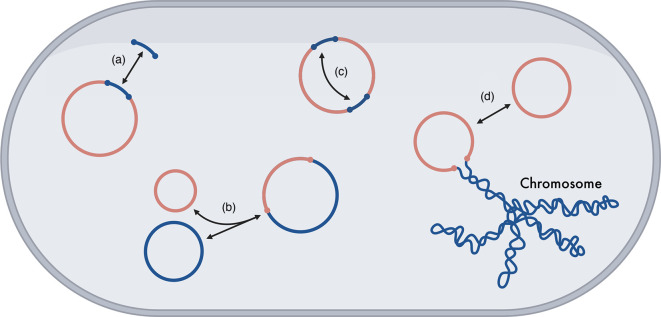
Fig. 1.
Fig. 1.. Structural changes between and within plasmids. These structural changes take place within a host cell. Arrows indicate possible changes, which might be reversible. (a) Gene gain and loss events within a plasmid. (b) Co-integration events between plasmids. (c) Inversions, rearrangements, recombination of sequence within a plasmid. (d) Chromosomal integration of plasmids. Figure made with BioRender.com.

References

    1. Coluzzi C, Garcillán-Barcia MP, de la Cruz F, Rocha EPC. Evolution of plasmid mobility: origin and fate of conjugative and nonconjugative plasmids. Mol Biol Evol. 2022;39:msac115. doi: 10.1093/molbev/msac115. - DOI - PMC - PubMed
    1. Castañeda-Barba S, Top EM, Stalder T. Plasmids, a molecular cornerstone of antimicrobial resistance in the One Health era. Nat Rev Microbiol. 2024;22:18–32. doi: 10.1038/s41579-023-00926-x. - DOI - PubMed
    1. Carattoli A, Zankari E, García-Fernández A, Voldby Larsen M, Lund O, et al. In silico detection and typing of plasmids using plasmidfinder and plasmid multilocus sequence typing. Antimicrob Agents Chemother. 2014;58:3895–3903. doi: 10.1128/AAC.02412-14. - DOI - PMC - PubMed
    1. Robertson J, Nash JHE. MOB-suite: software tools for clustering, reconstruction and typing of plasmids from draft assemblies. Microb Genom. 2018;4:e000206. doi: 10.1099/mgen.0.000206. - DOI - PMC - PubMed
    1. Redondo-Salvo S, Bartomeus-Peñalver R, Vielva L, Tagg KA, Webb HE, et al. COPLA, a taxonomic classifier of plasmids. BMC Bioinform. 2021;22:390. doi: 10.1186/s12859-021-04299-x. - DOI - PMC - PubMed

LinkOut - more resources