


Desmopressin dose requirements in patients with permanent arginine vasopressin deficiency: a tertiary center experience
- PMID: 39266909
- PMCID: PMC11513737
- DOI: 10.1007/s11102-024-01454-4
Desmopressin dose requirements in patients with permanent arginine vasopressin deficiency: a tertiary center experience
Abstract
Purpose: The desmopressin daily dose requirement is highly variable among patients with arginine vasopressin (AVP) deficiency (i.e. central diabetes insipidus) and few studies to date have evaluated this topic, with often inconclusive results. The aim of our study was to identify clinical and biochemical predictors of such dose requirements in a cohort of patients with a confirmed diagnosis of permanent AVP deficiency who have good and stable control under substitutive treatment.
Methods: We retrospectively analyzed data of all patients with permanent AVP deficiency undergoing regular follow-up at our Division. Inclusion criteria were the presence of stable disease under therapy for at least 12 months and in good biochemical and clinical control. Patients with AVP deficiency who lacked intact thirst or had a disease duration of less than 12 months were excluded from the analysis.
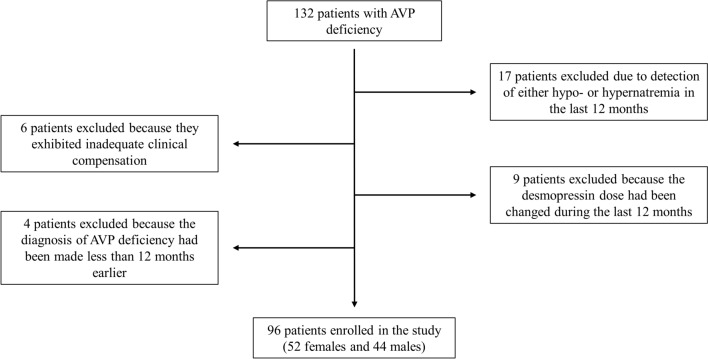
Results: Out of the 132 patients initially screened, 96 patients (M/F 44/52; age 51 [37-63] years) met the inclusion criteria. Patients on nasal spray therapy (n = 8) had a significantly longer disease duration (p = 0.002) than patients treated with oral lyophilizate (n = 88). In the bivariate analysis, considering only patients treated with the sublingual formulation, the drug dose was correlated positively with estimated glomerular filtration rate (eGFR) and weight (r = 0.410, p < 0.001; r = 0.224, p = 0.036, respectively) and negatively with age (r = - 0.433, p < 0.001). In the multivariate regression analysis taking into account age, weight, and eGFR, only age emerged as a significant predictor of the required sublingual desmopressin dose (β = - 1.426, p = 0.044).
Conclusion: Our data suggest that patient age appears to be the primary factor associated with the daily sublingual desmopressin dose required to achieve adequate clinical and biochemical control in patients with permanent AVP deficiency.
Keywords: AVP; Central diabetes insipidus; Nasal; Sublingual; dDAVP.
© 2024. The Author(s).
Conflict of interest statement
The authors have no conflict of interest to declare.
Figures
References
-
- Arima H, Cheetham T, Christ-Crain M, Cooper D, Gurnell M, Drummond JB, Levy M, McCormack AI, Verbalis J, Newell-Price J, Wass JAH (2022) Changing the name of diabetes insipidus: a position statement of the working group for renaming diabetes insipidus. Endocr Connect 11:e220378. 10.1530/EC-22-0378 - DOI - PMC - PubMed
-
- Lamas C, Pozo C del, Villabona C, & Neuroendocrinology Group of the SEEN (2014) Clinical guidelines for management of diabetes insipidus and syndrome of inappropriate antidiuretic hormone secretion after pituitary surgery. Endocrinologia Y Nutricion: Organo De La Sociedad Espanola De Endocrinologia Y Nutricion 61:e15-24. 10.1016/j.endonu.2014.01.005 - DOI - PubMed
MeSH terms
Substances
LinkOut - more resources
Full Text Sources
Research Materials
Miscellaneous
