


Deepening the decisional processes under value-based conditions in patients affected by Parkinson's disease: A comparative study
- PMID: 39266937
- PMCID: PMC11525292
- DOI: 10.3758/s13415-024-01211-x
Deepening the decisional processes under value-based conditions in patients affected by Parkinson's disease: A comparative study
Abstract
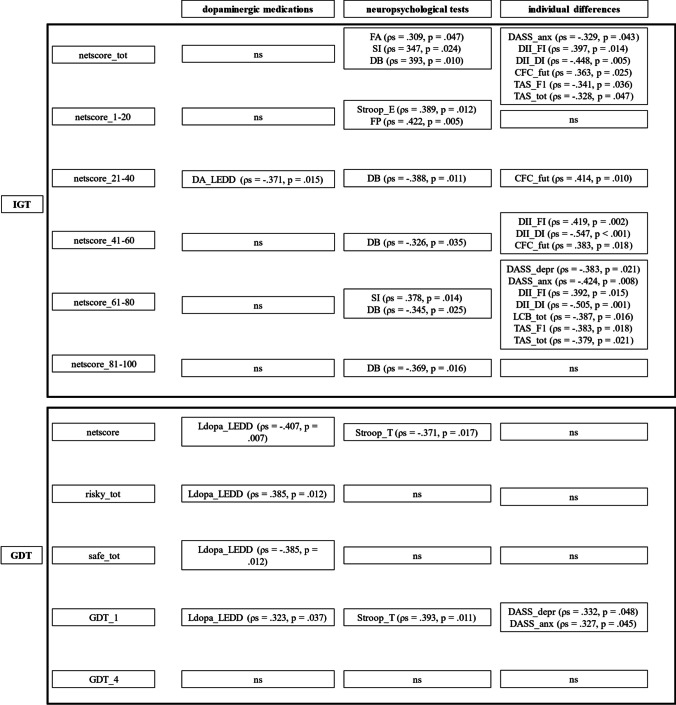
Patients affected by Parkinson's disease (PD) display a tendency toward making risky choices in value-based conditions. Possible causes may encompass the pathophysiologic characteristics of PD that affect neural structures pivotal for decision making (DM) and the dopaminergic medications that may bias choices. Nevertheless, excluding patients with concurrent impulse control disorders, results are few and mixed. Conversely, other factors, such as individual differences (e.g., emotional state, impulsivity, consideration for future consequences) and cognitive functioning, in particular executive functions (EFs), are involved, even though few studies investigated their possible role. The present study investigated (1) the differences in value-based DM between 33 patients with PD without impulse control disorders and 33 matched healthy controls, and (2) the relationships among decisional performances, EFs, and individual differences in a group of 42 patients with PD who regularly undertake dopaminergic medications. All participants underwent an individual assessment to investigate value-based DM, cognitive abilities, and individual differences associated with DM. Nonparametric analyses showed the presence of riskier decisions in patients compared with healthy controls, depending on the characteristics of the decisional situation. Moreover, parameters of the decisional tasks involving the number of risky choices were significantly related to the posology of dopaminergic medications, EFs, and individual differences. Findings were discussed, highlighting possible clinical implications.
Keywords: Decision making; Dopamine; Executive functions; Game of Dice Task; Iowa Gambling Task; Parkinson’s disease.
© 2024. The Author(s).
Conflict of interest statement
The authors have no competing interests to declare that are relevant to the content of this article.
Figures
References
-
- Antonietti, A., Colautti, L., & Iannello, P. (2023). Livelli di inibizione della risposta e comportamenti funzionali nella vita quotidiana. Giornale Italiano Di Psicologia,50(1), 37–144. 10.1421/106926 - DOI
-
- Argyelan, M., Herzallah, M., Sako, W., DeLucia, I., Sarpal, D., Vo, A., ... & Gluck, M. (2018). Dopamine modulates striatal response to reward and punishment in patients with Parkinson’s disease: A pharmacological challenge fMRI study. Neuroreport, 29(7), 532. 10.1097/WNR.0000000000000970 - PMC - PubMed
-
- Bagby, R. M., Parker, J. D., & Taylor, G. J. (1994). The twenty-item Toronto Alexithymia Scale—I. Item selection and cross-validation of the factor structure. Journal of Psychosomatic Research, 38(1), 23–32. 10.1016/0022-3999(94)90005-1 - PubMed
Sitography
-
- Colautti, L., Iannello, P., & Antonietti, A. (2023b). The drawn lots task. Retrieved from September 14, 2023. https://osf.io/cpjh4/?view_only=23bef8d21ee84b78a35d416e80803437
Publication types
MeSH terms
LinkOut - more resources
Full Text Sources
Medical
