


Effects of job demands, job resources, personal resources on night-shift alertness of ICU shift nurses: a cross‑sectional survey study based on the job demands-resources model
- PMID: 39267008
- PMCID: PMC11395936
- DOI: 10.1186/s12912-024-02313-0
Effects of job demands, job resources, personal resources on night-shift alertness of ICU shift nurses: a cross‑sectional survey study based on the job demands-resources model
Abstract
Background: A positive work environment can enhance nursing safety and patient satisfaction while alleviating nurse stress. Conversely, a poor work environment can harm nurses' physical and mental health and compromise the quality of care, particularly in the high-intensity and shift-based setting of the ICU.
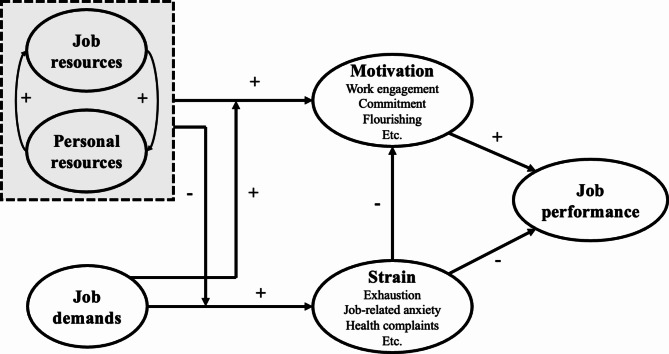
Objectives: Based on the Job demands-resources (JD-R) model, this study examined the effects of job demands and job resources in the work environment, as well as personal resources, on the night-shift alertness of ICU shift nurses.
Methods: This cross-sectional correlational exploratory study, conducted from July to September 2022, recruited 291 ICU shift nurses from a hospital in Beijing, China. The Copenhagen Psychosocial Questionnaire (COPSOQ), the Self-resilience scale, the General Self-Efficacy Scale (GSES), and the Psychomotor Vigilance Task (PVT) were used to subjectively and objectively measure the job demands, job resources, personal resources, and night-shift alertness. SPSS 26.0 and Mplus 8.3 were used to analyze the data and construct the structural equation model.
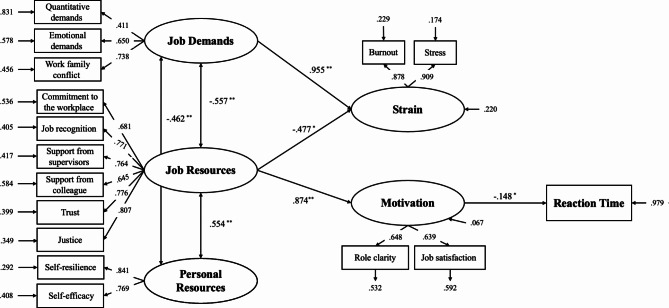
Results: The night-shift reaction time was 251.0 ms (Median), indicating a relatively high level of alertness. Job demands were negatively correlated with both job resources (r=-0.570, P < 0.001) and personal resources (r=-0.462, P < 0.001), while a positive correlation existed between job resources and personal resources (r = 0.554, P < 0.001). The results show that increased job demands can lead to higher levels of nurse strain (β = 0.955, P < 0.001), whereas job resources were found that it can decrease strain (β=-0.477, P = 0.047). Adequate job resources can enhance motivation directly (β = 0.874, P < 0.001), subsequently reducing reaction time (β=-0.148, P = 0.044) and improving night-shift alertness among ICU shift nurses.
Conclusion: Enhancing ICU shift nurses' work motivation through bolstering job resources can boost night-shift alertness. However, it is noteworthy that, in this study, neither strain nor individual resources significantly influenced nurses' night-shift alertness. This may be attributed to the complexity of the ICU environment and individual differences. Future research should explore the relationship between these factors and nurses' work alertness.
Keywords: Alertness; ICU nurse; JD-R model; Night shift; Shift work; Strain.
© 2024. The Author(s).
Conflict of interest statement
The authors declare no competing interests.
Figures
References
-
- WHO. Occupational health: health workers. https://www.who.int/news-room/fact-sheets/detail/occupational-health--he...
-
- Global patient safety action. plan 2021–2030: towards eliminating avoidable harm in health care. In. Geneva: World Health Organization; 2021.
-
- de Bienassis K, Slawomirski L, Klazinga NS. The economics of patient safety Part IV: Safety in the workplace: Occupational safety as the bedrock of resilient health systems. In.: OECD Publishing; 2021.
-
- Nantsupawat A, Kunaviktikul W, Nantsupawat R, Wichaikhum OA, Thienthong H, Poghosyan L. Effects of nurse work environment on job dissatisfaction, burnout, intention to leave. Int Nurs Rev 2017,64(1):91–8.10.1111/inr.12342 - PubMed
Grants and funding
LinkOut - more resources
Full Text Sources
