


Post-weaning social isolation alters sociability in a sex-specific manner
- PMID: 39267986
- PMCID: PMC11390411
- DOI: 10.3389/fnbeh.2024.1444596
Post-weaning social isolation alters sociability in a sex-specific manner
Abstract
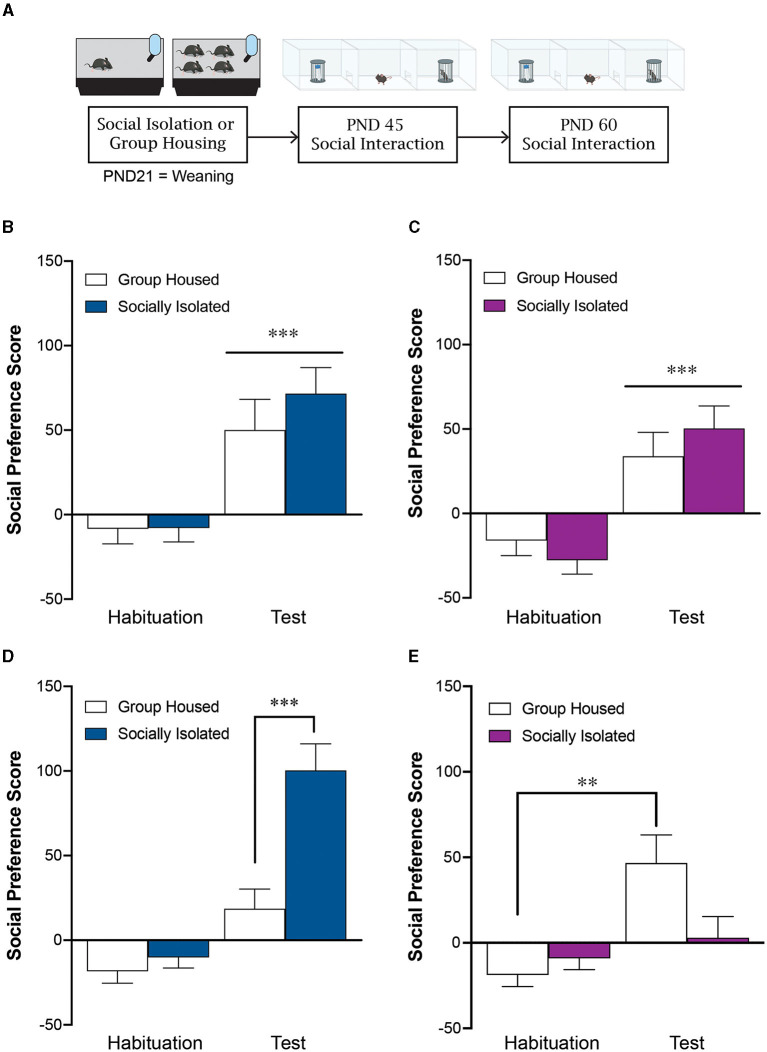
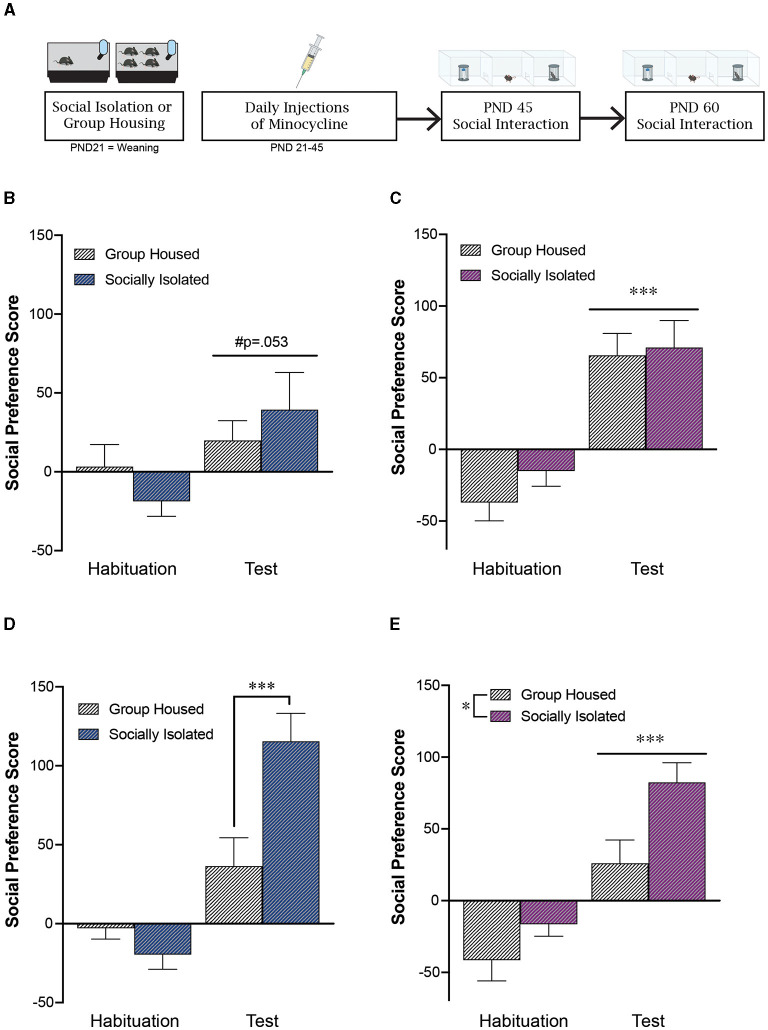
Adolescence is a critical period for brain development in humans and stress exposure during this time can have lasting effects on behavior and brain development. Social isolation and loneliness are particularly salient stressors that lead to detrimental mental health outcomes particularly in females, although most of the preclinical work on social isolation has been done in male animals. Our lab has developed a model of post-weaning adolescent social isolation that leads to increased drug reward sensitivity and altered neuronal structure in limbic brain regions. The current study utilized this model to determine the impact of adolescent social isolation on a three-chamber social interaction task both during adolescence and adulthood. We found that while post-weaning isolation does not alter social interaction during adolescence (PND45), it has sex-specific effects on social interaction in young adulthood (PND60), potentiating social interaction in male mice and decreasing it in female mice. As early life stress can activate microglia leading to alterations in neuronal pruning, we next examined the impact of inhibiting microglial activation with daily minocycline administration during the first 3 weeks of social isolation on these changes in social interaction. During adolescence, minocycline dampened social interaction in male mice, while having no effect in females. In contrast, during young adulthood, minocycline did not alter the impact of adolescent social isolation in males, with socially isolated males exhibiting higher levels of social interaction compared to their group housed counterparts. In females, adolescent minocycline treatment reversed the effect of social isolation leading to increased social interaction in the social isolation group, mimicking what is seen in naïve males. Taken together, adolescent social isolation leads to sex-specific effects on social interaction in young adulthood and adolescent minocycline treatment alters the effects of social isolation in females, but not males.
Keywords: adolescence; minocycline; sex differences; social interaction; social isolation.
Copyright © 2024 Myers, Birmingham, Rhoads, McGrath, Miles, Schuldt and Briand.
Conflict of interest statement
The authors declare that the research was conducted in the absence of any commercial or financial relationships that could be construed as a potential conflict of interest.
Figures
Update of
-
Post-weaning social isolation alters sociability in a sex-specific manner.bioRxiv [Preprint]. 2024 Jul 13:2024.07.11.603129. doi: 10.1101/2024.07.11.603129. bioRxiv. 2024. Update in: Front Behav Neurosci. 2024 Aug 29;18:1444596. doi: 10.3389/fnbeh.2024.1444596. PMID: 39026733 Free PMC article. Updated. Preprint.
References
-
- Aronson J. K. (ed.). (2016). “Minocycline,” in Meyler's Side Effects of Drugs, 16th Edn (Oxford: Elsevier; ), 1042–1052
-
- Bekhbat M., Mukhara D., Dozmorov M. G., Stansfield J. C., Benusa S. D., Hyer M. M., et al. (2021). Adolescent stress sensitizes the adult neuroimmune transcriptome and leads to sex-specific microglial and behavioral phenotypes. Neuropsychopharmacology 46, 949–958. 10.1038/s41386-021-00970-2 - DOI - PMC - PubMed
Grants and funding
LinkOut - more resources
Full Text Sources
Research Materials
Miscellaneous
