


Neurosustainability
- PMID: 39268220
- PMCID: PMC11390526
- DOI: 10.3389/fnhum.2024.1436179
Neurosustainability
Erratum in
-
Corrigendum: Neurosustainability.Front Hum Neurosci. 2024 Nov 22;18:1524620. doi: 10.3389/fnhum.2024.1524620. eCollection 2024. Front Hum Neurosci. 2024. PMID: 39651492 Free PMC article.
Abstract
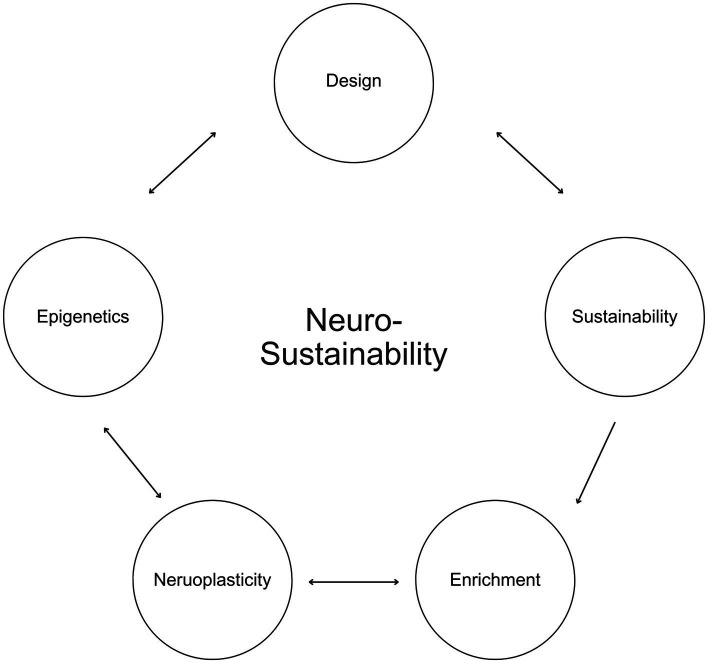
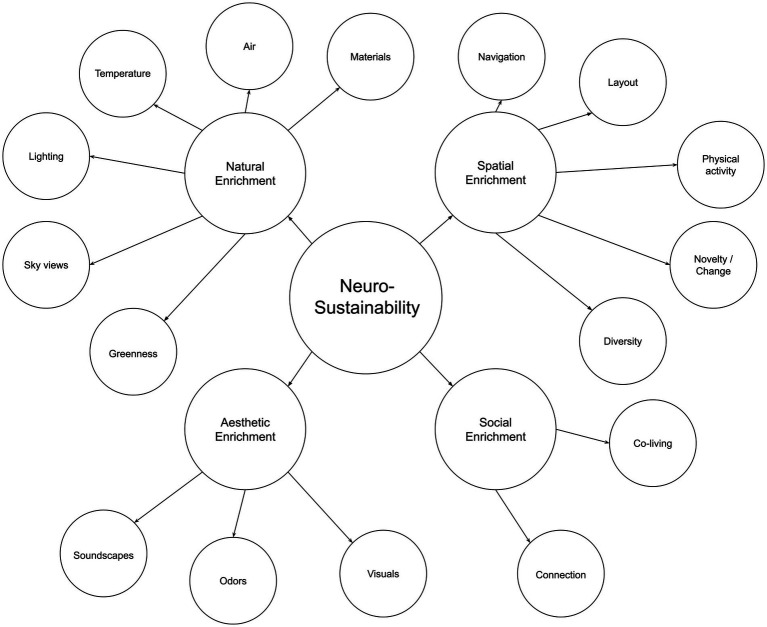
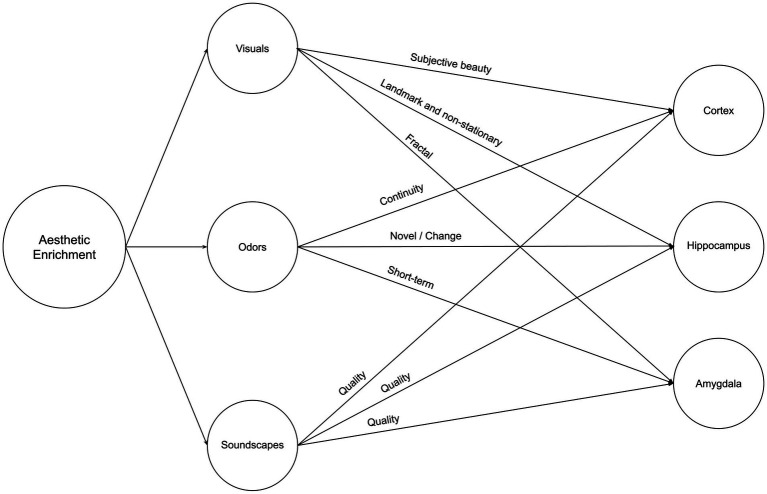
While the human brain has evolved extraordinary abilities to dominate nature, modern living has paradoxically trapped it in a contemporary "cage" that stifles neuroplasticity. Within this modern environment lurk unseen natural laws with power to sustain the human brain's adaptive capacities - if consciously orchestrated into the environments we design. For too long our contemporary environments have imposed an unyielding static state, while still neglecting the brain's constant adaptive nature as it evolves to dominate the natural world with increasing sophistication. The theory introduced in this article aims to go back in nature without having to go back in time, introducing and expounding Neurosustainability as a novel paradigm seeing beyond the contemporary confines to architect environments and brains in parallel. Its integrated neuro-evidenced framework proposes four enrichment scopes-spatial, natural, aesthetic, and social-each holding multifaceted attributes promising to sustain regions like the hippocampus, cortex and amygdala. Neurosustainability aims to liberate the quintessential essence of nature to sustain and enhance neuroplastic processes through a cycle that begins with design and extends through epigenetic changes. This paradigm shift aims to foster cognitive health and wellness by addressing issues like stress, depression, anxiety and cognitive decline common in the contemporary era thereby offering a path toward a more neurosustainable era aiming to nurture the evolution of the human brain now and beyond.
Keywords: adult hippocampal neurogenesis; amygdala; cortical thickness; environmental enrichment; human brain health; mental health and modern lifestyles; nature; neuroplasticity.
Copyright © 2024 Khalil.
Conflict of interest statement
The author declares that the research was conducted in the absence of any commercial or financial relationships that could be construed as a potential conflict of interest.
Figures
References
-
- Alqassim A. Y., Mahfouz M. S., Hakami M. M., Al Faqih A. A., Shugairi A. A., Alsanosy M. R., et al. . (2022). Depression, anxiety, stress and their association with the use of electronic devices among adolescents during the COVID-19 pandemic. Int. J. Ment. Health Promot. 24, 251–262. doi: 10.32604/ijmhp.2022.019000 - DOI
-
- Awadh O. (2017). Sustainability and green building rating systems: LEED, BREEAM, GSAS and Estidama critical analysis. J. Build. Eng. 11, 25–29. doi: 10.1016/j.jobe.2017.03.010 - DOI
LinkOut - more resources
Full Text Sources
