. 2025 Mar 6;148(3):861-874.
doi: 10.1093/brain/awae296.

Decision cost hypersensitivity underlies Huntington's disease apathy

Affiliations

Decision cost hypersensitivity underlies Huntington's disease apathy

Lee-Anne Morris et al. Brain. .

Abstract

The neuropsychiatric syndrome of apathy is now recognized to be a common and disabling condition in Huntington's disease. However, the mechanisms underlying it are poorly understood. One way to investigate apathy is to use a theoretical framework of normal motivated behaviour, to determine where breakdown has occurred in people with this behavioural disruption. A fundamental computation underlying motivated, goal-directed behaviour across species is weighing up the costs and rewards associated with actions. Here, we asked whether people with apathy are more sensitive to costs of actions (physical effort and time delay), less sensitive to rewarding outcomes, or both. Based on the unique anatomical substrates associated with Huntington's disease pathology, we hypothesized that a general hypersensitivity to costs would underpin Huntington's disease apathy. Genetically confirmed carriers of the expanded Huntingtin gene (premanifest to mild motor manifest disease, n = 53) were compared to healthy controls (n = 38). Participants performed a physical effort-based decision-making task (Apple Gathering Task) and a delay discounting task (Money Choice Questionnaire). Choice data was analysed using linear regression and drift diffusion models that also accounted for the time taken to make decisions. Apathetic people with Huntington's disease accepted fewer offers overall on the Apple Gathering Task, specifically driven by increased sensitivity to physical effort costs, and not explained by motor severity, mood, cognition or medication. Drift diffusion modelling provided further evidence of effort hypersensitivity, with apathy associated with a faster drift rate towards rejecting offers as a function of varying effort. Increased delay sensitivity was also associated with apathy, both when analysing raw choice and drift rate, where there was moderate evidence of Huntington's disease apathy drifting faster towards the immediately available (low-cost) option. Furthermore, the effort and delay sensitivity parameters from these tasks were positively correlated. The results demonstrate a clear mechanism for apathy in Huntington's disease, cost hypersensitivity, which manifests in both the effort and time costs associated with actions towards rewarding goals. This suggests that Huntington's disease pathology may cause a domain-general disruption of cost processing, which is distinct from apathy occurrence in other brain disorders and may require different therapeutic approaches.

Keywords: Huntington’s disease; apathy; decision-making; delay; effort.


Conflict of interest statement

The authors report no competing interests.

Figures

Figure 1
Figure 1
Study participants. (A) Flow chart of study participants. Owing to site test battery differences, not all participants completed the delay discounting task. (B) Age and (C) motor disease severity of Huntington’s disease participants, split by apathy status. UHDRS-TMS = Unified Huntington’s Disease Rating Scale Total Motor Score.
Figure 2
Figure 2
The Apple Gathering Task in Huntington’s disease. (A) The Apple Gathering Task. Levels of physical effort (squeezing a handheld dynamometer) and reward (apples, worth money) are varied; here we show 25 combinations of effort and reward, for each of which participants must decide if the reward is worth the effort. Participants in the UK performed a six-by-six version of this task, not shown. (B) Overall, apathetic participants with Huntington’s disease (HD) accepted fewer offers than their non-apathetic counterparts and control participants. (C) Proportion of offers accepted varied as a function of the effort and (D) reward on offer. (E) Model parameter estimates capturing overall tendency to accept (intercept), and effects of changing reward and effort levels. Apathetic people showed greater change in behaviour as effort, but not reward, varied, compared to non-apathetic people. (F) Difference in acceptance between people with and without apathy was in the high effort space. (G) All participants reached target effort levels when exerting effort, and (H) choice behaviour did not differ significantly across task blocks. (I) Decision times did not differ by apathy status in HD. Controls had shorter decision times than people with HD. New Zealand (NZ) data only are shown in G and H for graphical purposes. Error bars show standard error of the mean. MVC = maximum voluntary contraction. *P < 0.05; **P < 0.01; ***P < 0.001.
Figure 3
Figure 3
Drift diffusion model outputs from the Apple Gathering Task. Per subject parameter estimates from a drift diffusion model, showing probabilities from hypothesis testing between participants with Huntington’s disease (HD) and controls, and HD apathy versus no-apathy, for (A) drift rate, (B) threshold, (C) non-decision time and (D) bias. (E) An illustration of the drift diffusion model parameters. (F) Regression model parameter estimates of the drift rate intercept, the effects of changing reward and changing effort on drift rate, and their interaction, in HD. In people with apathy compared to people without, drift rate overall was slower, but increased as a function of increasing effort. Error bars show standard error of the mean. E re-used with permission from Saleh et al..
Figure 4
Figure 4
Delay discounting task and results. (A) Delay discounting task, in which participants are offered choices between smaller-sooner or larger-later monetary rewards. Whilst it is not possible to disentangle sensitivity to delay and reward in this task, each offer has a numeric value associated; choice behaviour changes as this number increases. A computerized version was used, to additionally capture decision times. (B) No significant difference between groups in overall proportion of delayed choices made. (C) As delay to reward increased, people with apathy selected more immediate options, compared to those without apathy and controls. Inset depicts modelled choice behaviour. (D) Mean decision times did not differ in Huntington’s disease (HD) as a function of apathy. (E) Drift diffusion regression model parameter estimates, showing baseline drift rate (intercept), and drift rate as a function of changing offer value, with a trend towards faster evidence accumulation towards the lower bound (smaller-sooner option) in HD apathy overall. Error bars show standard error of the mean. **P < 0.01.
Figure 5
Figure 5
Cost sensitivity in Huntington’s disease. Effort sensitivity (Apple Gathering Test) and proportion delayed choices (delay discounting task) showed significant correlation in Huntington’s disease (HD). For graphical purposes we show proportion immediate choices on the x-axis and reverse-coded effort sensitivity on the y-axis.
Figure 6
Figure 6
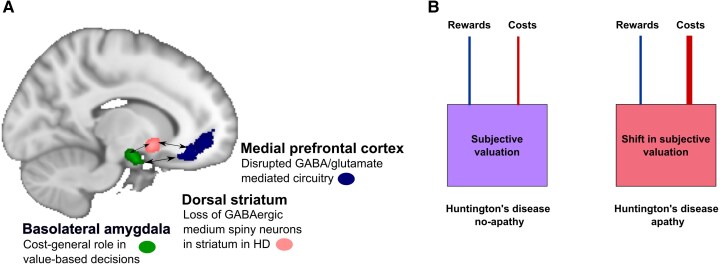
Theoretical model of cost sensitivity in Huntington’s disease apathy. A proposed theoretical model of mechanisms leading to apathy in Huntington’s disease (HD). (A) Loss of medium spiny neurons in the dorsal striatum may lead to altered GABA/glutamate balance, affecting frontal cortical—amygdala functional connectivity, with resultant increased amygdala activation. (B) Cost information may be weighted more heavily, in cost-reward integration, leading to a shift in threshold of costs deemed worth expending for reward, expressed as reduced goal-directed behaviour. This theoretical model is based on knowledge of Huntington’s disease neuropathology, previous rodent work, and our behavioural findings, and it remains to be empirically tested.

References

    1. Marin RS. Apathy: A neuropsychiatric syndrome. J Neuropsychiatry Clin Neurosci. 1991;3:243–254. - PubMed
    1. Robert P, Lanctôt KL, Agüera-Ortiz L, et al. Is it time to revise the diagnostic criteria for apathy in brain disorders? The 2018 international consensus group. Eur Psychiatry. 2018;54:71–76. - PubMed
    1. Tabrizi SJ, Scahill RI, Owen G, et al. Predictors of phenotypic progression and disease onset in premanifest and early-stage Huntington’s disease in the TRACK-HD study: Analysis of 36-month observational data. Lancet Neurol. 2013;12:637–649. - PubMed
    1. Thompson JC, Harris J, Sollom AC, et al. Longitudinal evaluation of neuropsychiatric symptoms in Huntington’s disease. J Neuropsychiatry Clin Neurosci. 2012;24:53–60. - PubMed
    1. Fritz NE, Boileau NR, Stout JC, et al. Relationships among apathy, health-related quality of life and function in Huntington’s disease. J Neuropsychiatry Clin Neurosci. 2018;30:194–201. - PMC - PubMed

Substances