Review
. 2024 Nov;19(6):845-865.
doi: 10.1007/s11523-024-01097-2. Epub 2024 Sep 13.

Diffuse Gastric Cancer: A Comprehensive Review of Molecular Features and Emerging Therapeutics

Affiliations
Review

Diffuse Gastric Cancer: A Comprehensive Review of Molecular Features and Emerging Therapeutics

Lawrence W Wu et al. Target Oncol. 2024 Nov.

Abstract

Diffuse-type gastric cancer (DGC) accounts for approximately one-third of gastric cancer diagnoses but is a more clinically aggressive disease with peritoneal metastases and inferior survival compared with intestinal-type gastric cancer (IGC). The understanding of the pathogenesis of DGC has been relatively limited until recently. Multiomic studies, particularly by The Cancer Genome Atlas, have better characterized gastric adenocarcinoma into molecular subtypes. DGC has unique molecular features, including alterations in CDH1, RHOA, and CLDN18-ARHGAP26 fusions. Preclinical models of DGC characterized by these molecular alterations have generated insight into mechanisms of pathogenesis and signaling pathway abnormalities. The currently approved therapies for treatment of gastric cancer generally provide less clinical benefit in patients with DGC. Based on recent phase II/III clinical trials, there is excitement surrounding Claudin 18.2-based and FGFR2b-directed therapies, which capitalize on unique biomarkers that are enriched in the DGC populations. There are numerous therapies targeting Claudin 18.2 and FGFR2b in various stages of preclinical and clinical development. Additionally, there have been preclinical advancements in exploiting unique therapeutic vulnerabilities in several models of DGC through targeting of the focal adhesion kinase (FAK) and Hippo pathways. These preclinical and clinical advancements represent a promising future for the treatment of DGC.


Conflict of interest statement

Declarations Funding LWW is supported by the NIH/NCI Molecular Oncology Training Program (5T32CA203703-09), and RHM is supported by grants from the NIH (K08CA263304) and Gastric Cancer Foundation. This publication is supported by NIH/NCI Cancer Center Support Grant P30CA013696. Conflict of interest Lawrence W. Wu, Sung Joo Jang, Cameron Shapiro, Ladan Fazlollahi, and Timothy C. Wang have no relevant conflicts of interest to declare that may be relevant to the contents of this article. Sandra W. Ryeom has undertaken consulting work for AttisLab and has received research support from ImmPACT Bio. Ryan H. Moy has undertaken consulting work for Puretech Health, served on the Advisory Board for IDEAYA Biosciences and Nimbus Therapeutics, and has received research funding, paid to the institution, from Nimbus Therapeutics and Repare Therapeutics. Ethics approval Not applicable. Consent to participate Not applicable. Consent for publication All authors consent to the publication of this article. Availability of data and material No datasets were generated or analyzed during this study. Code availability Not applicable. Authors’ contributions LWW and RHM proposed the review topic. LWW wrote the original draft of this article. LF provided representative images of diffuse-type and intestinal-type gastric cancer. All authors have reviewed, revised, and provided critical feedback on the manuscript, and provided final approval of the manuscript.

Figures

Fig. 1
Fig. 1
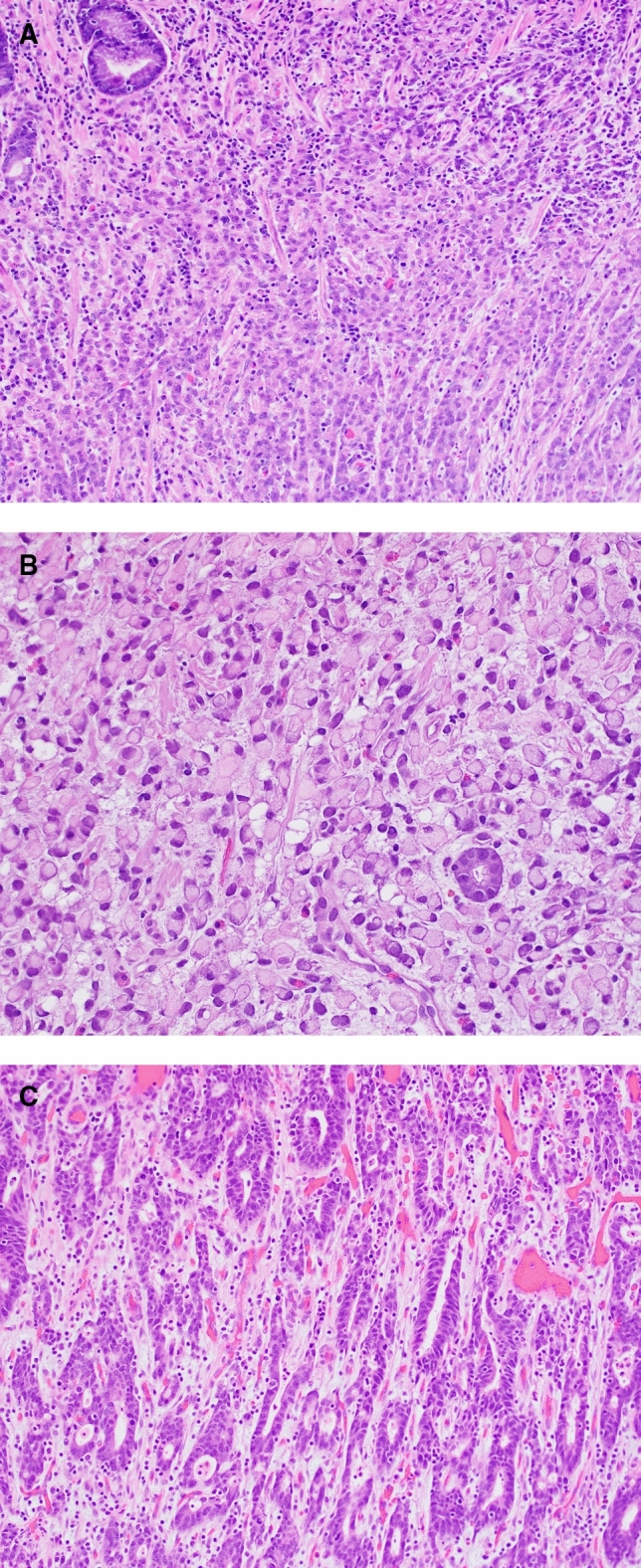
Representative images of diffuse-type and intestinal-type gastric cancer. a Diffuse-type gastric adenocarcinoma at × 200 magnification. Tumor is composed of small nests of poorly cohesive tumor cells. Hematoxylin and eosin-stained sections. b Diffuse-type gastric adenocarcinoma with signet ring cells at × 400 magnification. Tumor composed of single, poorly cohesive neoplastic cells with intracytoplasmic mucin and eccentrically located nuclei (signet ring cells). Hematoxylin and eosin-stained sections. c Intestinal-type gastric adenocarcinoma at × 200 magnification. Tumor is composed of irregularly shaped glands with areas of cribriform architecture. Hematoxylin and eosin-stained sections
Fig. 2
Fig. 2
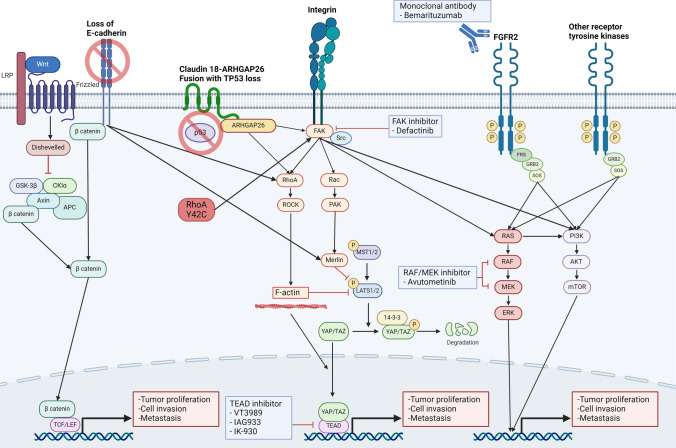
Key signaling pathways in diffuse-type gastric cancer. Key signaling pathways in diffuse gastric cancer include the focal adhesion kinase, E-cadherin, Wnt, Hippo, and FGFR2/other receptor tyrosine kinase pathways. There is signaling crosstalk between several of these pathways. The downstream effects of aberrant signaling of these pathways lead to tumor proliferation, cell invasion, and metastasis. Two preclinical models of DGC include gain-of-function RHOA Y42C with CDH1 loss and Claudin 18(CLDN18)-ARHGAP26 fusion with TP53 loss. There are several promising therapeutic options outside of the currently approved chemotherapy and immunotherapy regimens that target the focal adhesion kinase and Hippo pathways. Created with BioRender.com. FGFR2 fibroblast growth factor receptor 2, DGC diffuse-type gastric cancer
Fig. 3
Fig. 3
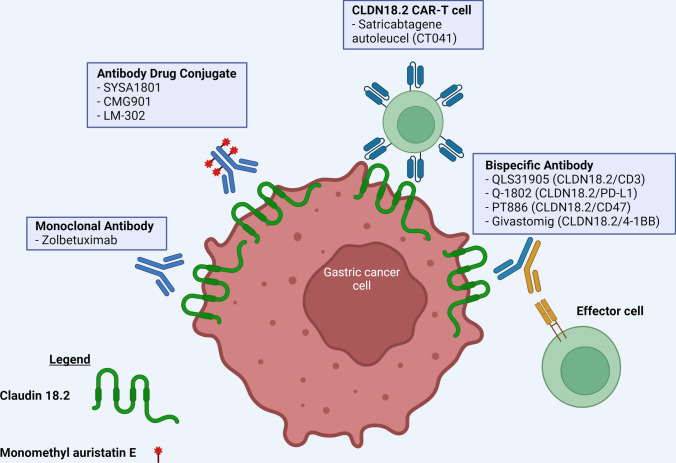
CLDN18.2-directed therapies. There are several therapeutics in clinical development that target CLDN18.2 and that take advantage of preferential expression of CLDN18.2 in gastric cancer. These mechanisms include monoclonal antibody binding leading to antibody-dependent cellular cytotoxicity and complement-dependent cytotoxicity, antibody drug conjugates with monoclonal antibody delivery of a cytotoxic payload, CAR T-cell therapies, and bispecific antibodies that bind to CLDN18.2 and other ligands that recruit immune effector cells. Antibody drug conjugates, CAR-T cells, and bispecific antibodies have the potential to be more effective at lower CLDN18.2 expression given bystander effect. Created with BioRender.com. CLDN18.2 Claudin 18.2, CAR chimeric antigen receptor

References

    1. Sung H, Ferlay J, Siegel RL, Laversanne M, Soerjomataram I, Jemal A, et al. Global Cancer Statistics 2020: GLOBOCAN Estimates of Incidence and Mortality Worldwide for 36 Cancers in 185 Countries. CA Cancer J Clin. 2021;71(3):209–49. 10.3322/caac.21660. - PubMed
    1. Lauren P. The two histological main types of gastric carcinoma: diffuse and so-called intestinal-type carcinoma. An attempt at a histo-clinical classification. Acta Pathol Microbiol Scand. 1965;64:31–49. 10.1111/apm.1965.64.1.31. - PubMed
    1. Chen YC, Fang WL, Wang RF, Liu CA, Yang MH, Lo SS, et al. Clinicopathological variation of Lauren classification in gastric cancer. Pathol Oncol Res. 2016;22(1):197–202. 10.1007/s12253-015-9996-6. - PubMed
    1. Monster JL, Kemp LJS, Gloerich M, van der Post RS. Diffuse gastric cancer: emerging mechanisms of tumor initiation and progression. Biochim Biophys Acta Rev Cancer. 2022;1877(3): 188719. 10.1016/j.bbcan.2022.188719. - PubMed
    1. WHO Classification of Tumours. Digestive system tumours: WHO classification of tumours, vol. 1. Geneva: World Health Organization; 2019.

LinkOut - more resources