Review
. 2024 Sep 2;13(17):5211.
doi: 10.3390/jcm13175211.

Evidence on Hidradenitis Suppurativa as an Autoinflammatory Skin Disease

Affiliations
Review

Evidence on Hidradenitis Suppurativa as an Autoinflammatory Skin Disease

Martina D'Onghia et al. J Clin Med. .

Abstract

Hidradenitis suppurativa (HS) is a chronic and debilitating inflammatory skin disease that often exhibits heterogeneity in its clinical presentation, especially in the context of its rare syndromic forms. The pathogenesis of HS results from a complex interplay of genetic predisposition, innate and adaptive immunity dysregulation, smoking, obesity and environmental factors. In the early phase of the disease, the innate immune system is hyperactivated, contributing to tissue damage and triggering the activation and amplification of the adaptive immune response, which plays a pivotal role in the chronic stages of the disease. Recent studies focused on elucidating the importance of innate immunity impairment and autoinflammation in HS and increasing evidence has emerged on the occurrence of the disease in the context of well-known monogenic and polygenic autoinflammatory syndromes (AIDs). This review provides a comprehensive examination of the current scientific background supporting the contribution of autoinflammation to HS etiology, including genetic data, molecular studies and clinical evidence, as well as the association between HS and AIDs. However, further research is needed to shed light on the pathogenic mechanism of this challenging condition and to identify potential perspectives for future therapeutic approaches.

Keywords: autoinflammation; hidradenitis suppurativa; inflammasome; interleukin-1 family.


Conflict of interest statement

K.P. received grants to the institution from Sanofi, Novartis, AbbVie and Almirall and participated in advisory board meetings with AbbVie, Almirall, Leo Pharma, Lilly, Janssen, Sanofi, Pierre Fabre, Sun Pharma, Biogen, Galderma, Philogen and Regeneron outside the submitted work. L.C., M.D., G.G., G.C., F.A., P.R. and D.M. declare no conflicts of interest.

Figures
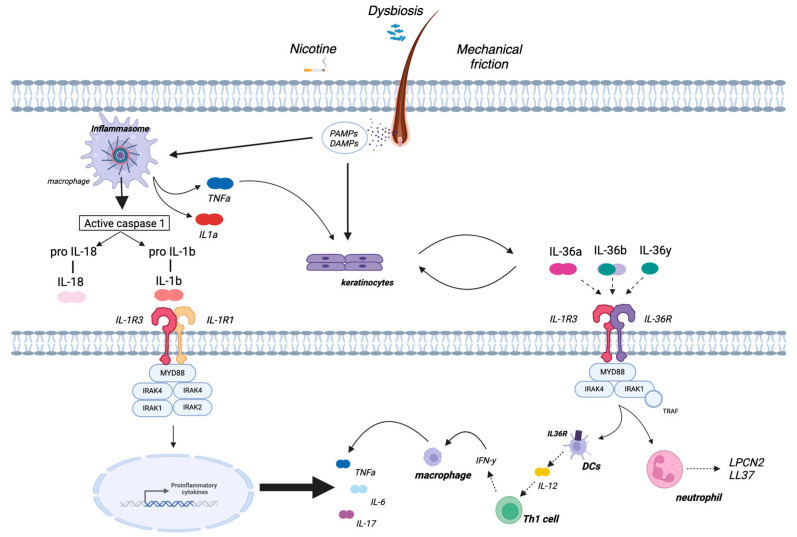
Figure 1
Figure 1
Pathogenesis of HS. Currently accepted paradigm of HS pathogenesis assumes an initial involvement of the terminal Pilosebaceous Unit (PSU) leading to surrounding inflammation through a multistep process that includes follicular occlusion and subsequent rupture. This results in the release of Pathogen-Associated Molecular Patterns (PAMPs) and Damage-Associated Molecular Patterns (DAMPs), with consequent activation of the innate immune response. The inactive precursor of IL-1β (pro-IL-1β) is converted into the active form IL-1β through the inflammasome. Activated keratinocytes produce IL-36 cytokines, which further promote the production of proinflammatory cytokines, such as IL-12 and IL-23, which, in turn, selectively trigger adaptive immunity in a feed-forward loop.
Figure 2
Figure 2
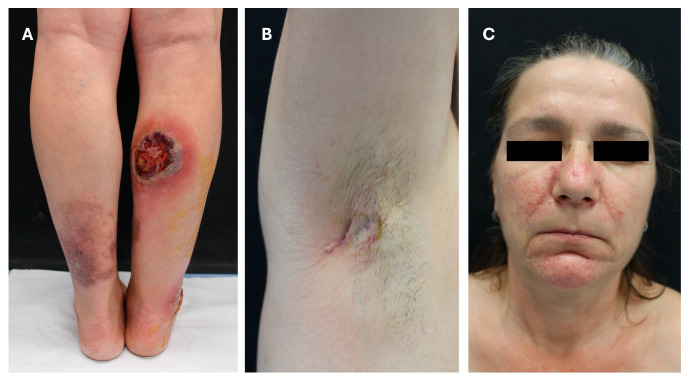
Syndromic HS – PASH syndrome. PASH syndrome is a rare autoinflammatory syndrome consisting of neutrophil-mediated inflammation, whose dermatological manifestations include the triad pyoderma gangrenosum (PG), acne and hidradenitis suppurativa (HS). The patient exhibited a painful ulcer with violaceous borders, involving the right lower extremity, consisting of PG (A). HS manifested with sinus tracts, deep-seated inflammatory nodules, as well as atrophic and rope-like scars, distributed throughout the axillae, inguinal–crural folds and genital area (B). Furthermore, the presence of papules, pustules and scarring on the face contributed to the complexity of the clinical presentation of this challenging case (C).

References

    1. Hendricks A.J., Hsiao J.L., Lowes M.A., Shi V.Y. A Comparison of International Management Guidelines for Hidradenitis Suppurativa. Dermatology. 2021;237:81–96. doi: 10.1159/000503605. - DOI - PubMed
    1. Guillet A., Brocard A., Bach Ngohou K., Graveline N., Leloup A.G., Ali D., Nguyen J.M., Loirat M.J., Chevalier C., Khammari A., et al. Verneuil’s disease, innate immunity and vitamin D: A pilot study. J. Eur. Acad. Dermatol. Venereol. 2015;29:1347–1353. doi: 10.1111/jdv.12857. - DOI - PubMed
    1. Jemec G.B., Kimball A.B. Hidradenitis suppurativa: Epidemiology and scope of the problem. J. Am. Acad. Dermatol. 2015;73:S4–S7. doi: 10.1016/j.jaad.2015.07.052. - DOI - PubMed
    1. Tavora I.G., Bissoli G.C., Miot H.A., Schmitt J.V. Clinical manifestations and quality of life in hidradenitis suppurativa patients: Survey of participants from an internet support group. An. Bras. Dermatol. 2019;94:298–303. doi: 10.1590/abd1806-4841.20197687. - DOI - PMC - PubMed
    1. Nguyen T.V., Damiani G., Orenstein L.A.V., Hamzavi I., Jemec G.B. Hidradenitis suppurativa: An update on epidemiology, phenotypes, diagnosis, pathogenesis, comorbidities and quality of life. J. Eur. Acad. Dermatol. Venereol. 2021;35:50–61. doi: 10.1111/jdv.16677. - DOI - PubMed

LinkOut - more resources