


Mandibular overdentures retained by 1 or 2 implants: a 5-year randomized clinical trial on implant stability and peri-implant outcomes
- PMID: 39279004
- PMCID: PMC11402838
- DOI: 10.1007/s00784-024-05914-w
Mandibular overdentures retained by 1 or 2 implants: a 5-year randomized clinical trial on implant stability and peri-implant outcomes
Abstract
Aim: This is a report of the 5-year results of a two-group parallel randomized clinical trial comparing longitudinal implant stability, and clinical and radiographic peri-implant outcomes of mandibular overdentures retained by one (1-IOD group) or two (2-IOD group) implants.
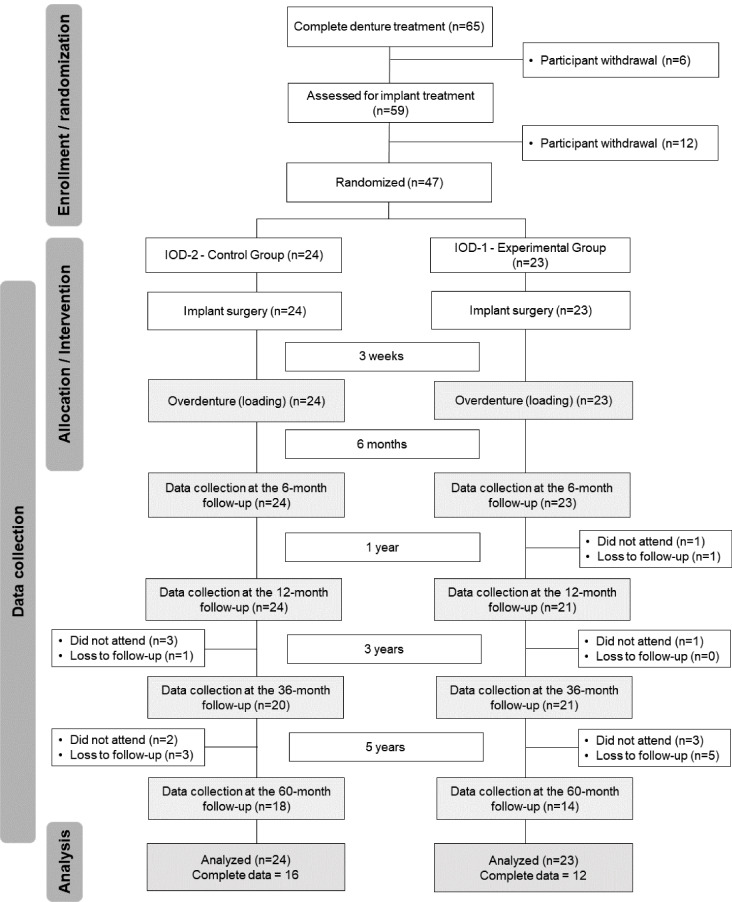
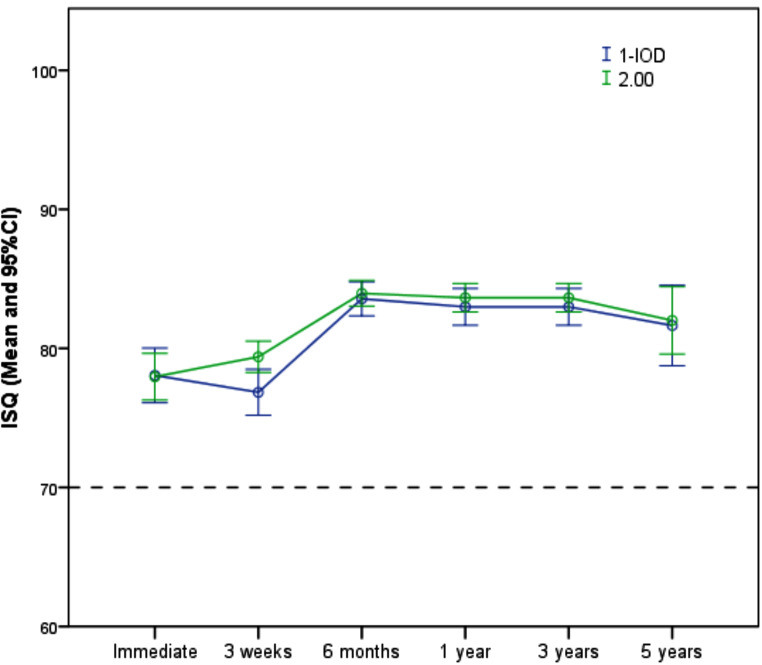
Methods: All participants received 4.1 mm diameter tissue-level implants (Straumann® Standard Plus - SLActive®, Institut Straumann AG), installed in the mandible midline (1-IOD; n = 23) or the lateral incisor-canine area bilaterally (2-IOD; n = 24), and loaded after 3 weeks. Implant Stability Quotient (ISQ) was measured using a resonance frequency device (Osstell® Mentor, Integration Diagnostics) at implant placement, after three weeks (loading), and at the 6-month, 1-, 3-, and 5-year follow-ups. Marginal bone loss and clinical implant outcomes (plaque, calculus, suppuration and bleeding) were assessed periodically up to 5 years after loading.
Results: Only minor changes in marginal bone level were observed after 5 years (mean = 0.37; SD = 0.44 mm), and satisfactory and stable peri-implant parameters were observed throughout the 5-year follow-up. No significant differences between groups were found. Overall, the mean primary implant stability was considered high (> 70) for the two groups (1-IOD = 78.1 ± 4.5; 2-IOD = 78.0 ± 5.8). No noticeable changes were observed between implant insertion and loading. A marked increase was observed from insertion to the 6-month follow-up - the mean difference for the 1-IOD group was + 5.5 ± 5.5 (Effect size = 1.00), while for the 2-IOD group, the mean difference was + 6.0 ± 5.6 (Effect size = 1.08). No relevant changes were observed throughout the follow-up periods up to 5 years. Linear mixed-effect model regression showed no influence of the bone-related variables (p > 0.05) and the number of implants (p = 0.087), and a significant effect of the time variable (p < 0.001).
Conclusion: Satisfactory peri-implant outcomes and stable secondary stability suggest good clinical performance and successful long-term osseointegration of the implants for single and two-implant mandibular overdentures. Using a single implant to retain a mandibular overdenture does not seem to result in detrimental implant loading over the five years of overdenture use.
Clinical relevance: This study corroborates the use of a single implant to retain a mandibular denture.
Keywords: Dental implant; Early dental implant loading; Edentulous mouth; Implant stability quotient; Overdenture; Randomized clinical; Trials.
© 2024. The Author(s).
Conflict of interest statement
Cláudio R. Leles, Murali Srinivasan and Martin Schimmel are the recipients of other funding from Institut Straumann AG and the ITI. The other authors declare they do not have any conflict of interest related to the present study.
Figures

References
-
- Schwarz F, Ramanauskaite A (2022) It is all about peri-implant tissue health. Periodontol 2000 88:9–12. 10.1111/prd.12407 - PubMed
-
- Sennerby L, Meredith N (2008) Implant stability measurements using resonance frequency analysis: biological and biomechanical aspects and clinical implications. Periodontol 2000 47:51–66. 10.1111/j.1600-0757.2008.00267.x - PubMed
-
- Meredith N (1998) Assessment of implant stability as a prognostic determinant. Int J Prosthodont 11(5):491–501 - PubMed
-
- Feine JS, Carlsson GE, Awad MA, Chehade A, Duncan WJ, Gizani S, Head T, Lund JP, MacEntee M, Mericske-Stern R, Mojon P, Morais J, Naert I, Payne AG, Penrod J, Stoker GT Jr, Tawse-Smith A, Taylor TD, Thomason JM, Thomson WM, Wismeijer D (2002) The McGill Consensus Statement on overdentures. Montreal, Quebec, Canada. May 24–25, 2002. Int J Prosthodont 15(4):413–414 - PubMed
Publication types
MeSH terms
LinkOut - more resources
Full Text Sources
