This is a preprint.
The Impact of Estrogen-Suppressing Contraceptives on Behavioral and Functional Difficulties in Borderline Personality Disorder
- PMID: 39281740
- PMCID: PMC11398603
- DOI: 10.1101/2024.09.04.24313069
The Impact of Estrogen-Suppressing Contraceptives on Behavioral and Functional Difficulties in Borderline Personality Disorder
Update in
-
The impact of ovulation-suppressing contraceptives on behavioral and functional difficulties in borderline personality disorder.Neuropsychopharmacology. 2025 Apr;50(5):841-848. doi: 10.1038/s41386-024-02045-4. Epub 2025 Jan 11. Neuropsychopharmacology. 2025. PMID: 39799250 Free PMC article.
Abstract
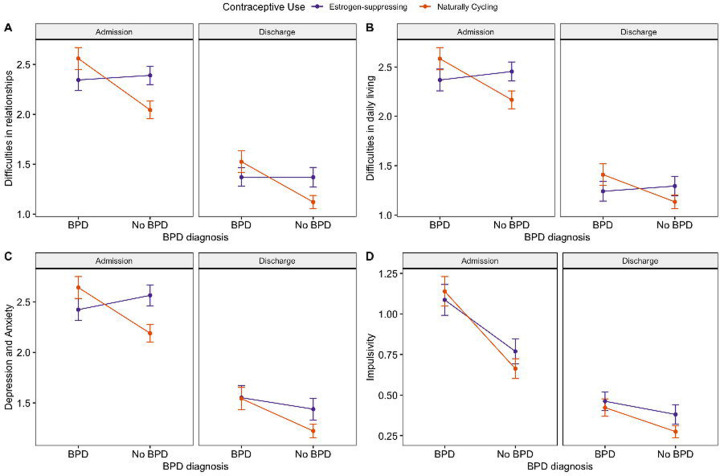
Borderline Personality Disorder (BPD) is characterized by rapidly shifting emotional, interpersonal, and behavioral symptoms, and is often co-morbid with mood and anxiety disorders. Females are more likely to be diagnosed with BPD than males and exhibit greater functional impairment. Hormonal fluctuations, particularly in estrogen levels, may influence the manifestation of BPD symptoms. Here we investigated the influence of estrogen-suppressing contraceptives on behavioral and functional difficulties in BPD. The analytical sample included 348 females ages 18-50 undergoing residential treatment for psychiatric disorders, with 131 having a BPD diagnosis. Patients were categorized based on their contraceptive method: 1) Estrogen-suppressing contraceptives (N=145) and 2) Naturally cycling (N=203). Interaction models tested the impact of estrogen-suppressing contraceptives on the relationship between BPD diagnosis and behavioral and functional difficulties at admission and discharge, assessed by the four Behavior and Symptom Identification Scale (BASIS-32) domains: difficulties in relationships, daily living, depression/anxiety, and impulsivity. Females with a BPD diagnosis were more likely to use estrogen-suppressing contraceptives compared to those without BPD (p=0.04). However, estrogen-suppressing contraceptive use was not associated with behavioral and functional difficulties at admission, discharge, or over time. Estrogen-suppressing contraceptives moderated the association between BPD diagnosis and difficulties in relationships (p=0.004), difficulties in daily living (p=0.01), and depression/anxiety symptoms (p=0.004). Patients with BPD expressed increased behavioral and functional difficulties at admission, discharge, and over time only if naturally cycling (p<0.003). Our findings suggest that estrogen-suppressing contraceptives may help to regulate the rapidly shifting emotional, interpersonal, and behavioral symptoms in females with BPD by stabilizing estrogen levels.
Figures
References
-
- American Psychiatric Association. Diagnostic and Statistical Manual of Mental Disorders (5th ed.). 2013.
-
- Zimmerman M, Mattia JI. Axis I diagnostic comorbidity and borderline personality disorder. Compr Psychiatry. 1999;40(4):245–52. - PubMed
-
- Steiner M, Dunn E, Born L. Hormones and mood: from menarche to menopause and beyond. J Affect Disord. 2003;74(1):67–83. - PubMed
Publication types
Grants and funding
LinkOut - more resources
Full Text Sources