This is a preprint.
Phenome-Wide Association of APOE Alleles in the All of Us Research Program
- PMID: 39281754
- PMCID: PMC11398429
- DOI: 10.1101/2024.09.04.24313010
Phenome-Wide Association of APOE Alleles in the All of Us Research Program
Update in
-
Phenome-wide association of APOE alleles in the All of Us Research Program.EBioMedicine. 2025 Jul;117:105768. doi: 10.1016/j.ebiom.2025.105768. Epub 2025 May 31. EBioMedicine. 2025. PMID: 40451134 Free PMC article.
Abstract
Background: Genetic variation in APOE is associated with altered lipid metabolism, as well as cardiovascular and neurodegenerative disease risk. However, prior studies are largely limited to European ancestry populations and differential risk by sex and ancestry has not been widely evaluated. We utilized a phenome-wide association study (PheWAS) approach to explore APOE-associated phenotypes in the All of Us Research Program.
Methods: We determined APOE alleles for 181,880 All of Us participants with whole genome sequencing and electronic health record (EHR) data, representing seven gnomAD ancestry groups. We tested association of APOE variants, ordered based on Alzheimer's disease risk hierarchy (ε2/ε2<ε2/ε3<ε3/ε3<ε2/ε4<ε3/ε4<ε4/ε4), with 2,318 EHR-derived phenotypes. Bonferroni-adjusted analyses were performed overall, by ancestry, by sex, and with adjustment for social determinants of health (SDOH).
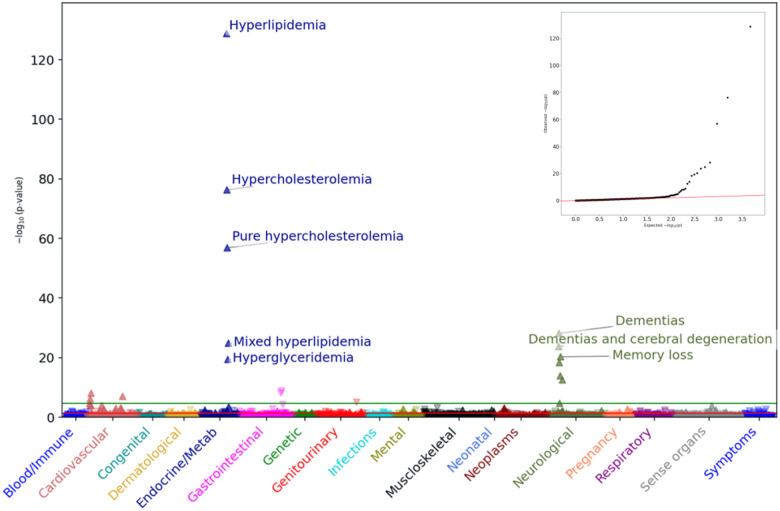
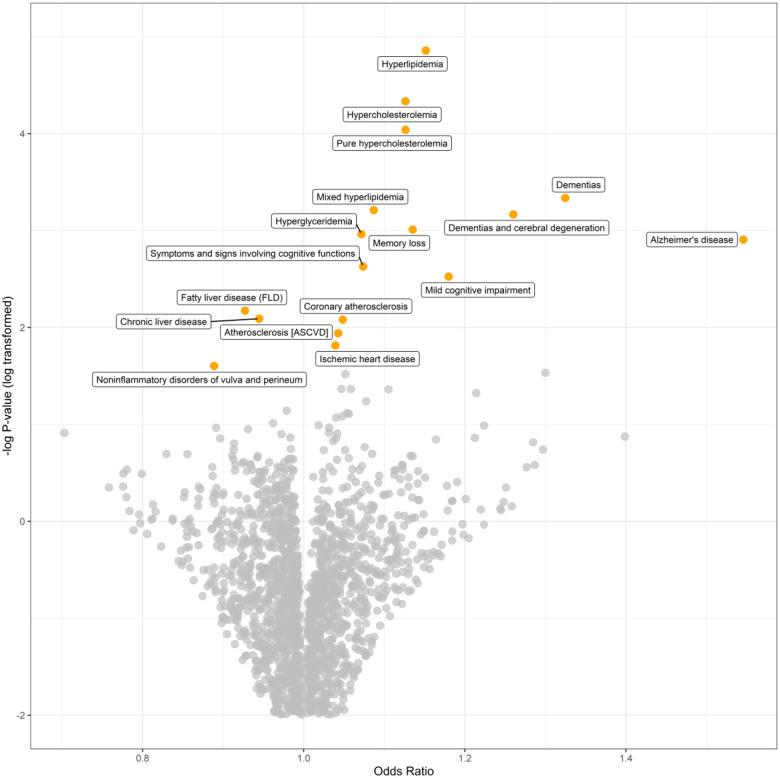
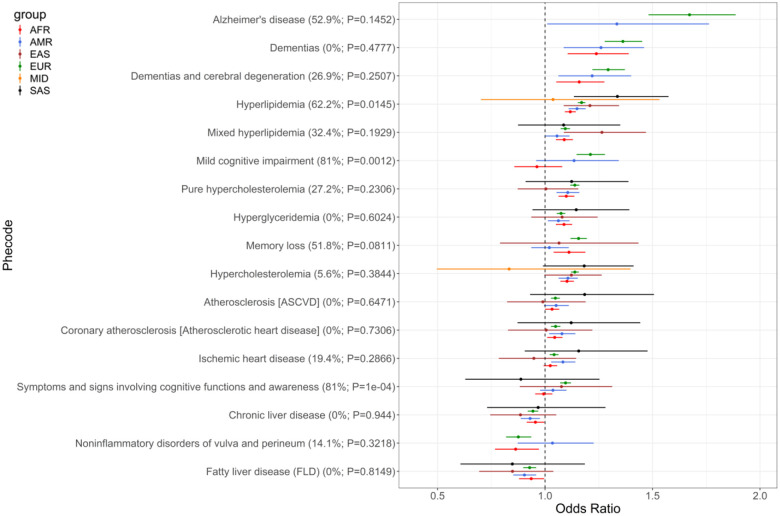
Findings: In the overall cohort, PheWAS identified 17 significant associations, including an increased odds of hyperlipidemia (OR 1.15 [1.14-1.16] per APOE genotype group; P=1.8×10-129), dementia, and Alzheimer's disease (OR 1.55 [1.40-1.70]; P=5×10-19), and a reduced odds of fatty liver disease (OR 0.93 [0.90-0.95]; P=1.6×10⁻⁹) and chronic liver disease. ORs were similar after SDOH adjustment and by sex, except for an increased number of cardiovascular associations in males, and decreased odds of noninflammatory disorders of vulva and perineum in females (OR 0.89 [0.84-0.94]; P=1.1×10⁻⁵). Significant heterogeneity was observed for hyperlipidemia and mild cognitive impairment across ancestry. Unique associations by ancestry included transient retinal arterial occlusion in the European ancestry group, and first-degree atrioventricular block in the American Admixed/Latino ancestry group.
Interpretation: We replicate extensive phenotypic associations with APOE alleles in a large, diverse cohort, despite limitations in accuracy for EHR-derived phenotypes. We provide a comprehensive catalog of APOE-associated phenotypes and present evidence of unique phenotypic associations by sex and ancestry, as well as heterogeneity in effect size across ancestry.
Figures

References
-
- Mahley RW. Apolipoprotein E: cholesterol transport protein with expanding role in cell biology. Science (New York, NY) 1988; 240(4852): 622–30. - PubMed
-
- Farrer LA, Cupples LA, Haines JL, et al. Effects of age, sex, and ethnicity on the association between apolipoprotein E genotype and Alzheimer disease. A meta-analysis. APOE and Alzheimer Disease Meta Analysis Consortium. Jama-J Am Med Assoc 1997; 278(16): 1349–56. - PubMed
Publication types
Grants and funding
- R01 HL156993/HL/NHLBI NIH HHS/United States
- OT2 OD026556/OD/NIH HHS/United States
- U2C OD023196/OD/NIH HHS/United States
- OT2 OD025315/OD/NIH HHS/United States
- OT2 OD026551/OD/NIH HHS/United States
- OT2 OD026552/OD/NIH HHS/United States
- OT2 OD026549/OD/NIH HHS/United States
- OT2 OD025337/OD/NIH HHS/United States
- OT2 OD026555/OD/NIH HHS/United States
- OT2 OD026550/OD/NIH HHS/United States
- OT2 OD026553/OD/NIH HHS/United States
- OT2 OD023205/OD/NIH HHS/United States
- R01 HL158686/HL/NHLBI NIH HHS/United States
- OT2 OD025276/OD/NIH HHS/United States
- OT2 OD026554/OD/NIH HHS/United States
- U24 OD023163/OD/NIH HHS/United States
- OT2 OD023206/OD/NIH HHS/United States
- R01 AG069453/AG/NIA NIH HHS/United States
- U24 OD023176/OD/NIH HHS/United States
- OT2 OD026548/OD/NIH HHS/United States
- U24 OD023121/OD/NIH HHS/United States
- P30 AG072980/AG/NIA NIH HHS/United States
- OT2 OD025277/OD/NIH HHS/United States
- R21 HL172036/HL/NHLBI NIH HHS/United States
- OT2 OD026557/OD/NIH HHS/United States
- OT2 OD036485/OD/NIH HHS/United States
LinkOut - more resources
Full Text Sources
Molecular Biology Databases
Miscellaneous