


This is a preprint.
Structural proteomics defines a sequential priming mechanism for the progesterone receptor
- PMID: 39282295
- PMCID: PMC11398526
- DOI: 10.1101/2024.09.06.611729
Structural proteomics defines a sequential priming mechanism for the progesterone receptor
Update in
-
Structural proteomics defines a sequential priming mechanism for the progesterone receptor.Nat Commun. 2025 May 12;16(1):4403. doi: 10.1038/s41467-025-59458-y. Nat Commun. 2025. PMID: 40355435 Free PMC article.
Abstract
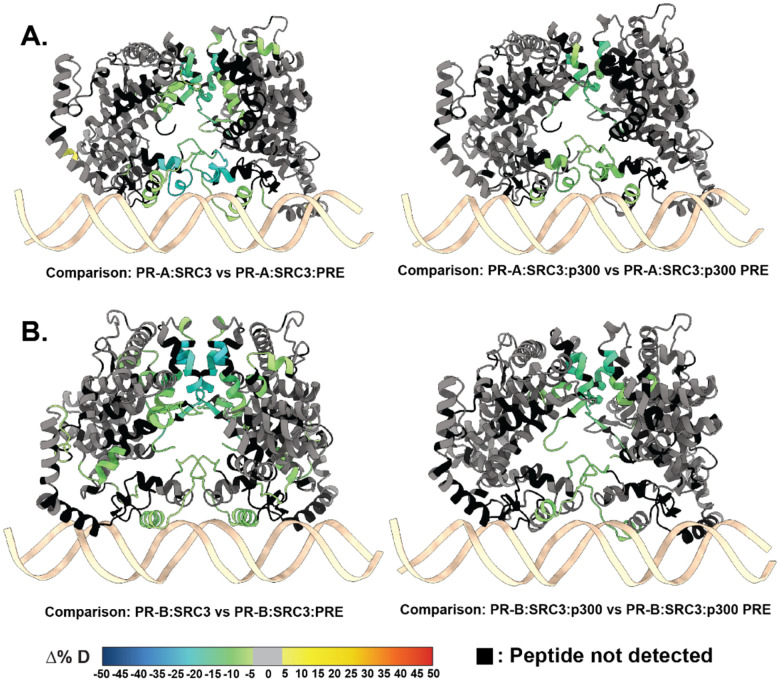
The progesterone receptor (PR) is a steroid-responsive nuclear receptor with two isoforms: PR-A and PR-B. Disruption of PR-A:PR-B signaling is associated with breast cancer through interactions with oncogenic co-regulatory proteins (CoRs). However, molecular details of isoform-specific PR-CoR interactions remain poorly understood. Using structural mass spectrometry, we investigate the sequential binding mechanism of purified full-length PR and intact CoRs, steroid receptor coactivator 3 (SRC3) and p300, as complexes on target DNA. Our findings reveal selective CoR NR-box binding by PR and unique interaction surfaces between PR and CoRs during complex assembly, providing a structural basis for CoR sequential binding on PR. Antagonist-bound PR showed persistent CoR interactions, challenging the classical model of nuclear receptor activation and repression. Collectively, we offer a peptide-level perspective on the organization of the PR transcriptional complex and infer the mechanisms behind the interactions of these proteins, both in active and inactive conformations.
Keywords: Progesterone receptor; crosslinking; hydrogen-deuterium exchange; mass spectrometry; nuclear receptors; protein-protein interactions; transcriptional co-regulatory proteins.
Figures
References
-
- Roemer SC, Donham DC, Sherman L, Pon VH, Edwards DP, Churchill ME. Structure of the progesterone receptor-deoxyribonucleic acid complex: novel interactions required for binding to half-site response elements. Mol Endocrinol. 2006;20(12):3042–52. Epub 20060824. doi: 10.1210/me.2005-0511. - DOI - PMC - PubMed
-
- Melvin VS, Harrell C, Adelman JS, Kraus WL, Churchill M, Edwards DP. The role of the C-terminal extension (CTE) of the estrogen receptor alpha and beta DNA binding domain in DNA binding and interaction with HMGB. J Biol Chem. 2004;279(15):14763–71. Epub 20040121. doi: 10.1074/jbc.M313335200. - DOI - PubMed
Publication types
Grants and funding
LinkOut - more resources
Full Text Sources
Research Materials
Miscellaneous
