This is a preprint.
Mutagenesis Sensitivity Mapping of Human Enhancers In Vivo
- PMID: 39282388
- PMCID: PMC11398460
- DOI: 10.1101/2024.09.06.611737
Mutagenesis Sensitivity Mapping of Human Enhancers In Vivo
Update in
-
In vivo mapping of mutagenesis sensitivity of human enhancers.Nature. 2025 Jul;643(8072):839-846. doi: 10.1038/s41586-025-09182-w. Epub 2025 Jun 18. Nature. 2025. PMID: 40533554
Abstract
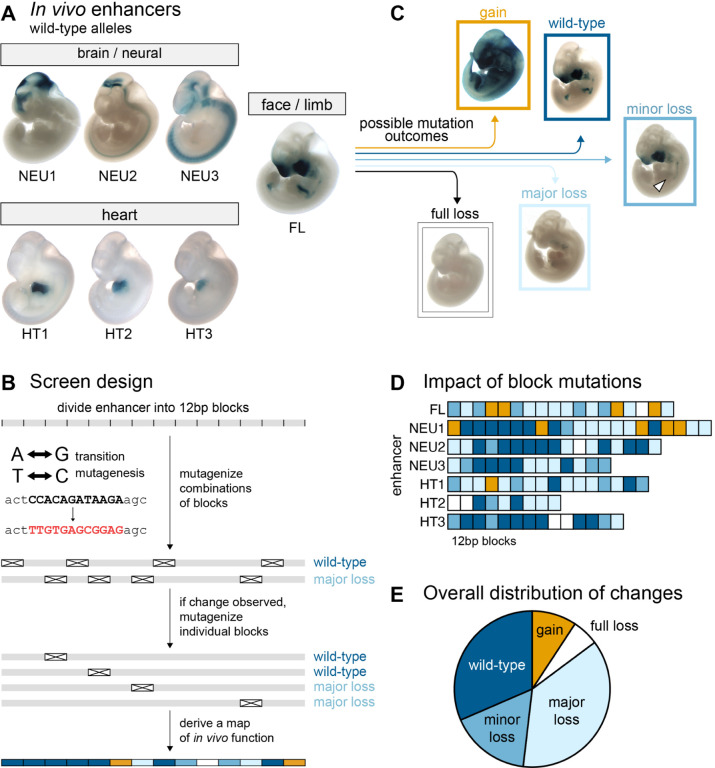
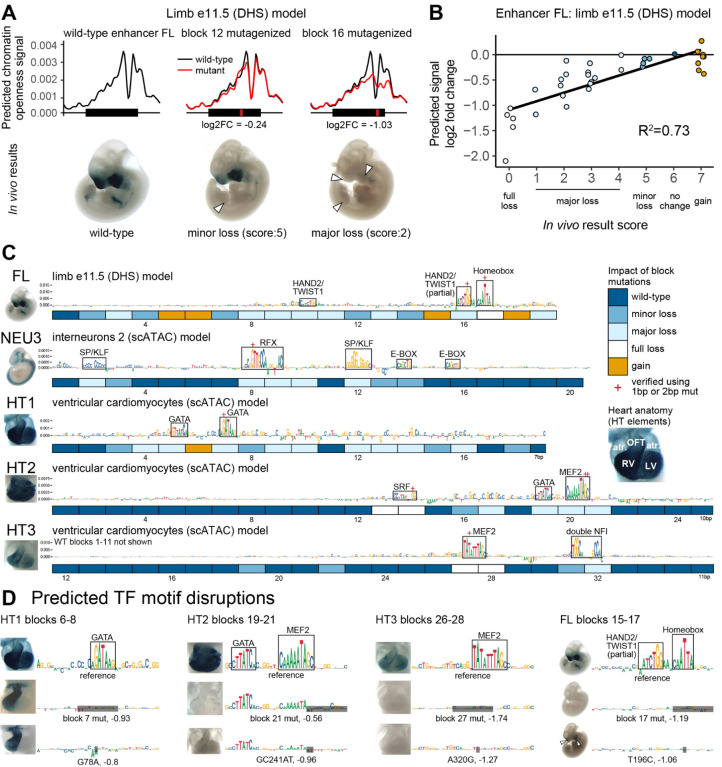
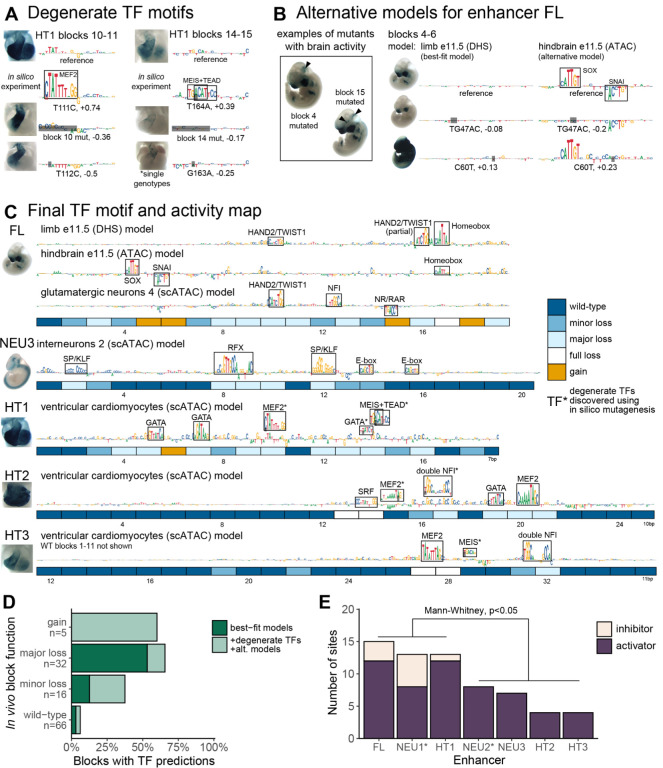
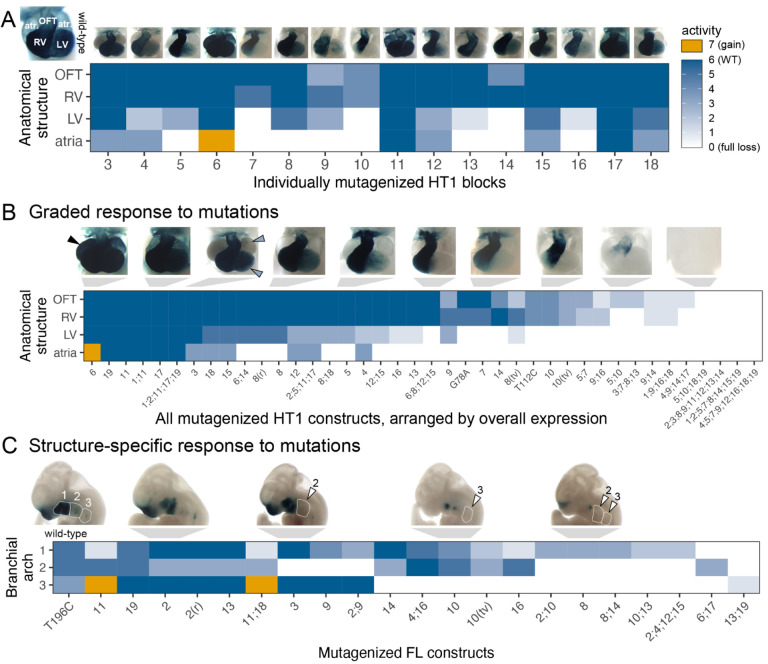
Distant-acting enhancers are central to human development. However, our limited understanding of their functional sequence features prevents the interpretation of enhancer mutations in disease. Here, we determined the functional sensitivity to mutagenesis of human developmental enhancers in vivo. Focusing on seven enhancers active in the developing brain, heart, limb and face, we created over 1700 transgenic mice for over 260 mutagenized enhancer alleles. Systematic mutation of 12-basepair blocks collectively altered each sequence feature in each enhancer at least once. We show that 69% of all blocks are required for normal in vivo activity, with mutations more commonly resulting in loss (60%) than in gain (9%) of function. Using predictive modeling, we annotated critical nucleotides at base-pair resolution. The vast majority of motifs predicted by these machine learning models (88%) coincided with changes to in vivo function, and the models showed considerable sensitivity, identifying 59% of all functional blocks. Taken together, our results reveal that human enhancers contain a high density of sequence features required for their normal in vivo function and provide a rich resource for further exploration of human enhancer logic.
Conflict of interest statement
Conflicts of Interest A.K. is on the scientific advisory board of SerImmune, AINovo, TensorBio and OpenTargets. A.K. was a scientific co-founder of RavelBio, a paid consultant with Illumina, was on the SAB of PatchBio and owns shares in DeepGenomics, Immunai, Freenome, and Illumina.
Figures