


Impact of inpatient self-efficacy and trust in physicians on inpatient satisfaction with medical services: the mediating role of patient participation in medical decision-making
- PMID: 39282672
- PMCID: PMC11392843
- DOI: 10.3389/fpsyg.2024.1364319
Impact of inpatient self-efficacy and trust in physicians on inpatient satisfaction with medical services: the mediating role of patient participation in medical decision-making
Abstract
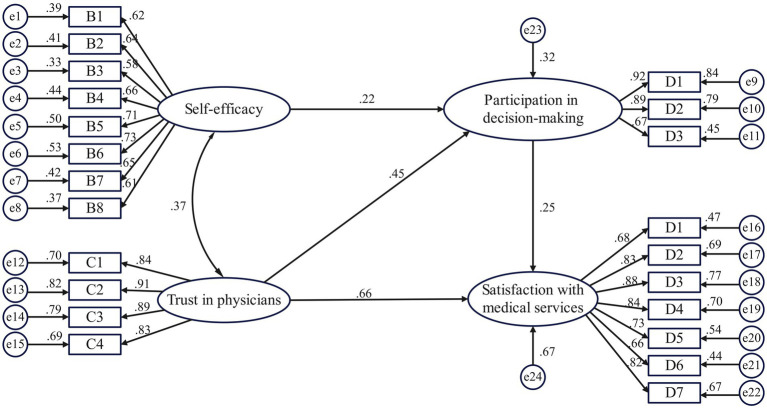
Objective: Patient satisfaction reflects the social benefits of hospitals and is an important indicator of hospital performance. This study explores the mechanism through which inpatients' trust in physicians, self-efficacy, and participation in medical decision-making impact their satisfaction with medical services.
Methods: A questionnaire was administered to 814 inpatients in 10 randomly selected tertiary hospitals and 10 randomly selected secondary hospitals in Hangzhou, China. A correlation analysis and hierarchical linear regression were conducted to analyze the factors influencing inpatient satisfaction.
Results: The outcome measures of trust in physicians and participation in medical decision-making behaviors had significant positive effects on inpatient satisfaction.Trust in physicians was shown to directly influence inpatient satisfaction, while inpatient participation in decision-making partially mediated this relationship. Inpatient participation in medical decision-making fully mediated the relationship between self-efficacy and inpatient satisfaction.
Conclusion: While inpatients were relatively satisfied, there is room for improvement. Healthcare providers should improve patient trust by actively listening to their needs and providing feedback, establishing effective communication mechanisms. Patient self-efficacy can be enhanced through health education, special lectures, and case sharing. Patients should also be encouraged to actively participate in medical decision-making.
Practical implications: Based on inpatient feedback during a preliminary survey, we refined this study's questionnaire to enhance its feasibility for future research. This article shares key findings for healthcare managers and providers, advising that patient satisfaction can be enhanced through trust, self-efficacy, and participation.
Keywords: inpatient satisfaction; medical decision-making; patient participation; self-efficacy; trust in physicians.
Copyright © 2024 Wang, Jia, Fan, Chen, Lou, Wang and Huang.
Conflict of interest statement
The authors declare that the research was conducted in the absence of any commercial or financial relationships that could be construed as a potential conflict of interest.
Figures


References
-
- Alsarhan M. A., Alaqeely R. S., Aljasser R., Otaibi D. H., Aloraini S., Alshiddi I. F. (2021). Evaluation of complacency about dental implants with shared decision making and satisfaction scores: a cross-sectional study. Saudi. Dent. J. 33, 929–936. doi: 10.1016/j.sdentj.2021.09.001, PMID: - DOI - PMC - PubMed
-
- Arnetz J. E., Almin I., Bergström K., Franzén Y., Nilsson H. (2004). Active patient involvement in the establishment of physical therapy goals: effects on treatment outcome and quality of care. Adv. Physiother. 6, 50–69. doi: 10.1080/14038190310017147 - DOI
-
- Binbin H., Shengqi Z., Xinchun W., Liu C. (2019). The association between father coparenting behavior and adolescents’ peer attachment: the mediating role of father-child attachment and the moderating role of adolescents’ neuroticism. Psychol. Dev. Educ. 35, 176–183. doi: 10.16187/j.cnki.issn1001-4918.2019.02.06 - DOI
LinkOut - more resources
Full Text Sources
