. 2024 Sep 16;12(9):E1065-E1074.
doi: 10.1055/a-2366-7302. eCollection 2024 Sep.

The updated Asia-Pacific consensus statement on the role of endoscopic management in malignant hilar biliary obstruction

Affiliations

The updated Asia-Pacific consensus statement on the role of endoscopic management in malignant hilar biliary obstruction

Phonthep Angsuwatcharakon et al. Endosc Int Open. .

Abstract

The first Asia-Pacific consensus recommendations for endoscopic and interventional management of hilar cholangiocarcinoma were published in 2013. Since then, new evidence on the role of endoscopy for management of malignant hilar biliary obstruction (MHBO) has emerged. To update the recommendation, we reviewed the literature using a PICO (population/intervention/comparison/outcomes) framework and created consensus statements. The expert panel voted anonymously using the modified Delphi method and all final statements were evaluated for the quality of evidence and strength of recommendation. The important points with inadequate supporting evidence were classified as key concepts. There were seven statements and five key concepts that reached consensus. The statements and key concepts dealt with multiple aspects of endoscopy-based management in MHBO starting from diagnosis, strategies and options for biliary drainage, management of recurrent biliary obstruction, management of cholecystitis after biliary stenting, and adjunctive treatment before stenting. Although the recommendations may assist physicians in planning the treatment for MHBO patients, they should not replace the decision of a multidisciplinary team in the management of individual patients.

Keywords: Biliary tract; ERC topics; Endoscopic ultrasonography; Intervention EUS; Pancreatobiliary (ERCP/PTCD); Strictures; Tissue diagnosis.


Conflict of interest statement

Conflict of Interest The authors declare that they have no conflict of interest.

Figures
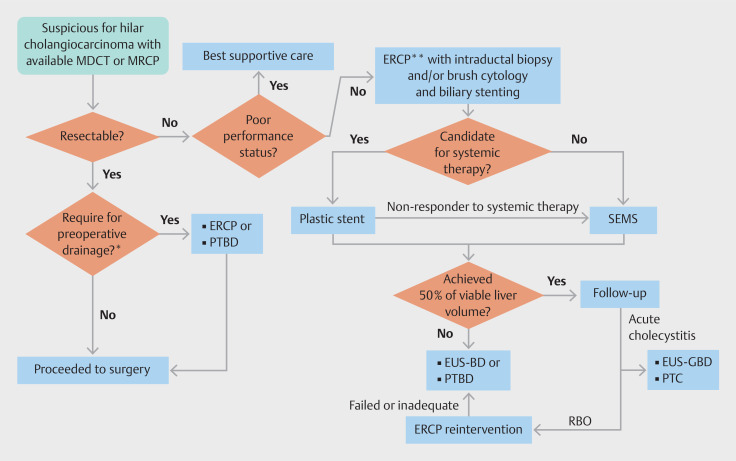
Fig. 1
Fig. 1
Conceptualized roles of endoscopy in management of malignant hilar biliary obstruction. ERCP; endoscopic retrograde cholangiopancreatography, EUS-BD; endoscopic ultrasound-guided biliary drainage, EUS-GBD; endoscopic ultrasound-guided gallbladder drainage, MDCT; multidetector computed tomography, MRCP; magnetic resonance cholangiopancreatography, PTBD; percutaneous biliary drainage, PTC; percutaneous cholecystostomy, RBO; recurrent biliary obstruction, SEMS; self-expandable metal stent. * Preoperative biliary drainage may be indicated in patients with cholangitis, prolonged jaundice, delayed surgery (e.g. waiting for portal vein intervention, malnutrition [serum albumin less than 3 g/dL], etc.), or total bilirubin ≥15 mg/dL ** Wire-guided selection of preselected liver segment before performing cholangiogram. Followed by air/carbon dioxide cholangiogram or limited injection with contrast media. Photodynamic therapy or endo-biliary radiofrequency ablation may be used as adjunctive treatment before stenting.
Fig. 2
Fig. 2
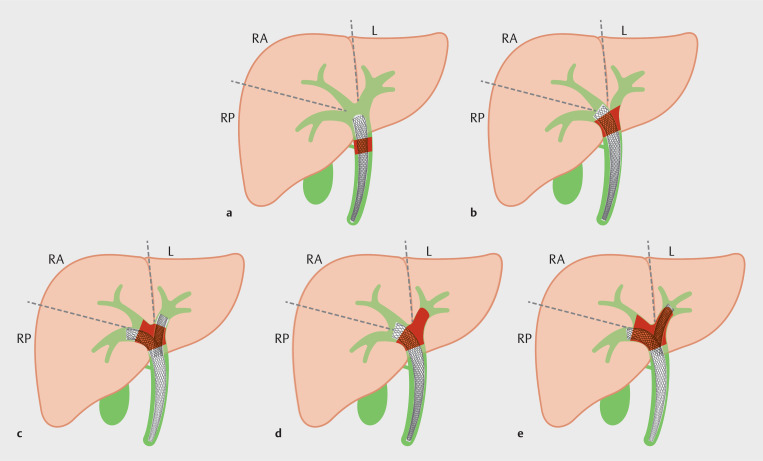
Strategy for biliary sector selection for drainage according to Bismuth classification of malignant hilar biliary obstruction. RA; right anterior sector, RP; right posterior sector, L; left sector. a Bismuth I; one stent can drain all three sectors (100%). b Bismuth II: placement of one stent in the right main hepatic duct can drain both RA and RP sectors (60%). c Bismuth IIIa: at least two stents are required to achieve at least 50% of liver volume. d Bismuth IIIb: placement of one stent in the right main hepatic duct can drain both RA and RP sectors (60%). e Bismuth IV: at least two stents are required to achieve at least 50% of liver volume.
Fig. 3
Fig. 3
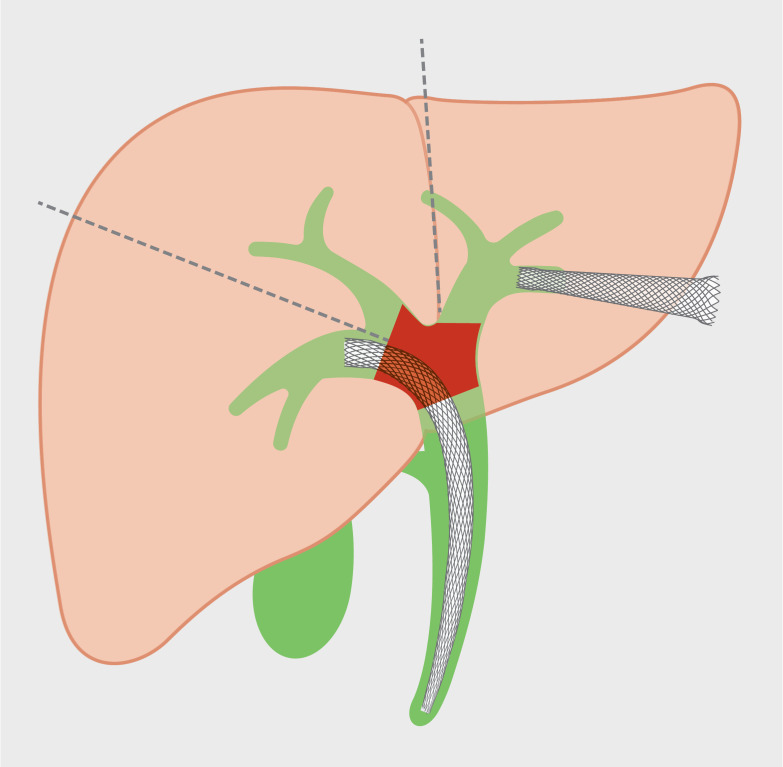
Endoscopic ultrasound-guided biliary drainage of undrained liver segment after ERCP. Endoscopic ultrasound-guided hepaticogastrostomy for drainage of the left hepatic sector after inadequate drainage of right hepatic sector by ERCP.
Fig. 4
Fig. 4
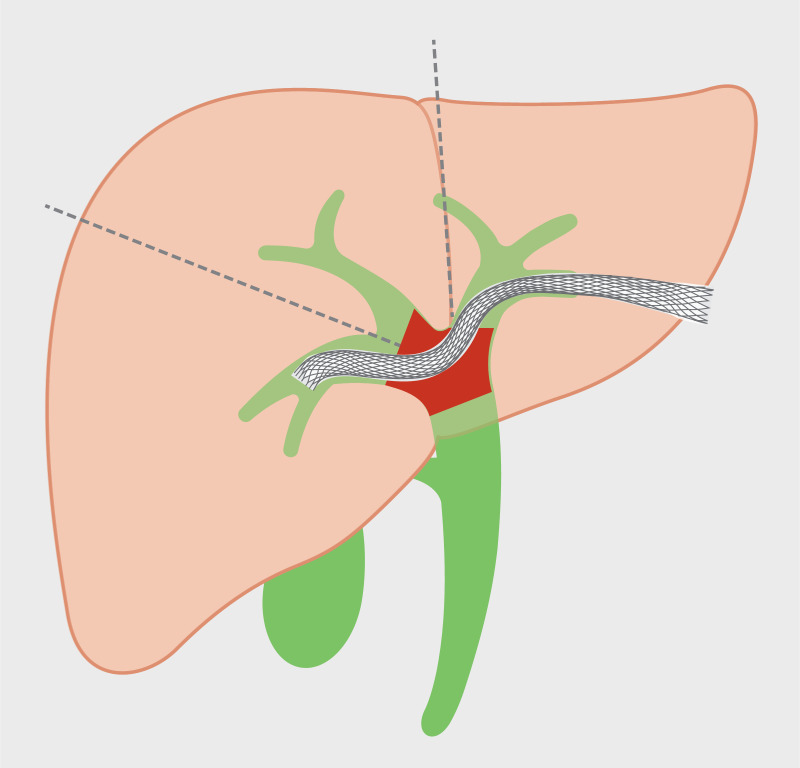
Transgastric approach of endoscopic ultrasound-guided drainage of right hepatic duct. Endoscopic ultrasound-guided biliary drainage is a viable technique to bridge right and left hepatic duct via a transgastric puncture.

References

    1. Angsuwatcharakon P, Kulpatcharapong S, Moon JH et al. Consensus guidelines on the role of cholangioscopy to diagnose indeterminate biliary stricture. HPB (Oxford) 2022;24:17–29. doi: 10.1016/j.hpb.2021.05.005. - DOI - PubMed
    1. Rerknimitr R, Angsuwatcharakon P, Ratanachu-ek T et al. Asia-Pacific consensus recommendations for endoscopic and interventional management of hilar cholangiocarcinoma. J Gastroenterol Hepatol. 2013;28:593–607. doi: 10.1111/jgh.12128. - DOI - PubMed
    1. Guyatt GH, Oxman AD, Kunz R et al. GRADE guidelines: 2. Framing the question and deciding on important outcomes. J Clin Epidemiol. 2011;64:395–400. doi: 10.1016/j.jclinepi.2010.09.012. - DOI - PubMed
    1. Guyatt GH, Oxman AD, Vist GE et al. GRADE: an emerging consensus on rating quality of evidence and strength of recommendations. BMJ. 2008;336:924–926. doi: 10.1136/bmj.39489.470347.AD. - DOI - PMC - PubMed
    1. Balshem H, Helfand M, Schunemann HJ et al. GRADE guidelines: 3. Rating the quality of evidence. J Clin Epidemiol. 2011;64:401–406. doi: 10.1016/j.jclinepi.2010.07.015. - DOI - PubMed

LinkOut - more resources