. 2024 Sep 2:37:100859.
doi: 10.1016/j.lana.2024.100859. eCollection 2024 Sep.

Ultra-processed foods and cardiovascular disease: analysis of three large US prospective cohorts and a systematic review and meta-analysis of prospective cohort studies

Affiliations

Ultra-processed foods and cardiovascular disease: analysis of three large US prospective cohorts and a systematic review and meta-analysis of prospective cohort studies

Kenny Mendoza et al. Lancet Reg Health Am. .

Abstract

Background: Prospective associations between total and groups of ultra-processed foods (UPF) and cardiovascular disease (CVD) remained to be characterised. Our aim was to assess the association of total and group-specific UPF intakes with CVD, coronary heart disease (CHD), and stroke in three large prospective cohorts of US adults. Additionally, we conducted a systematic review and meta-analyses on the existing evidence on the associations of total UPF intake with these outcomes.

Methods: UPF intake was assessed through food frequency questionnaires in the Nurses' Health Study (NHS; n = 75,735), Nurses' Health Study II (NHSII; n = 90,813), and Health Professionals Follow-Up Study (HPFS; n = 40,409). Cox regression estimated cohort-specific associations of total and group-specific UPF intake with risk of CVD (cases = 16,800), CHD (cases = 10,401), and stroke (cases = 6758), subsequently pooled through fixed-effect models. Random-effects meta-analyses pooled existing prospective findings on the UPF-CVD association identified on Medline and Embase up to April 5, 2024, without language restrictions. Risk of bias was assessed with the Newcastle-Ottawa Scale, funnel plots, and Egger's tests, and meta-evidence was evaluated using NutriGrade.

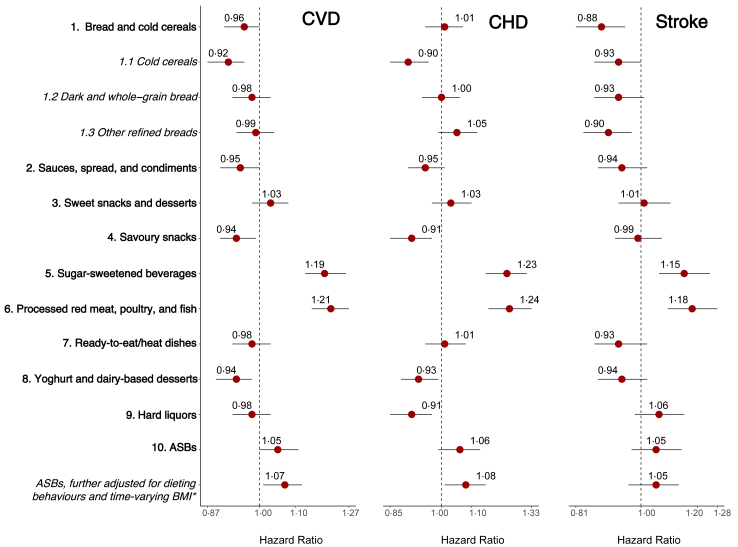
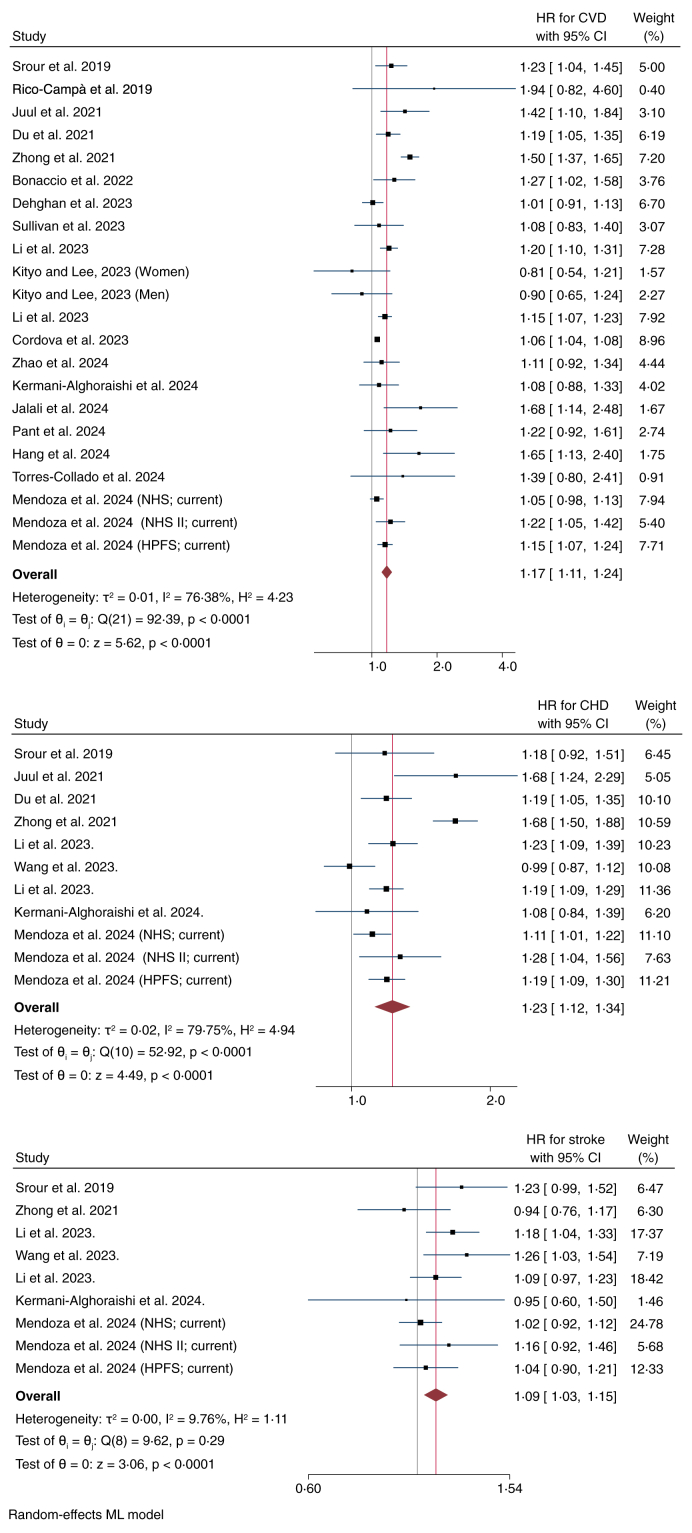
Findings: The baseline mean (SD) age was 50.8 years (7.2) for the NHS, 36.7 years (4.6) for the NHSII, and 53.4 years (9.6) for the HPFS. The proportion of participants of White race was 97.7% in the NHS, 96.4% in the NHSII, and 94.9% in the HPFS. Among the three cohorts, multivariable-adjusted hazard ratios [HRs (95% CIs)] for CVD, CHD, and stroke for the highest (vs. lowest) total UPF intake quintile were 1.11 (1.06-1.16), 1.16 (1.09-1.24), and 1.04 (0.96-1.12), respectively. UPF groups demonstrated divergent associations. Sugar-/artificially-sweetened drinks and processed meats were associated with higher CVD risk, whereas inverse associations were observed for bread/cold cereals, yoghurt/dairy desserts, and savoury snacks. Meta-analysing 22 prospective studies showed that total UPF intake at the highest category (vs. lowest) was associated with 17% (11%-24%), 23% (12%-34%), and 9% (3%-15%) higher CVD, CHD, and stroke risk. Meta-evidence quality was high for CHD, moderate for CVD, and low for stroke.

Interpretation: Total UPF intake was adversely associated with CVD and CHD risk in US adults, corroborated by prospective studies from multiple countries, also suggesting a small excess stroke risk. Nutritional advice for cardiovascular health should consider differential consequences of group-specific UPF. Replication is needed in racially/ethnically-diverse populations.

Funding: National Institutes of Health (NIH) grants supported the NHS, NHSII, and HPFS.

Keywords: Cardiovascular disease; Cohort studies; Meta-analysis; Nurses’ health study; Systematic analysis; Ultra-processed foods.


Conflict of interest statement

The authors declare no conflict of interest.

Figures
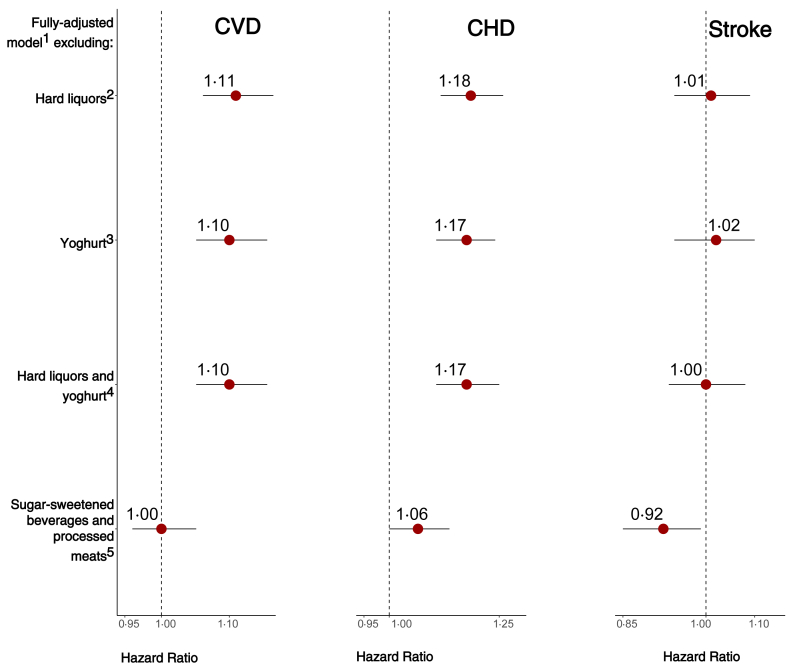
Fig. 1
Fig. 1
Association between UPF intake (highest vs. lowest quintile) and cardiovascular disease in three US cohorts, excluding liquors, yoghurt, sugar-sweetened beverages, and processed meats. Cohort-specific estimates from the NHS (n = 75,735; 1984–2016), NHS II (n = 90,813; 1991–2017), and HPFS (n = 40,409; 1986–2016) were meta-analysed with fixed-effects models. Pooled hazard ratios and 95% confidence intervals for total cardiovascular disease, coronary heart disease, and stroke are presented. 1Multivariable Cox regression stratified by age in months and the calendar year in two-year intervals was used to estimate the associations between cumulatively-averaged UPF intake and CVD risk. The models were adjusted for race/ethnicity, marital status, working status, smoking status, quintiles of physical activity (MET-hours/week), sleep patterns (hours/day), family history of CVD, multivitamin use, aspirin use, NSAID use, menopausal hormone use status (women only), oral contraceptive use (women only), energy intake, BMI at baseline, hypertension at baseline, hypercholesterolemia at baseline, and diabetes at baseline. NHS and NHSII only included women, and HPFS only included men; therefore, cohort-specific models inherently controlled for sex. 2Hard liquors (e.g., whiskey, vodka, brandy, rum) were removed from the variable reflecting total UPF intake. 3Sugar-sweetened flavoured and artificially-sweetened yoghurt were removed from the variable reflecting total UPF intake. 4Both yoghurt and hard liquors were removed from the variable reflecting total UPF intake (notice that dairy desserts were included). 5Both ultra-processed sugar-sweetened beverages and meat were removed from the total UPF intake variable. Abbreviations: NHS, Nurses’ Health Study; HPFS, the Health Professionals Follow-Up Study; UPF, ultra-processed foods; UP, ultra-processed; CVD, cardiovascular disease; CHD, Coronary Heart Disease; NSAID, Non-steroidal-inflammatory drugs; BMI, body mass index.
Fig. 2
Fig. 2
Association between group-specific UPF intake (highest vs. lowest quintile) and cardiovascular disease in three US cohorts. Cohort-specific estimates from the NHS (n = 75,735; 1984–2016), NHS II (n = 90,813; 1991–2017), and HPFS (n = 40,409; 1986–2016) were meta-analysed with fixed-effects models. Pooled hazard ratios and 95% confidence intervals for total cardiovascular disease, coronary heart disease, and stroke are presented. Multivariable Cox regression stratified by age in months and the calendar year in two-year intervals was used to estimate the associations between cumulatively-averaged UPF group intake and CVD risk. All UPF groups were simultaneously included in the model as distinct covariables, adjusting for race/ethnicity, marital status, working status, smoking status, quintiles of physical activity (MET-hours/week), sleep patterns (hours/day), family history of CVD, multivitamin use, aspirin use, NSAID use, menopausal hormone use status (women only), oral contraceptive use (women only), energy intake, BMI at baseline, hypertension at baseline, hypercholesterolemia at baseline, and diabetes at baseline. NHS and NHSII only included women, and HPFS only included men; therefore, cohort-specific models inherently controlled for sex. ∗A separate model was fit to evaluate the effect of artificially-sweetened beverages, further adjusting for dieting and loss weight behaviours (i.e., self-report of intentional and unintentional weight loss, adherence to low-calorie diets, fasting, increases in exercise, use of pills, following weight loss programs, gastric bypass, and other methods) and time-varying BMI. Abbreviations: NHS, Nurses’ Health Study; HPFS, the Health Professionals Follow-Up Study; UPF, ultra-processed foods; CVD, cardiovascular disease; CHD, Coronary Heart Disease; NSAID, Non-steroidal-inflammatory drugs; BMI, body mass index ASBs: artificially sweetened beverages.
Fig. 3
Fig. 3
Random-effects meta-analyses of prospective cohort studies on the association of total UPF consumption (high vs. low) with CVD, CHD, and stroke risk. Top: Association between UPF intake and fatal and non-fatal CVD events; 95% CI for I2 = 64.5, 84.3; 95% CI for H2 = 2.8, 6.4. Middle: Association between UPF intake and fatal and non-fatal CHD events; 95% CI for I2 = 64.5, 88.4; 95% CI for H2 = 2.8, 8.7. Bottom: Association between UPF intake and fatal and non-fatal stroke events; 95% CI for I2 = 0.001, 68.2; 95% CI for H2 = 0.4, 3.1. Abbreviations. HR, hazard ratio; ML, maximum likelihood; CVD, cardiovascular disease; CHD, coronary heart disease; NHS, the Nurses’ Health Study; HPFS, the Health Professionals Follow-Up Study.

References

    1. Monteiro C.A., Cannon G., Levy R.B., et al. Ultra-processed foods: what they are and how to identify them. Public Health Nutr. 2019;22(5):936–941. doi: 10.1017/S1368980018003762. - DOI - PMC - PubMed
    1. Juul F., Parekh N., Martinez-Steele E., et al. Ultra-processed food consumption among US adults from 2001 to 2018. Am J Clin Nutr. 2022;115(1):211–221. doi: 10.1093/ajcn/nqab305. - DOI - PubMed
    1. Mozaffarian D. Dietary and policy priorities for cardiovascular disease, diabetes, and obesity. Circulation. 2016;133(2):187–225. doi: 10.1161/CIRCULATIONAHA.115.018585. - DOI - PMC - PubMed
    1. Hall K.D., Ayuketah A., Brychta R., et al. Ultra-processed diets cause excess calorie intake and weight gain: an inpatient randomized controlled trial of ad libitum food intake. Cell Metab. 2019;30(1):67–77. doi: 10.1016/j.cmet.2019.05.008. - DOI - PMC - PubMed
    1. Roth G.A., Mensah G.A., Johnson C.O., et al. Global burden of cardiovascular diseases and risk factors, 1990–2019. J Am Coll Cardiol. 2020;76(25):2982–3021. doi: 10.1016/j.jacc.2020.11.010. - DOI - PMC - PubMed

LinkOut - more resources