


Assessment of the HIV Enhanced Access Testing in the Emergency Department (HEATED) program in Nairobi, Kenya: a quasi-experimental prospective study
- PMID: 39290079
- PMCID: PMC11443818
- DOI: 10.1080/25787489.2024.2403958
Assessment of the HIV Enhanced Access Testing in the Emergency Department (HEATED) program in Nairobi, Kenya: a quasi-experimental prospective study
Abstract
Background: Persons seeking emergency injury care are often from higher-risk and underserved key populations (KPs) and priority populations (PPs) for HIV programming. While facility-based HIV Testing Services (HTS) in Kenya are effective, emergency department (ED) delivery is limited, despite the potential to reach underserved persons.
Methods: This quasi-experimental prospective study evaluated implementation of the HIV Enhanced Access Testing in Emergency Departments (HEATED) at Kenyatta National Hospital ED in Nairobi, Kenya. The HEATED program was designed as a multi-component intervention employing setting appropriate strategies for HIV care sensitization and integration, task shifting, resource reorganization, linkage advocacy, skills development and education to promote ED-HTS with a focus on higher-risk persons. KPs included sex workers, gay men, men who have sex with men, transgender persons and persons who inject drugs. PPs included young persons (18-24 years), victims of interpersonal violence, persons with hazardous alcohol use and persons never HIV tested. Data were obtained from systems-level records, enrolled injured patient participants and healthcare providers. Systems and patient-level data were collected during a pre-implementation period (6 March - 16 April 2023) and post-implementation (period 1, 1 May - 26 June 2023). Additional, systems-level data were collected during a second post-implementation (period 2, 27 June - 20 August 2023). HTS data were evaluated as facility-based HIV testing (completed in the ED) and distribution of HIV self-tests independently, and aggregated as ED-HTS. Evaluation analyses were completed across reach, effectiveness, adoption, implementation and maintenance framework domains.
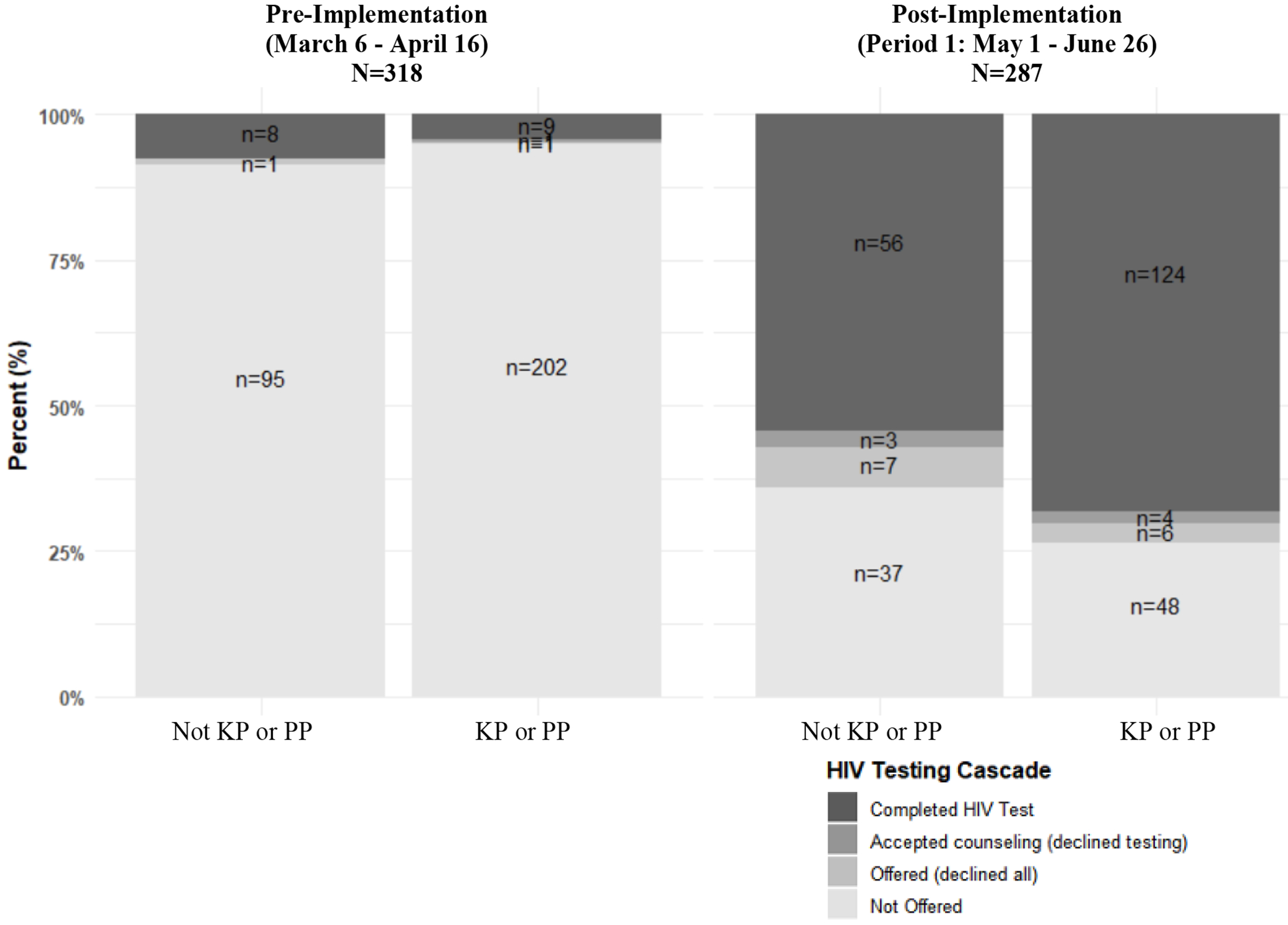
Results: All 151 clinical staff were reached through trainings and sensitizations on the HEATED program. Systems-level ED-HTS among all presenting patients increased from 16.7% pre-implementation to 23.0% post-implementation periods 1 and 2 (RR = 1.31, 95% CI: 1.21-1.43; p < 0.001). Among 605 enrolled patient participants, facilities-based HTS increased from 5.7% pre-implementation to 62.3% post-implementation period 1 (RR = 11.2, 95%CI: 6.9-18.1; p < 0.001). There were 440 (72.7%) patient participants identified as KPs (5.6%) and/or PPs (65.3%). For enrolled KPs/PPs, facilities-based HTS increased from 4.6% pre-implementation to 72.3% post-implementation period 1 (RR = 13.8, 95%CI: 5.5-28.7, p < 0.001). Systems and participant level data demonstrated successful adoption and implementation of the HEATED program. Through 16 wk post-implementation a significant increase in ED-HTS delivery was maintained as compared to pre-implementation.
Conclusions: The HEATED program increased overall ED-HTS and augmented delivery to KPs/PPs, suggesting that broader implementation could improve HIV services for underserved persons already in contact with health systems.
Keywords: Africa; HIV; HIV testing; Kenya; emergency medical services; health systems.
Figures



Update of
-
Implementation and Assessment of the HIV Enhanced Access Testing in the Emergency Department (HEATED) Program in Nairobi, Kenya: A Quasi-Experimental Prospective Study.medRxiv [Preprint]. 2024 Apr 4:2024.04.03.24305277. doi: 10.1101/2024.04.03.24305277. medRxiv. 2024. Update in: HIV Res Clin Pract. 2024 Dec;25(1):2403958. doi: 10.1080/25787489.2024.2403958. PMID: 38633813 Free PMC article. Updated. Preprint.
References
-
- UNAIDS. Confronting Inequalities - Lessons for pandemic responses from 40 years of AIDS. 2021. Accessed at: https://www.unaids.org/sites/default/files/media_asset/2021-global-aids-...
-
- UNAIDS. IN DANGER: UNAIDS Global AIDS Update 2022. Geneva. Accessed at: https://www.unaids.org/sites/default/files/media_asset/2022-global-aids-.... 2022
-
- Joint United Nations Programme on HIV/AIDS. IN DANGER: UNAIDS Global AIDS Update 2022. Geneva, 2022.
-
- National Syndemic Diseases Control Council. Repulic of Kenya. National Multisectoral HIV Prevention Acceleration Plan 2023–2030. August 2023. Accessed at: https://nsdcc.go.ke/download/national-multisectoral-hiv-prevention-accel....
-
- National AIDS and STI Control Programme (NASCOP). 2022. Kenya Population-based HIV Impact Assessment (KENPHIA) 2018: Final Report. Nairobi: NASCOP. Accessed at: https://phia.icap.columbia.edu/wp-content/uploads/2022/08/KENPHIA_Ago25-....
Publication types
MeSH terms
Grants and funding
LinkOut - more resources
Full Text Sources
Medical
Miscellaneous
