. 2024 Mar 5;46(5):648-660.
doi: 10.1016/j.pld.2024.02.006. eCollection 2024 Sep.

An unprotected vulnerable relict subtropical conifer- Keteleeria evelyniana: Its forests, populations, growth and endangerment by invasive alien plant species in China

Affiliations

An unprotected vulnerable relict subtropical conifer- Keteleeria evelyniana: Its forests, populations, growth and endangerment by invasive alien plant species in China

Cindy Q Tang et al. Plant Divers. .

Abstract

Relict subtropical coniferous forests in China face severe fragmentation, resulting in declining populations, and some are under significant threat from invasive alien species. Despite the crucial importance of understanding forest dynamics, knowledge gaps persist, particularly regarding the impact of invasive plants on vulnerable natives like Keteleeria evelyniana. In this study, we investigated the impact of invasive plants on the regeneration of forests dominated by K. evelyniana, a subtropical relict species in southwestern China. For this purpose, we characterized forest dynamics of 160 forest plots featuring K. evelyniana as the primary dominant species and determined whether the presence of invasive plants was correlated with regeneration of K. evelyniana. We identified four distinct forest types in which K. evelyniana was dominant. We found that radial growth of K. evelyniana trees is faster in younger age-classes today than it was for older trees at the same age. The population structure of K. evelyniana in each forest type exhibited a multimodal age-class distribution. However, three forest types lacked established saplings younger than 10 years old, a situation attributed to the dense coverage of the invasive alien Ageratina adenophora. This invasive species resulted in a reduction of understory species diversity. Additionally, our analysis uncovered a significant negative correlation in phylogenetic relatedness (net relatedness index) between native and invasive alien plant species in eastern Yunnan. This suggests closely related invasive species face heightened competition, hindering successful invasion. Taken together, our findings indicate that successful establishment and habitat restoration of K. evelyniana seedling/saplings require effective measures to control invasive plants.

Keywords: Age structure; Invasive alien species; Keteleeria evelyniana; Phylogenetic relatedness; Regeneration; Species diversity.


Conflict of interest statement

The authors declare that they have no known competing financial interests or personal relationships that could have appeared to influence the work reported in this paper.

Figures
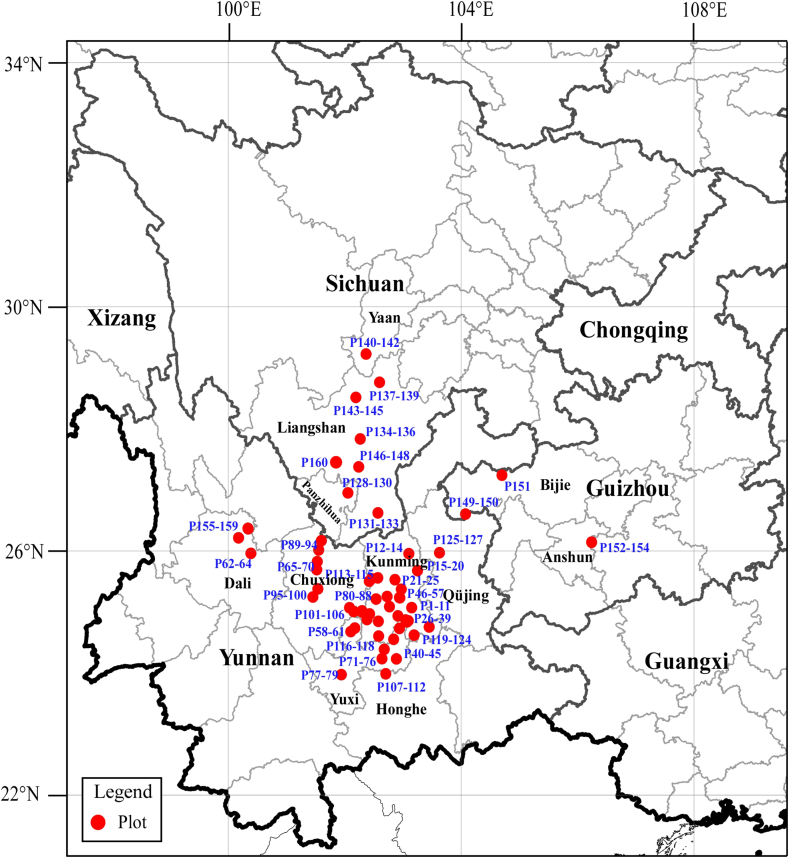
Fig. 1
Fig. 1
Study areas and plot locations in southwestern China.
Fig. 2
Fig. 2
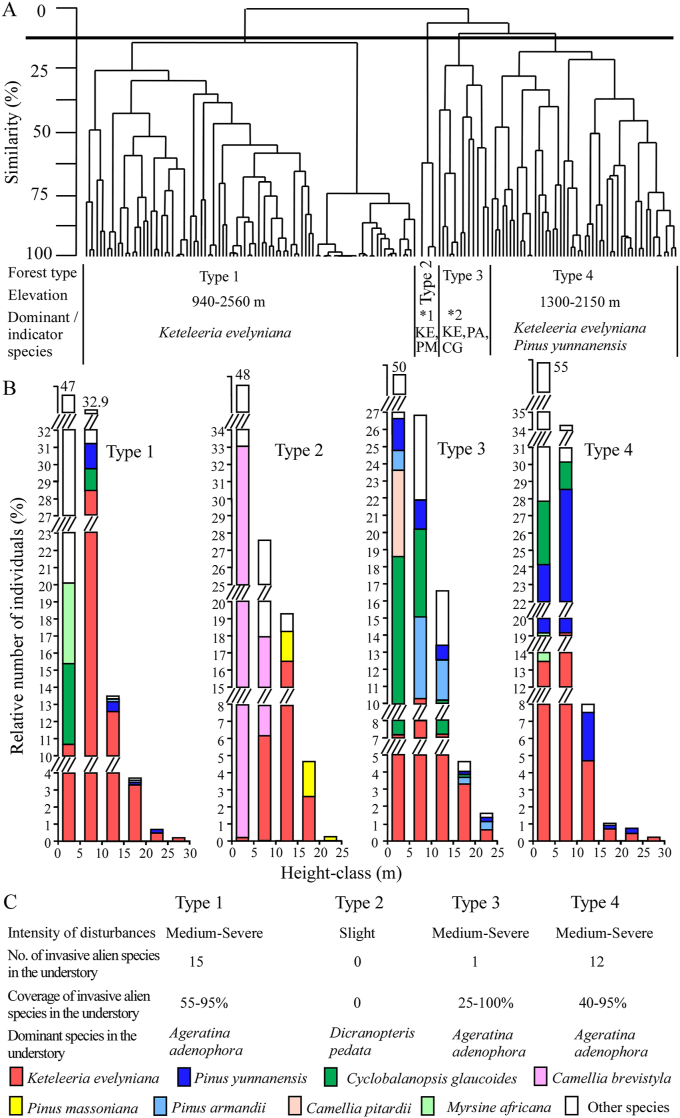
Cluster analysis and the frequency distribution in height-classes of woody species and habitat characteristics. (A) Cluster analysis of the 160 plots. (B) The frequency distribution in height-classes of woody species (height ≥ 1.3 m) of each forest type. (C) The intensity of disturbances, the number and coverage of invasive alien species in the understory of each forest type. KE: Keteleeria evelyniana; PM: Pinus massoniana; PA: Pinus armandii; CG: Cyclobalanopsis glaucoides; ∗1: 1200–1300 m; ∗2: 1700–2300 m; Type 1: Keteleeria evelyniana evergreen coniferous forest; Type 2: Keteleeria evelynianaPinus massoniana evergreen coniferous forest; Type 3: Keteleeria evelynianaPinus armandiiCyclobalanopsis glaucoides evergreen coniferous and broad-leaved mixed forest; Type 4: Keteleeria evelynianaPinus yunnanensis evergreen coniferous forest.
Fig. 3
Fig. 3
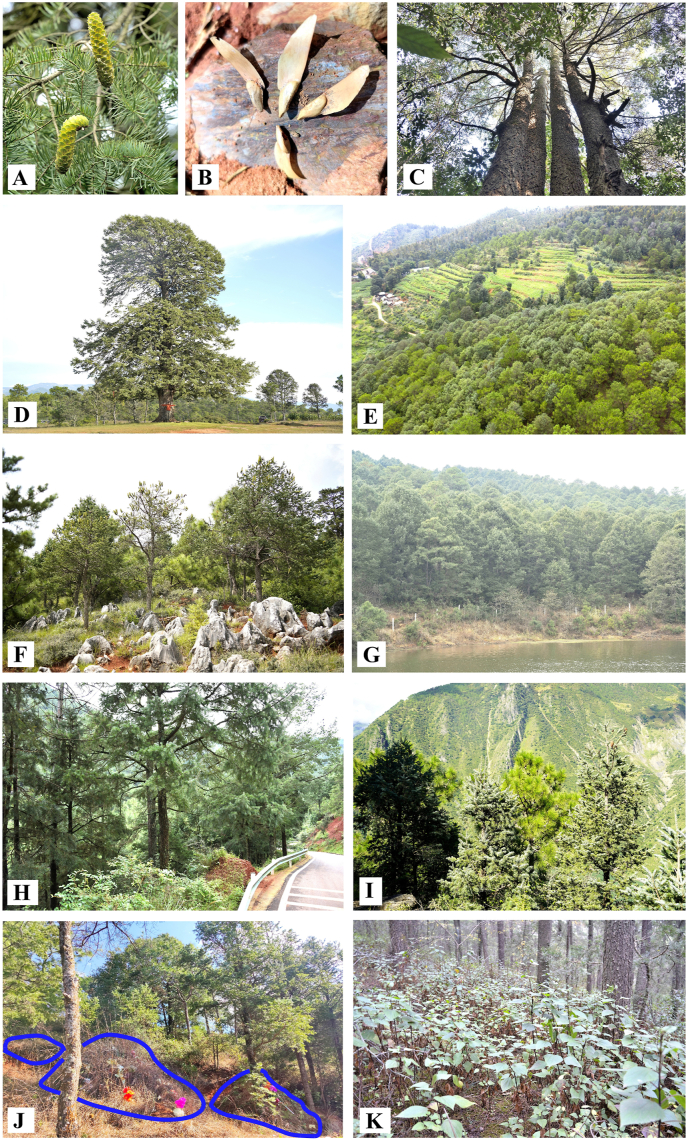
Keteleeria evelyniana and its representative forest stands and habitats. (A) Seed corns and foliage of K. evelyniana; (B) Winged seeds of K. evelyniana; (C) The canopy of a K. evelyniana forest at 1988 m a.s.l. in Longshan, Wenquan Zhen, Anning City, Yunnan Province; (D) A 208-year-old K. evelyniana tree, ca. 146 cm DBH, 27 m tall at 2560 m a.s.l in Sankeshu Village, Wu Town, Yanyuan County, Sichuan Province; (E) A fragmented forest of K. evelyniana surrounded by farmland at 2044 m a.s.l. in Tanglangqing, Luquan County, Yunnan Province; (F) A fragmented forest of K. evelyniana at 1730 m a.s.l. in the Karst area of Sijiaotian Village, Shilin County, Yunnan Province; (G) A fragmented forest of K. evelyniana by a lake at 1813 m a.s.l. in Shuangmei Village, Anning City, Yunnan Province; (H) A fragmented forest of K. evelyniana by a road at 1215 m a.s.l. in Shuchang, Meiqi Village, Anshun City, Guizhou Province; (I) A fragmented forest of K. evelyniana at 2100 m a.s.l. in Mulihe, Bajia Village, Muli County, Sichuan Province; (J) The forest floor was used for burial plots (indicated by the blue lines) by local villagers at 1990 m a.s.l. in Chenggong District, Kunming, Yunnan Province; (K) An invasive alien species, Ageratina adenophora, densely occupies the understory of a K. evelyniana forest at 2020 m a.s.l. in Danaobao, Jiulongsi Village, Yiliang County, Yunnan Province.
Fig. 4
Fig. 4
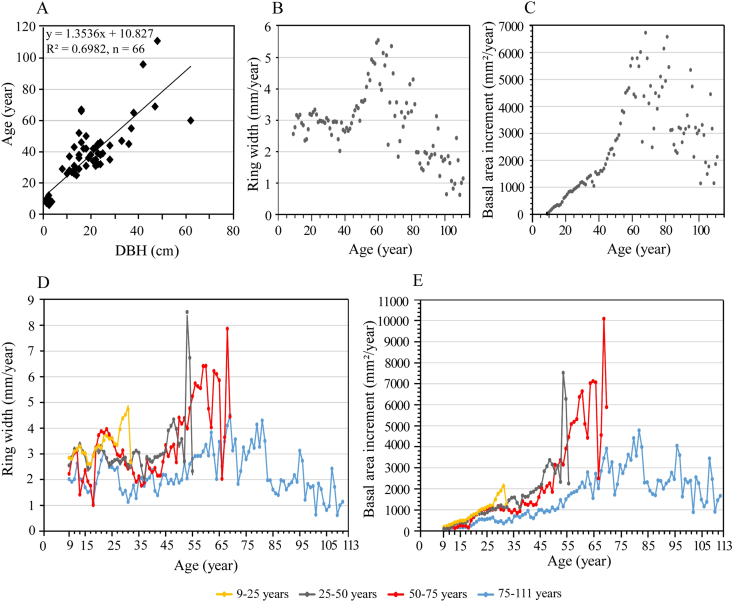
Growth trends of Keteleeria evelyniana trees (height ≥ 1.3 m). (A) Relationships of DBH and age; (B) Changes in ring width over the years; (C) Changes in basal area increment over the years; (D) Ring widths in the four age classes (i.e., 9–25, 25–50, 50–75, 75–111 years) over the years; (E) The basal area increment in the four age classes over the years.
Fig. 5
Fig. 5
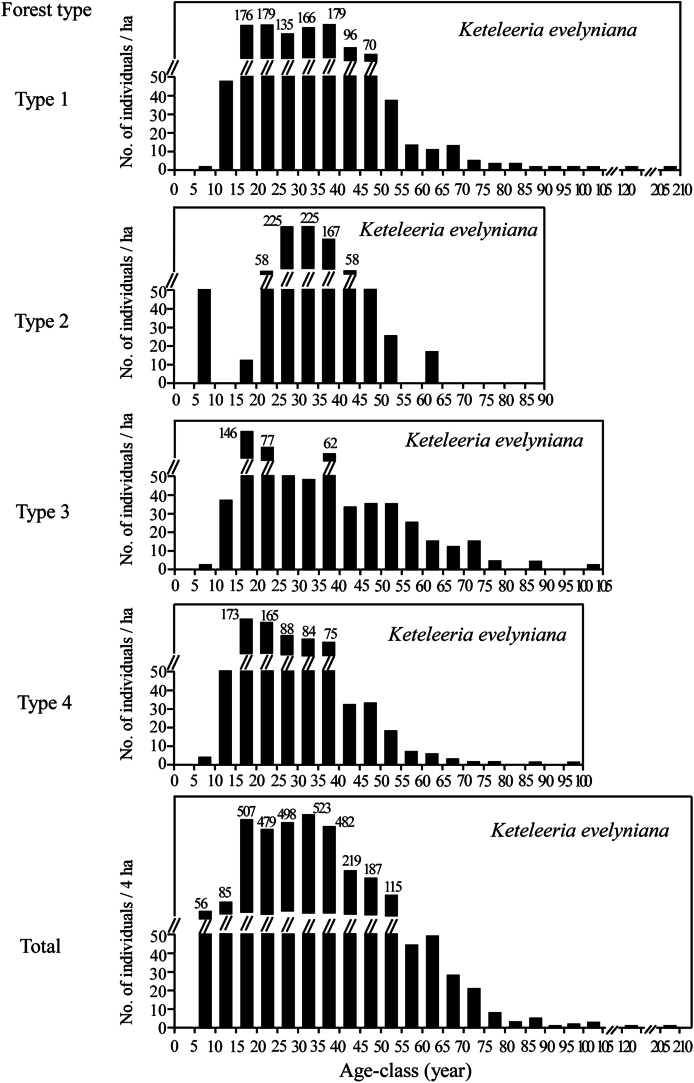
The age structure of Keteleeria evelyniana. Type 1: Keteleeria evelyniana evergreen coniferous forest; Type 2: Keteleeria evelynianaPinus massoniana evergreen coniferous forest; Type 3: Keteleeria evelynianaPinus armandiiCyclobalanopsis glaucoides evergreen coniferous and broad-leaved mixed forest; Type 4: Keteleeria evelynianaPinus yunnanensis evergreen coniferous forest.
Fig. 6
Fig. 6
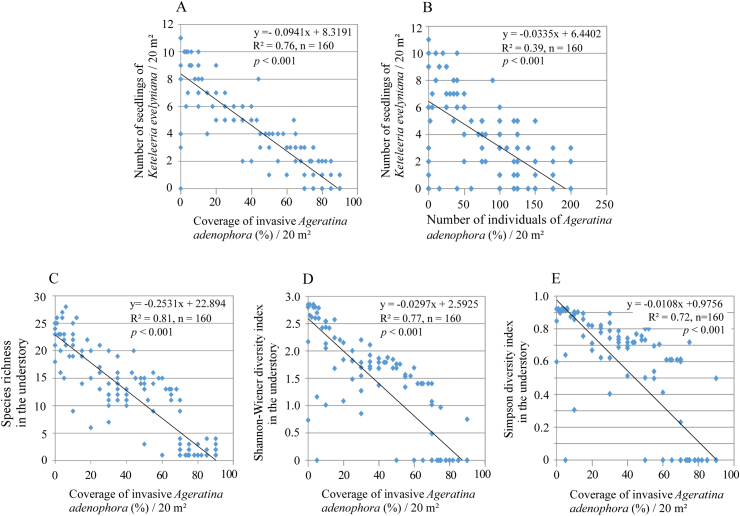
Negative impacts of invasive alien species on number of seedlings of Keteleeria evelyniana and understory species diversity. (A) & (B) Changes in numbers of seedlings of Keteleeria evelyniana by respective coverage and density of invasive alien Ageratina adenophora; (C), (D) & (E) Changes of species richness, Shannon–Wiener diversity and Simpson diversity, respectively, in the understory by coverage of invasive alien Ageratina adenophora.
Fig. 7
Fig. 7
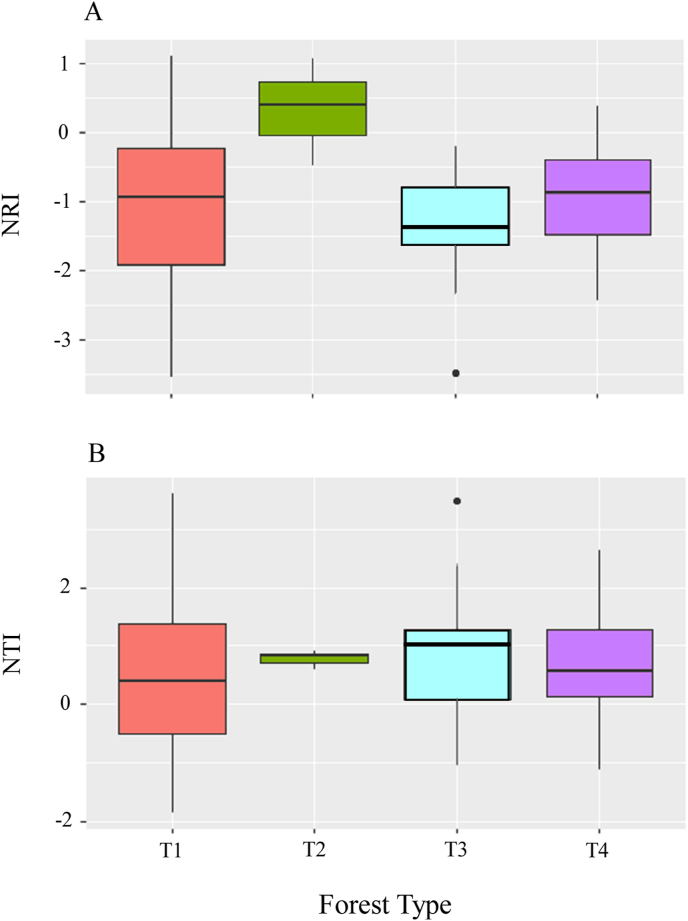
Phylogenetic indices (NRI, NTI) of each forest type. NRI: Net relatedness index; NTI: Nearest taxon index; T1 (Type 1): Keteleeria evelyniana evergreen coniferous forest; T2 (Type 2): Keteleeria evelynianaPinus massoniana evergreen coniferous forest; T3 (Type 3): Keteleeria evelynianaPinus armandiiCyclobalanopsis glaucoides evergreen coniferous and broad-leaved mixed forest; T4 (Type 4): Keteleeria evelynianaPinus yunnanensis evergreen coniferous forest.

References

    1. Atwater D.Z., Ervine C., Barney J.N. Climatic niche shifts are common in introduced plants. Nat. Ecol. Evol. 2018;2:34–43. - PubMed
    1. Auld B.A. Eupatorium weed species in Australia. PANS (Pest. Artic. News Summ.) 1970;16:82–86.
    1. Averyanov L.V., Nguyen T.H., Sinh K.N., et al. Gymnosperms of Laos. Nord. J. Bot. 2014;32:765–805. doi: 10.1111/njb.00498. - DOI
    1. Bai F., Chrisholm R., Sang W., et al. Spatial risk assessment of alien invasive plants in China. Environ. Sci. Technol. 2013;47:7624–7632. doi: 10.1021/es400382c. - DOI - PubMed
    1. Bai W., Xu H., Wu Q., et al. Ecological study of Keteleeria davidiana populations of Yachang forest farm in Guangxi Zhuang autonomous region. J. Nanjing For. Univ. (Natural Sci. Edition) 2017;41:71–76.

LinkOut - more resources