. 2024 Jul 16;9(9):2685-2694.
doi: 10.1016/j.ekir.2024.06.021. eCollection 2024 Sep.

Importance of IFT140 in Patients with Polycystic Kidney Disease Without a Family History

Affiliations

Importance of IFT140 in Patients with Polycystic Kidney Disease Without a Family History

Takuya Fujimaru et al. Kidney Int Rep. .

Abstract

Introduction: Recently, the monoallelic loss-of-function IFT140 variant was identified as a causative gene for autosomal dominant polycystic kidney disease (ADPKD). In patients with polycystic kidneys who have a positive family history, >90% have pathogenic variants in PKD1 or PKD2, whereas only 1% have IFT140. However, approximately 40% of patients with polycystic kidneys without a family history do not have any pathogenic variants in PKD1 and PKD2.

Methods: We conducted a comprehensive genetic analysis of 157 adult patients with polycystic kidneys whose parents did not have evident polycystic kidneys. We sequenced up to 92 genes associated with inherited cystic kidney disease, including IFT140.

Results: Of the 157 patients, 7 (4.5%) presented with monoallelic loss-of-function variants in the IFT140 gene, 51 (32.5%) with pathogenic variants in the PKD1 or PKD2 gene, and 7 (4.5%) with pathogenic variants in other genes related to inherited kidney cystic disease. The proportion of monoallelic loss-of-function IFT140 variants in this cohort was higher than that in previously reported cohorts with polycystic kidneys who had a positive family history. None of the patients with monoallelic loss-of-function IFT140 variants had polycystic liver disease (PLD). Furthermore, patients with IFT140 pathogenic variants had a significantly smaller kidney volume and a remarkably higher estimated glomerular filtration rate (eGFR) than those with PKD1 pathogenic variants (P = 0.01 and 0.03, respectively).

Conclusion: Because the phenotype of polycystic kidneys caused by the IFT140 gene is mild, parental kidney disease may be overlooked. Therefore, patients without a positive family history are more likely to carry pathogenic variants in IFT140.

Keywords: ADPKD; IFT140; inherited kidney cystic disease; next-generation sequencing; polycystic kidney disease; total kidney volume.


Figures

None
Graphical abstract
Figure 1
Figure 1
Variants in adult patients with polycystic kidneys whose parents do not have evident polycystic kidneys. Of the 157 patients, 36 (22.9%) had pathogenic variants in PKD1, 15 (9.6%) had pathogenic variants in PKD2, 7 (4.5%) had monoallelic loss-of-function variants in IFT140, and 7 (4.5%) had pathogenic variants in other genes. Three (1.9%) patients had HNF1B variants, 2 (1.3%) patients had PKHD1 variants. One (0.6%) patient had OFD1 variant, and 1 (0.6%) had NPHP4 variants. VUS, variant of unknown significance.
Figure 2
Figure 2
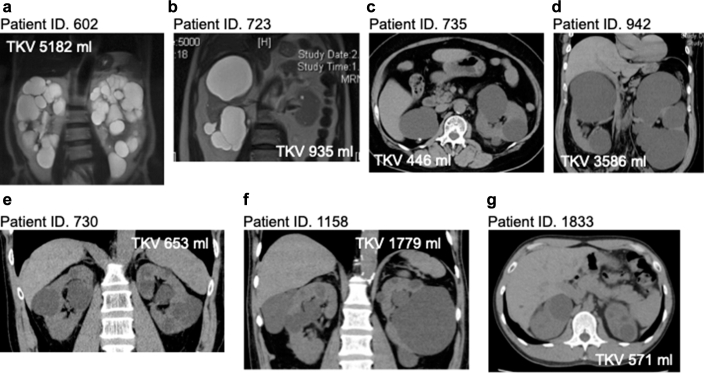
Computed tomography or magnetic resonance images of the kidneys in patients with pathogenic variants in IFT140. The TKV varied among these patients. Regarding kidney cysts, each cyst was larger than typical ADPKD, with some cases being asymmetrical. (a) Patient ID.602. (b) Patient ID. 723. (c) Patient ID.735. (d) Patient ID. 942. (e) Patient ID.730. (f) Patient ID. 1158. (g) Patient ID. 1833. ADPKD, autosomal dominant polycystic kidney disease; TKV, total kidney volume.
Figure 3
Figure 3
Distribution of age, eGFR, and TKV in patients with pathogenic variants in the IFT140, PKD1, or PKD2 gene. Using the ANCOVA model, patients with pathogenic variants in the IFT140 gene had a significantly higher eGFR and a smaller logarithmized TKV than those with pathogenic variants in the PKD1 gene (P = 0.01 and 0.03, respectively). The shading indicates the 95% confidence intervals. (a) Scatter plot of age and eGFR. The regression equation obtained from a simple regression analysis was y = 112−0.903x for the IFT140 group, y = 93.6−1.08x for the PKD1 group, and y = 168−2.05x for the PKD2 group. (b) Scatter plot of age and TKV. The regression equation obtained from a simple regression analysis was y = 2.07−0.018x for the IFT140 group, y = 3.02−0.00527x for the PKD1 group, and y = 2.4−0.0102x for the PKD2 group. ANCOVA, analysis of covariance; eGFR, estimated glomerular filtration rate; TKV, total kidney volume.

References

    1. Torres V.E., Harris P.C. Autosomal dominant polycystic kidney disease: the last 3 years. Kidney Int. 2009;76:149–168. doi: 10.1038/ki.2009.128. - DOI - PMC - PubMed
    1. Lanktree M.B., Haghighi A., Guiard E., et al. Prevalence estimates of polycystic kidney and liver disease by population sequencing. J Am Soc Nephrol. 2018;29:2593–2600. doi: 10.1681/ASN.2018050493. - DOI - PMC - PubMed
    1. Grantham J.J., Mulamalla S., Swenson-Fields K.I. Why kidneys fail in autosomal dominant polycystic kidney disease. Nat Rev Nephrol. 2011;7:556–566. doi: 10.1038/nrneph.2011.109. - DOI - PubMed
    1. Cornec-Le Gall E., Torres V.E., Harris P.C. Genetic complexity of autosomal dominant polycystic kidney and liver diseases. J Am Soc Nephrol. 2018;29:13–23. doi: 10.1681/ASN.2017050483. - DOI - PMC - PubMed
    1. Izzi C., Dordoni C., Delbarba E., et al. Lessons from the clinic: ADPKD genetic test unraveling severe phenotype, intrafamilial variability, and new, rare causing genotype. Kidney Int Rep. 2022;7:895–898. doi: 10.1016/j.ekir.2021.12.027. - DOI - PMC - PubMed

LinkOut - more resources