


Tear film parameters and meibography in eyes of children with vernal keratoconjunctivitis
- PMID: 39291432
- PMCID: PMC11831951
- DOI: 10.4103/IJO.IJO_24_24
Tear film parameters and meibography in eyes of children with vernal keratoconjunctivitis
Abstract
Purpose: To study tear film parameters and Meibomian glands in pediatric patients with vernal keratoconjunctivitis (VKC).
Methods: Forty-four eyes of 22 patients with VKC and 44 eyes of 22 age-matched controls were studied in a hospital-based cross-sectional study. Each subject underwent a complete ophthalmological examination including slit-lamp biomicroscopy, non-invasive break-up time (NIBUT), fluorescein break-up time (FBUT), corneal fluorescein staining, and Schirmer's test. Non-contact meibography was performed using a Sirius topographer.
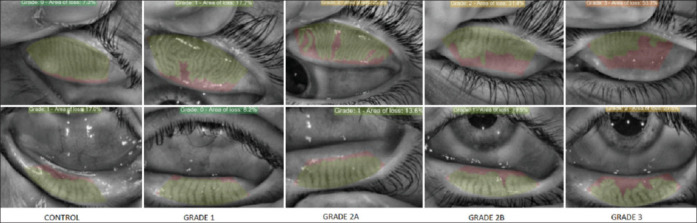
Results: All patients had VKC grades between 1 and 3 (Bonini scale). The mean NIBUT for cases was 8.83 ± 4.02 s and in controls, it was 15 ± 2.8 s ( P value < 0.001). The mean FBUT for cases was 9.41 ± 3.45 s and in controls, it was 16.7 ± 2.5 s ( P value < 0.001). Schirmer's values were 32 ± 3.1 mm in cases and 21.4 ± 4.1 mm in controls, which were significantly higher ( P value < 0.001). Also, 22.72% of the cases had corneal fluorescein staining in the form of superficial punctuate keratitis, whereas none of the control groups showed corneal staining. The examination of Meibomian glands using non-contact meibography showed a mean Meibomian gland dropout in the upper lid to be 29.7 ± 14.4% in VKC cases and 10.5 ± 3.2% in controls ( P value < 0.001). Meibography of the lower lid showed 25.9 ± 10.2% dropout in cases and 20.5 ± 6.1% in controls ( P value = 0.004).
Conclusion: Tear film parameters were significantly deranged in children with VKC in the active stage as compared to age-matched controls. Children with VKC also had a higher Meibomian gland dropout.
Copyright © 2024 Indian Journal of Ophthalmology.
Conflict of interest statement
There are no conflicts of interest.
Figures

References
-
- Kumar S. Vernal keratoconjunctivitis: A major review. Acta Ophthalmol. 2009;87:133–47. - PubMed
-
- Singhal D, Sahay P, Maharana PK, Raj N, Sharma N, Titiyal JS. Vernal keratoconjunctivitis. Surv Ophthalmol. 2019;64:289–311. - PubMed
-
- Villani E, Rabbiolo G, Nucci P. Ocular allergy as a risk factor for dry eye in adults and children. Curr Opin Allergy Clin Immunol. 2018;18:398–403. - PubMed
-
- Sabu S, Gupta N, Raj N, Panigrahi A, Lomi N, Vanathi M, et al. Ocular surface characteristics in pediatric vernal keratoconjunctivitis: A clinico-cytological study. J AAPOS. 2022;26:240–e1. - PubMed
-
- Arita R, Itoh K, Maeda S, Maeda K, Furuta A, Tomidokoro A, et al. Meibomian gland duct distortion in patients with perennial allergic conjunctivitis. Cornea. 2010;29:858–60. - PubMed
MeSH terms
LinkOut - more resources
Full Text Sources
Medical
