. 2024 Jan-Dec;16(1):2397058.
doi: 10.1080/19490976.2024.2397058. Epub 2024 Sep 18.

Gut microbiota-derived butyrate selectively interferes with growth of carbapenem-resistant Escherichia coli based on their resistance mechanism

Affiliations

Gut microbiota-derived butyrate selectively interferes with growth of carbapenem-resistant Escherichia coli based on their resistance mechanism

Eva Happ et al. Gut Microbes. 2024 Jan-Dec.

Abstract

We investigated consequences of resistance acquisition in Escherichia coli clinical isolates during anaerobic (continuous culture) growth and examined their sensitivity to butyrate, a hallmark metabolite of healthy gut microbiota. Strains were stratified based on carrying either a carbapenemase (CARB) or displaying porin malfunctioning (POR). POR displayed markedly altered growth efficiencies, lower membrane stability and increased sensitivity to butyrate compared with CARB. Major differences in global gene expression between the two groups during anaerobic growth were revealed involving increased expression of alternative substrate influx routes, the stringent response and iron acquisition together with lower expression of various stress response systems in POR. Longitudinal analyses during butyrate wash-in showed common responses for all strains as well as specific features of POR that displayed strong initial "overshoot" reactions affecting various stress responses that balanced out over time. Results were partly reproduced in a mutant strain verifying porin deficiencies as the major underlying mechanism for results observed in clinical isolates. Furthermore, direct competition experiments confirmed butyrate as key for amplifying fitness disadvantages based on porin malfunctioning. Results provide new (molecular) insights into ecological consequences of resistance acquisition and can assist in developing measures to prevent colonization and infection based on the underlying resistance mechanism.

Keywords: Antibiotic resistance; Escherichia coli; anaerobic cultivation; bacterial physiology; butyrate; gene expression; gut microbiota.


Conflict of interest statement

No potential conflict of interest was reported by the author(s).

Figures
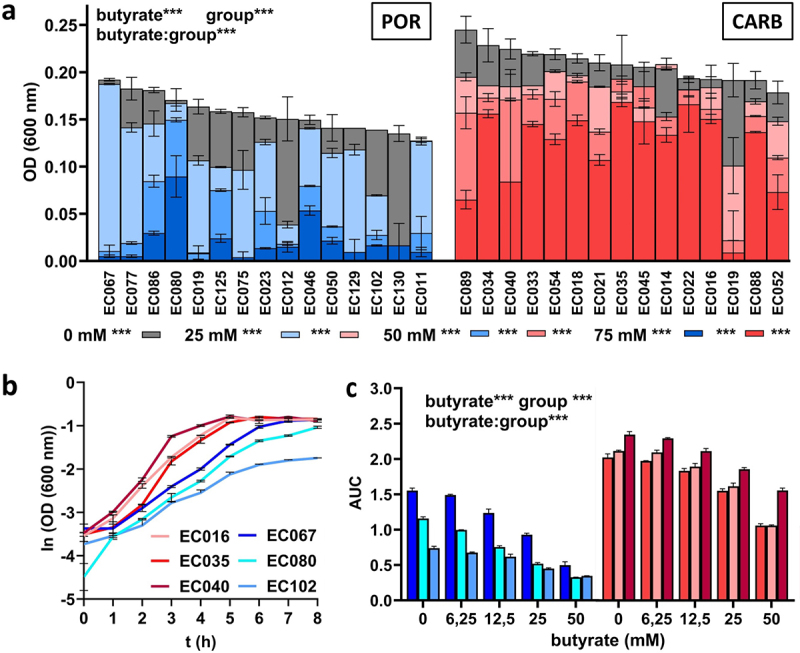
Figure 1.
Figure 1.
Batch growth of POR (blue) and CARB (red) strains at different concentrations of butyrate (0 mM, 25 mM, 50 mM and 75 mM) under anaerobic conditions. Final growth (OD 600) after 48 h (n = 15 strains for each group) are shown in panel a, whereas growth curves of three selected POR and CARB strains at 0 mM butyrate are given in panel b. The influence of butyrate on growth dynamics based on the area under the curve (AUC) calculations from growth curves for the selected strains is given in panel c. All individual growth curves are given in Figure S3. The mean of replicate samples (n = 2) is given, where error bars display standard deviations. Statistical calculations are based on two-way ANOVA analyses with Tukey’s HSD post-hoc testing, where “butyrate” refers to the effect of butyrate, “group” describes the effect of the resistance mechanism and “butyrate:group” gives their interaction. *, **, ***; p < .05, p < .01, p < .001. Statistics of post-hoc testing in panel a are given as follows: results right of the butyrate concentration signify difference between groups, whereas comparisons of each concentration to 0 mM butyrate within each group is given next to color-coded boxes.
Figure 2.
Figure 2.
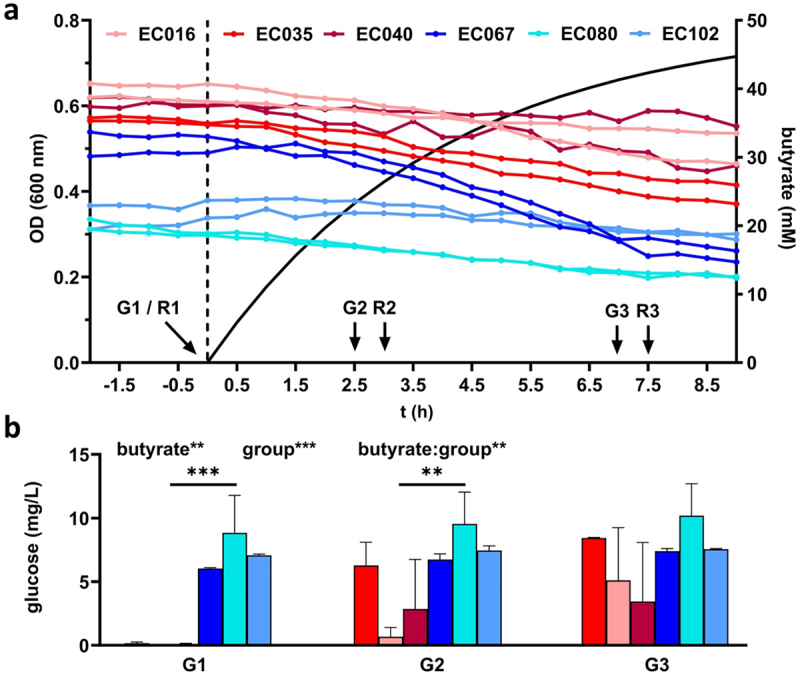
Continuous culture growth of three POR (blue) and three CARB (red) strains under anaerobic conditions. Panel a gives the optical density of cultures in steady state and during butyrate wash-in (separated by the dashed line; calculated butyrate concentration is shown as solid black line). Sampling points for RNASeq (R1-R3) and glucose measurements (G1-G3) are indicated. The amount of residual glucose concentrations in reactors is displayed in panel b (the mean and standard deviation are given based on replicate (n = 2) measurements for each culture). Statistical calculations are based on two-way ANOVA analyses with Tukey’s HSD post-hoc testing, where “butyrate” refers to the effect of butyrate, “group” describes the effect of the resistance mechanism and “butyrate:group” gives their interaction. *, **, ***; p < .05, p < .01, p < .001.
Figure 3.
Figure 3.
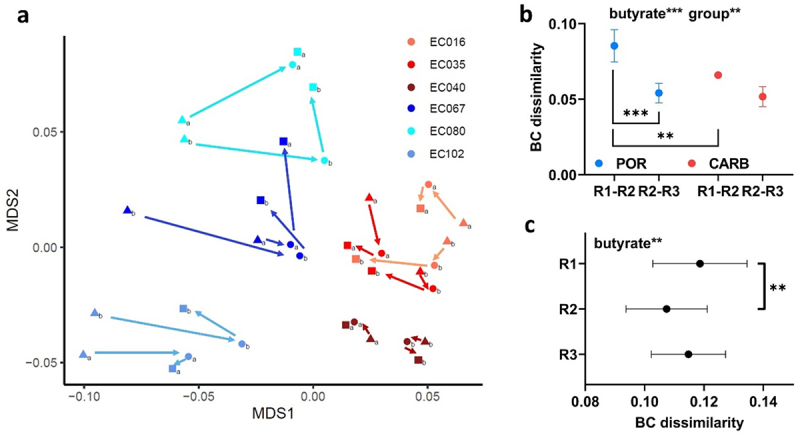
Gene-expression analysis of POR (blue) and CARB (red) strains during anaerobic continuous culture growth in steady state and during butyrate wash-in (two time-points). In panel a ordination analysis based on metric multidimensional scaling (MDS) analysis and Bray Curtis (BC) dissimilarity is given; results for steady state (0 mM butyrate; triangle; R1) and at butyrate concentrations of 25 mM (dot; R2) and 43 mM (square; R3), respectively, are displayed. BC dissimilarities between R1 and R2 and for R2 to R3 within strains of the two groups are shown in panel b, whereas dissimilarities between POR and CARB strains of the three time-points are given in panel c. The mean and standard deviation are shown. Statistical calculations are based on two-way ANOVA analyses with Tukey’s HSD post-hoc testing where “butyrate” refers to the effect of butyrate and “group” describes the effect of the resistance mechanism. *, **, ***; p < .05, p < .01, p < .001.
Figure 4.
Figure 4.
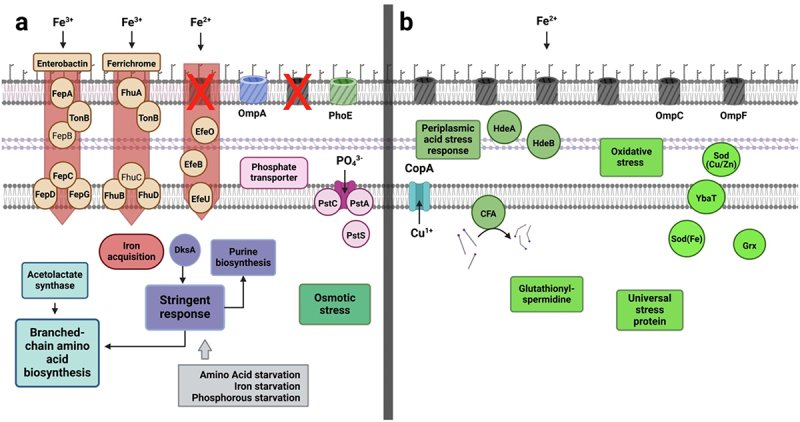
Mechanistic model based on significantly differentially expressed genes and RAST subsystems in POR and CARB during steady state growth (0 mM butyrate). On the left (panel a) features higher expressed in POR are shown, whereas those expressed at higher levels in CARB are shown on the right (panel b). Genes encoding unspecific porins of the outer membrane along with several iron uptake systems, the stringent response and synthesis of branched chain amino acids as well as the osmotic stress response were main features higher expressed in POR, whereas several other stress response systems and a copper stress sensing protein showed higher levels in CARB. Cycloproprane-fatty acyl phospholipid synthase (cfa) is displayed with its main function to catalyze integration of cyclopropane ring in membrane fatty acids. RAST subsystems are given as boxes (except for iron acquisition belonging to a RAST category) and single proteins are shown as circles. FepB and FhuC (standard font) were not significantly differentially expressed and are shown for comprehensive reasons. For detailed explanations see the text and Tables S3 and S4(a).
Figure 5.
Figure 5.
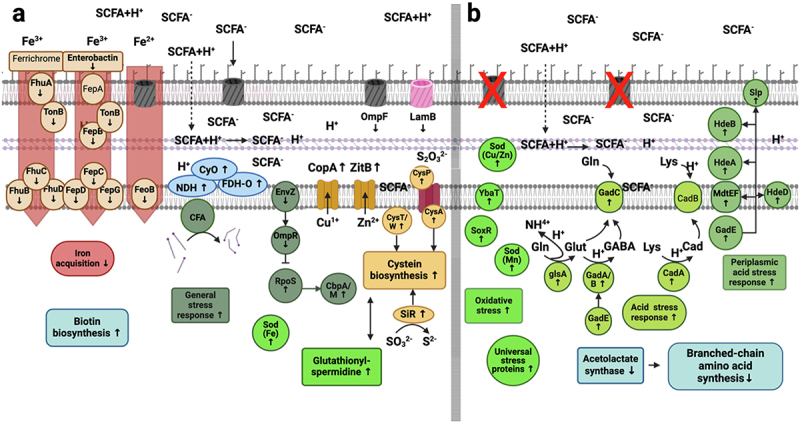
Mechanistic model of significantly differentially regulated genes and RAST subsystems during butyrate challenge in comparison to steady state (up-/down regulation is indicated by arrows). Regulated features common to both groups (POR+CARB) are shown on the left (a), whereas features specific for POR are displayed on the right (b). Common responses comprised a downregulation of lamB and ompF genes associated with iron uptake, whereas the general stress response, genes encoding enzymes involved in cysteine and biotin synthesis as well as those encoding specific metal transporters were upregulated. Strains of the POR group additionally increased expression of several stress response genes primarily connected to acid stress response, whereas those involved in branched-chain amino acid synthesis were downregulated. RAST subsystems are given as boxes (except for iron acquisition that represents a RAST category; acid and general stress responses are not specifically annotated in RAST and were manually categorized), single proteins are shown as circles. Effects of deprotonated butyrate (SCFA), which can enter the periplasm through porins and intercalate in the inner membrane, as well as its protonated form (SCFA+H+), which can cause acidic stress in the periplasm by diffusion through the outer membrane subsequently releasing protons, are indicated. Cycloproprane-fatty acyl phospholipid synthase (cfa) is displayed with its main function to catalyze integration of cyclopropane ring in membrane fatty acids. The siderophore ferrichrome, FepA and CadB (standard font) are shown for completeness, despite not being significantly regulated in either group. For detailed explanation see the text and Tables S4(b, c) and S5.
Figure 6.
Figure 6.
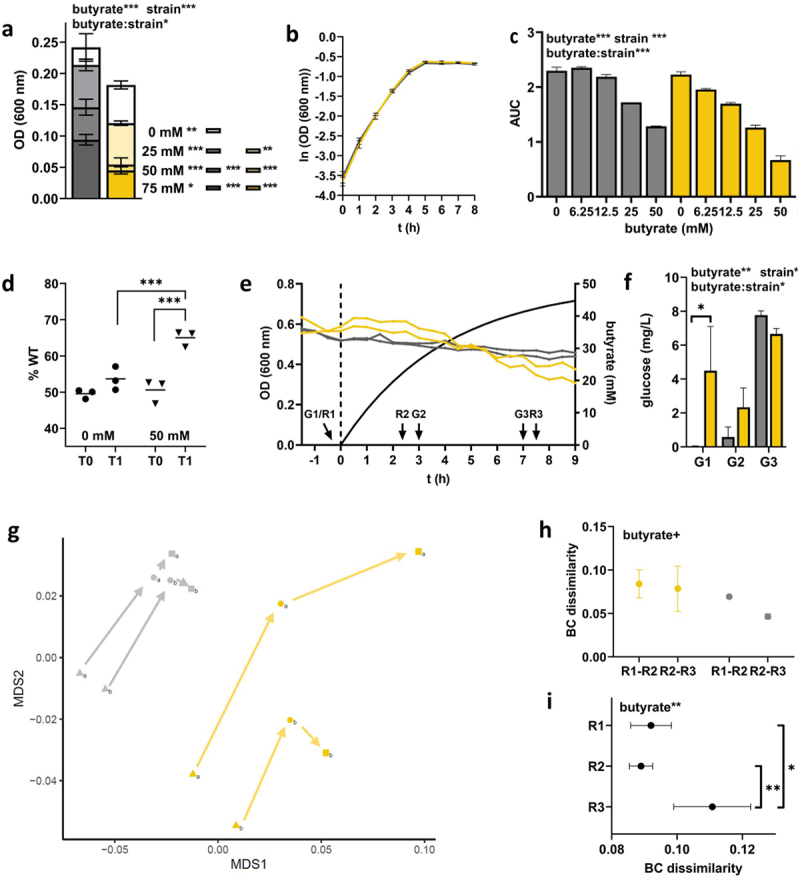
Investigating the growth physiology under anaerobic conditions and responses to butyrate of gut-derived E. coli ATCC 8739 (wt; gray) and its ∆ompC/∆ompF double mutant (mt, yellow). Final batch growth after 48 h (OD 600) at different concentrations of butyrate (0, 25, 50, and 75 mM) is shown in panel a, whereas growth curves at 0 mM butyrate are given in panel b. The influence of butyrate on growth dynamics based on the area under the curve (AUC) calculations from growth curves is displayed in panel c. The mean of replicate samples (n = 2) is given, where error bars display standard deviations. Relative abundance of wt (% wt) before (T0) and after (T1, stationary phase) competitive growth between the two strains in batch culture (without (•) and with(▾) butyrate) is displayed in panel d. Results from anaerobic continuous culture experiments in steady-state and during butyrate wash-in is shown in panel e (separated by the dashed line; calculated butyrate concentration is shown as solid black line), whereas the amount of residual glucose concentrations in reactors is displayed in panel f. Global gene-expression analysis of the two strains presented by ordination analysis based on metric multidimensional scaling (MDS) analysis and Bray Curtis dissimilarities (BCdis) is shown in panel g. Results for steady state (0 mM butyrate; triangle; R1) and at butyrate concentrations of 25 mM (dot; R2) and 43 mM (square; R3), respectively, are given. In panel h, BCdis between R1 and R2 and R2 and R3 within strains of the two groups are shown, whereas BCdis between wt and mt at the three time points are given in panel i. Statistical calculations are based on two-way ANOVA analyses with Tukey’s HSD post-hoc testing, where “butyrate” refers to the effect of butyrate, “strain” describes the effect of the double mutation and “butyrate:strain” gives their interaction. +, *, **, ***; p < .1, p < .05, p < .01, p < .001.
Figure 7.
Figure 7.
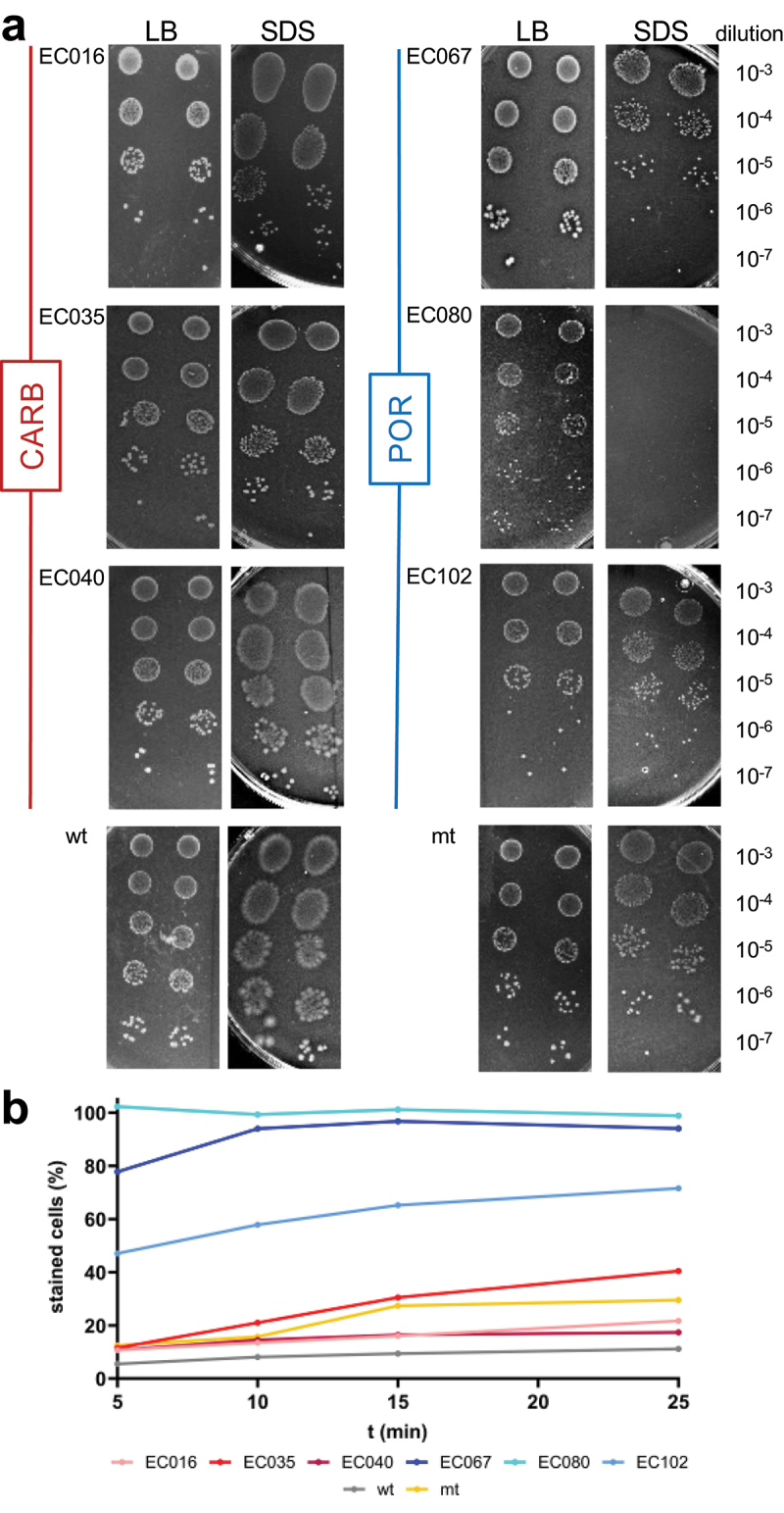
Investigating outer membrane stability of strains. Panel a shows growth on LB agar plates (LB) compared with growth on plates additionally containing 2% of the envelope stressor sodium dodecyl sulfate (SDS); 5 μL of 10−3 −10−7 dilutions of overnight cultures were spotted in replicates (n = 2) on plates and incubated at 37°C under anaerobic conditions. Below (panel b) displays results challenging strains with SDS (0.025%) followed by recording the percentage of SYTOX green positive cells by flow cytometry.

References

    1. Murray CJL, Ikuta KS, Sharara F, Swetschinski L, Robles Aguilar G, Gray A, Han C, Bisignano C, Rao P, Wool E, et al. Global burden of bacterial antimicrobial resistance in 2019: a systematic analysis. Lancet [Internet]. 2022;399(10325):629–21. http://www.ncbi.nlm.nih.gov/pubmed/35065702. - PMC - PubMed
    1. World Health Organization . Global antimicrobial resistance and use surveillance system (‎GLASS)‎ report: 2021. 2021.
    1. Ma J, Song X, Li M, Yu Z, Cheng W, Yu Z, Zhang W, Zhang Y, Shen A, Sun H, et al. Global spread of carbapenem-resistant enterobacteriaceae: epidemiological features, resistance mechanisms, detection and therapy. Microbiol Res [Internet]. 2023;266:127249. http://www.ncbi.nlm.nih.gov/pubmed/36356348. - PubMed
    1. Sader HS, Castanheira M, Kimbrough JH, Kantro V, Mendes RE.. Aztreonam/Avibactam activity against a large collection of carbapenem-resistant enterobacterales (CRE) collected in hospitals from Europe, Asia and Latin America (2019–21). JAC Antimicrob Resist [Internet]. 2023;5(2):dlad032. http://www.ncbi.nlm.nih.gov/pubmed/36968952. - PMC - PubMed
    1. Yuan W, Xu J, Guo L, Chen Y, Gu J, Zhang H, Yang C, Yang Q, Deng S, Zhang L, et al. Clinical risk factors and microbiological and intestinal characteristics of carbapenemase-producing enterobacteriaceae colonization and subsequent infection. Microbiol Spectr [Internet]. 2022;10(6):e0190621. http://www.ncbi.nlm.nih.gov/pubmed/36445086 10.1128/spectrum.01906-21. - DOI - PMC - PubMed

MeSH terms

LinkOut - more resources