177Lu-PSMA-617 versus a change of androgen receptor pathway inhibitor therapy for taxane-naive patients with progressive metastatic castration-resistant prostate cancer (PSMAfore): a phase 3, randomised, controlled trial
- PMID: 39293462
- PMCID: PMC12121614
- DOI: 10.1016/S0140-6736(24)01653-2
177Lu-PSMA-617 versus a change of androgen receptor pathway inhibitor therapy for taxane-naive patients with progressive metastatic castration-resistant prostate cancer (PSMAfore): a phase 3, randomised, controlled trial
Erratum in
-
Department of Error.Lancet. 2025 Dec 21;404(10471):2542. doi: 10.1016/S0140-6736(24)02716-8. Lancet. 2025. PMID: 39709208 Free PMC article. No abstract available.
Abstract
Background: [177Lu]Lu-PSMA-617 (177Lu-PSMA-617) prolongs radiographic progression-free survival and overall survival in patients with metastatic castration-resistant prostate cancer previously treated with androgen receptor pathway inhibitor (ARPI) and taxane therapy. We aimed to investigate the efficacy of 177Lu-PSMA-617 in patients with taxane-naive metastatic castration-resistant prostate cancer.
Methods: In this phase 3, randomised, controlled trial conducted at 74 sites across Europe and North America, taxane-naive patients with prostate-specific membrane antigen (PSMA)-positive metastatic castration-resistant prostate cancer who had progressed once on a previous ARPI were randomly allocated (1:1) to open-label, intravenous 177Lu-PSMA-617 at a dosage of 7·4 GBq (200 mCi) ± 10% once every 6 weeks for six cycles, or a change of ARPI (to abiraterone or enzalutamide, administered orally on a continuous basis per product labelling). Crossover from ARPI change to 177Lu-PSMA-617 was allowed after centrally confirmed radiographic progression. The primary endpoint was radiographic progression-free survival, defined as the time from randomisation until radiographic progression or death, assessed in the intention-to-treat population. Safety was a secondary endpoint. This study is registered with ClinicalTrials.gov (NCT04689828) and is ongoing. In this primary report of the study, we present primary (first data cutoff) and updated (third data cutoff) analyses of radiographic progression-free survival; all other data are based on the third data cutoff.
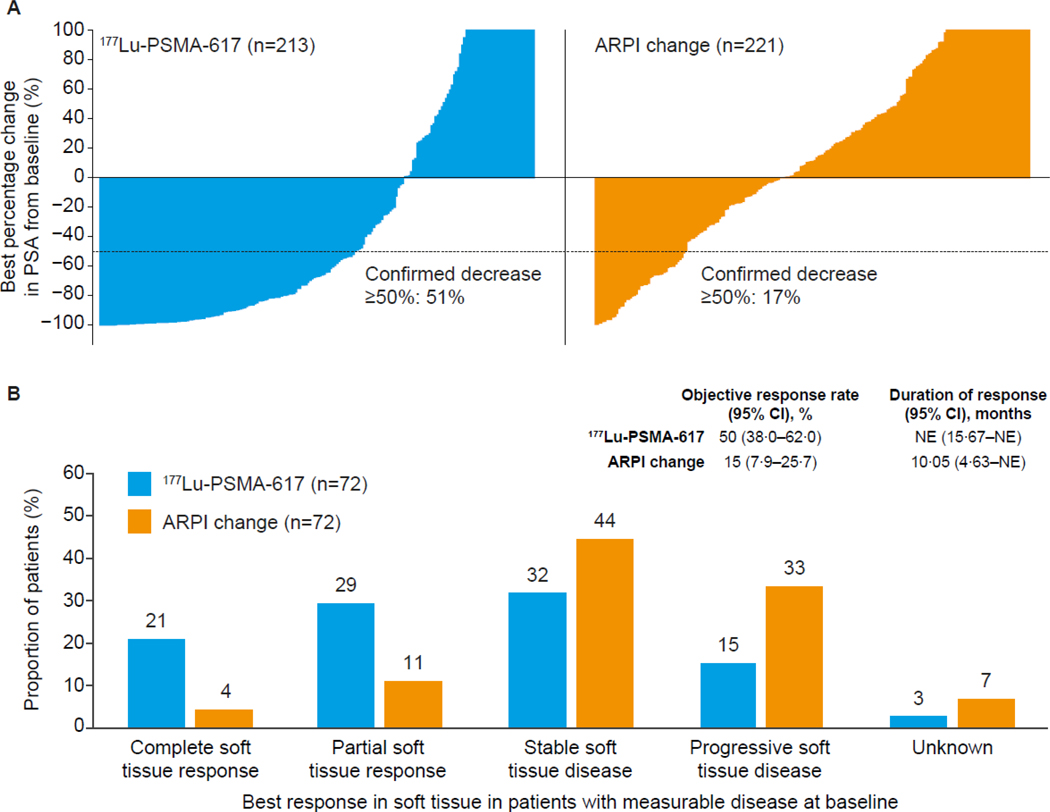
Findings: Overall, of the 585 patients screened, 468 met all eligibility criteria and were randomly allocated between June 15, 2021 and Oct 7, 2022 to receive 177Lu-PSMA-617 (234 [50%] patients) or ARPI change (234 [50%]). Baseline characteristics were mostly similar between groups; median number of 177Lu-PSMA-617 cycles was 6·0 (IQR 4·0-6·0). Of patients assigned to ARPI change, 134 (57%) crossed over to receive 177Lu-PSMA-617. In the primary analysis (median time from randomisation to first data cutoff 7·26 months [IQR 3·38-10·55]), the median radiographic progression-free survival was 9·30 months (95% CI 6·77-not estimable) in the 177Lu-PSMA-617 group versus 5·55 months (4·04-5·95) in the ARPI change group (hazard ratio [HR] 0·41 [95% CI 0·29-0·56]; p<0·0001). In the updated analysis at time of the third data cutoff (median time from randomisation to third data cutoff 24·11 months [IQR 20·24-27·40]), median radiographic progression-free survival was 11·60 months (95% CI 9·30-14·19) in the 177Lu-PSMA-617 group versus 5·59 months (4·21-5·95) in the ARPI change group (HR 0·49 [95% CI 0·39-0·61]). The incidence of grade 3-5 adverse events was lower in the 177Lu-PSMA-617 group (at least one event in 81 [36%] of 227 patients; four [2%] grade 5 [none treatment related]) than the ARPI change group (112 [48%] of 232; five [2%] grade 5 [one treatment related]).
Interpretation: 177Lu-PSMA-617 prolonged radiographic progression-free survival relative to ARPI change, with a favourable safety profile. For patients with PSMA-positive metastatic castration-resistant prostate cancer who are being considered for a change of ARPI after progression on a previous ARPI, 177Lu-PSMA-617 may be an effective treatment alternative.
Funding: Novartis.
Copyright © 2024 Elsevier Ltd. All rights reserved, including those for text and data mining, AI training, and similar technologies.
Conflict of interest statement
Declaration of interests MJM declares receiving consulting or advisory fees from Amgen, AstraZeneca, Blue Earth Diagnostics, Clarity Pharmaceuticals, Convergent Therapeutics, Daiichi, ITM Isotope Technologies Munich, Lantheus Medical Imaging, Pfizer, POINT Biopharma, Progenics, Telix Pharmaceuticals, and Z-Alpha; stock and other ownership in Doximity; travel, accommodations, and expenses from APCCC, AstraZeneca, and Memorial Sloan-Kettering Cancer Center; institutional research funding from Astellas Pharma, Bayer, Celgene, Corcept Therapeutics, Janssen, Novartis, Progenics, and Roche/Genentech; patents pending with Novartis; and royalties from Telix. DC declares receiving payment or honorarium from Astellas, AstraZeneca, Bayer, Bristol Myers Squibb, Clovis, Eisai, Exelisis, GlaxoSmithKline, Ipsen, Janssen, Lilly, MSD, Pfizer, QED Therapeutics, and Roche; travel or other expenses from Astellas, AstraZeneca, Bristol Myers Squibb, GlaxoSmithKline, Ipsen, Janssen, MSD, Novartis, Pfizer, and Roche; participation on a data safety monitoring or advisory board for Astellas, AstraZeneca, Bristol Myers Squibb, GlaxoSmithKline, Ipsen, Janssen, MSD, Novartis, Pfizer, and Roche; and other financial or non-financial interests in Spanish Oncology Genito-Urinary Group Foundation and GUARD Consortium Spanish group. KH declares receiving grants or contracts from Boston Scientific, Janssen, and Novartis; consulting fees from Amgen, AstraZeneca, Bain Capital, Bayer, Boston Scientific, Convergent, Curium, Debiopharm, EcoR1, Fusion, GE Healthcare, Immedica, Isotopen Technologien München, Janssen, Merck, Molecular Partners, Novartis, NVision, POINT Biopharma, Pfizer, Radiopharm Theranostics, Rhine Pharma, Siemens Healthineers, Sofie Biosciences, Telix, Theragnostics, and Y-mAbs Therapeutics; and stock or other ownership in AdvanCell, Aktis Oncology, Convergent, NVision, Pharma 15, and Sofie Biosciences. JSdB declares receiving grants or contracts from Amgen, Astellas, AstraZeneca, Bayer, Bioxcel Therapeutics, Crescendo, Daiichi-Sankyo, Endocyte, Genentech/Roche, GlaxoSmithKline, ImCheck Therapeutics, Janssen, Merck Serono, Merck Sharp & Dohme, Novartis, Pfizer, and Sanofi Aventis; consulting or advisory fees from Astellas, AstraZeneca, Bayer, Daiichi-Sankyo, Genentech/Roche, GlaxoSmithKline, Janssen, Merck Serono, Merck Sharp & Dohme, Orion, Pfizer, Sanofi Aventis, and Taiho; payment or honorarium from Astellas, AstraZeneca, Bayer, Cellcentric, Crecendo, Daiichi, Genentech, Genmab, GlaxoSmithKline, Janssen, Merck Serono, Mycrix, MSD, Orion, Pfizer, Sanofi Aventis, and Taiho; being an inventor on patent 8822438 for a method for treating cancer; participating on a data safety monitoring or advisory board for Amgen, AstraZeneca, Bayer, Bioxcel Therapeutics, Crescendo, Daiichi-Sankyo, Endocyte, Genentech/Roche, GlaxoSmithKline, ImCheck Therapeutics, Janssen, Merck Serono, Merck Sharp & Dohme, Novartis, Oncternal, Pfizer, and Sanofi Aventis; and receiving institutional royalties or licences related to abiraterone, PARP inhibitor, and PI3K/AKT. NDS declares receiving support for the present manuscript from Novartis; consulting fees from AbbVie, Accord, Amgen, Antev, Arquer, Asieris, Astellas, AstraZeneca, Aura Biosciences, Bayer, Bioprotect, Bristol Myers Squibb, Clarity, Cold Genesys, Curium, Dendreon, Exact Imaging, Ferring, Fize Medical, Invitae, Janssen, Lantheus, Lilly, MDXHealth, Merck, Minomic, Myriad, Novartis, PlatformQ, Pfizer, POINT Biopharma, Preview, Promaxo, Propella, Protara, Sanofi Genzyme, Siemens, Speciality Networks, Sumitomo, Telix, Tolmar, and Urogen; having a leadership or fiduciary role for Photocure, and Alessa; and having stock or stock options with Photocure, and Alessa. KNC declares receiving grants or contracts from AstraZeneca, Bayer, Janssen, Merck, Novartis, Pfizer, POINT Biopharma, and Roche; and consulting fees from Astellas, AstraZeneca, Bayer, Janssen, Merck, Novartis, Pfizer, POINT Biopharma, and Roche. MC declares receiving support for the present manuscript from Novartis; consulting fees from Astellas, AstraZeneca, Blue Earth Diagnostics, Boston Scientific, Elekta, Johnson & Johnson, Lantheus, Macrogenics, Pfizer, Profound Medical, Sumitomo, Telix, Tolmar, and Tempus; payment or honorarium from Johnson & Johnson, Pfizer, Profound Medical, and Telix; participating on an advisory board for Telix; and having a leadership or fiduciary role for the Society of Nuclear Medical and Molecular Imaging, and the American Urological Association. JMP declares receiving grants or contracts from BeiGene, Bristol Myers Squibb, Immunocore, Mirati, MSD, and Pfizer; consulting fees from Astellas, AstraZeneca, BeiGene, Bristol Myers Squibb, Clovis, Ideaya, Immunocore, Janssen, MSD, Novartis, and Pfizer; and travel expenses from AstraZeneca, Janssen, and Pfizer. AF declares receiving payment or honorarium from Astellas, AstraZeneca, Bayer, Bristol Myers Squibb, Janssen, Merck, MSD, Novartis, and Pfizer; and travel expenses from Astellas, AstraZeneca, Bayer, Bristol Myers Squibb, Janssen, Merck, SD, Novartis, and Pfizer. XXW declares receiving institutional grants or contracts from Bristol Myers Squibb; consulting fees from Dendreon and Novartis; honorarium from Novartis; travel or other expenses from Novartis; and participating on a data safety monitoring or advisory board for Dendreon and Novartis. HM declares receiving payment or honorarium from Astellas, AstraZeneca, Bayer, Bristol Myers Squibb, Ipsen, Janssen, Merck, MSD, Novartis and Pfizer; travel or other expenses from AstraZeneca, Novartis, Pfizer, Roche; and acting on a scientific steering committee for Curium. GR declares receiving grants or contracts from Bayer; and consulting fees from Astellas, AstraZeneca, Bayer, Janssen, MSD, Novartis, and Pfizer. HŠ declares receiving consulting fees from Astellas, Bayer, Janssen, Novartis, and Pfizer. JN declares receiving contracts or grants from ABX, and Novartis; consulting fees from Curium, and POINT Biopharma; and payment or honorarium from Bayer AG, and Pfizer. BM declares receiving grants or contracts from Astellas, Bayer, Janssen, Roche, and Sanofi; payment or honorarium from Astellas, Bayer, Bristol Myers Squibb, Ipsen, Janssen, Pfizer, Roche, and Sanofi; travel or other expenses from Ipsen, Janssen Pfizer, and Roche; and other financial or non-financial interests in Astellas, Bayer, Bristol Myers Squibb, Ipsen, Janssen, Pfizer, Roche, and Sanofi. ÁM-P declares receiving personal fees from Astellas, AstraZeneca, Bayer, Bristol Myers Squibb, Ipsen, Janssen, Merck, MSD, Novartis, and Pfizer; and non-financial support from Bayer, Ipsen, Merck, and Pfizer. EK, SG, TNK, CW, and KL declare being employed by and receiving restricted stock options from Novartis. OS declares receiving support for the present manuscript from Novartis; institutional grants or contracts from Amgen, AstraZeneca, Bayer, Endocyte, Invitae, Janssen, Lantheus, Merck, Novartis, Progenics, and Tenebio; consulting fees from ARTBIO, AstraZeneca, Bayer, Blue Earth Diagnostics, Clarity Pharmaceuticals, Fusion, Isotopen Technologien Muenchen, Janssen, Merck, Myovant, Myriad, Noria Therapeutics, NorthStar, Novartis, Pfizer, POINT Biopharma, Sanofi, Telix, and Tenebio; travel and accommodation expenses from Lantheus, NorthStar, and Novartis; participation on a data safety monitoring or advisory board for AstraZeneca, Merck, and Pfizer; and stock or stock options in ARTBIO, Clarity Pharmaceuticals, Convergent, Fusion, Lilly, Pfizer, Ratio, and Telix. KF declares receiving institutional honorarium or payments to Gustave Roussy Institute from Astellas, AstraZeneca, Bayer, Janssen, MSD, Novartis, and Sanofi; institutional participation on data safety monitoring or advisory boards for Amgen, Astellas, AstraZeneca, Bayer, Clovis, Daiichi Sankyo, Janssen, MSD, Novartis, Pfizer, and Sanofi; and personal participation on a data safety monitoring or advisory board for Arvinas, CureVac, Macrogenics, Orion.
Figures


Comment in
-
177Lu-PSMA-617 for metastatic prostate cancer: aiming for the right spot.Lancet. 2024 Sep 28;404(10459):1174-1176. doi: 10.1016/S0140-6736(24)01919-6. Epub 2024 Sep 15. Lancet. 2024. PMID: 39293463 No abstract available.
-
177Lu-PSMA-617 extends progression-free survival in taxane-naive mCRPC.Nat Rev Urol. 2024 Dec;21(12):706. doi: 10.1038/s41585-024-00970-z. Nat Rev Urol. 2024. PMID: 39528752 No abstract available.
References
-
- Sartor O, de Bono JS. Metastatic prostate cancer. N Engl J Med 2018; 378: 645–57. - PubMed
-
- George DJ, Sartor O, Miller K, et al. Treatment patterns and outcomes in patients with metastatic castration-resistant prostate cancer in a real-world clinical practice setting in the United States. Clin Genitourin Cancer 2020; 18: 284–94. - PubMed
-
- Ghantoji S, Yu C, Sawhney A, et al. Real-world treatment patterns in the U.S. and trends pre-post CARD trial among patients with metastatic castration-resistant prostate cancer. J Clin Oncol 2022; 40: e17024.
-
- Shayegan B, Wallis CJD, Malone S, et al. Real-world use of systemic therapies in men with metastatic castration resistant prostate cancer (mCRPC) in Canada. Urol Oncol 2022; 40: 192 e1-e9. - PubMed
Publication types
MeSH terms
Substances
Associated data
Grants and funding
LinkOut - more resources
Full Text Sources
Medical
Miscellaneous