


Global burden of benign prostatic hyperplasia, urinary tract infections, urolithiasis, bladder cancer, kidney cancer, and prostate cancer from 1990 to 2021
- PMID: 39294748
- PMCID: PMC11409598
- DOI: 10.1186/s40779-024-00569-w
Global burden of benign prostatic hyperplasia, urinary tract infections, urolithiasis, bladder cancer, kidney cancer, and prostate cancer from 1990 to 2021
Abstract
Background: The burden of common urologic diseases, including benign prostatic hyperplasia (BPH), urinary tract infections (UTI), urolithiasis, bladder cancer, kidney cancer, and prostate cancer, varies both geographically and within specific regions. It is essential to conduct a comprehensive and precise assessment of the global burden of urologic diseases.
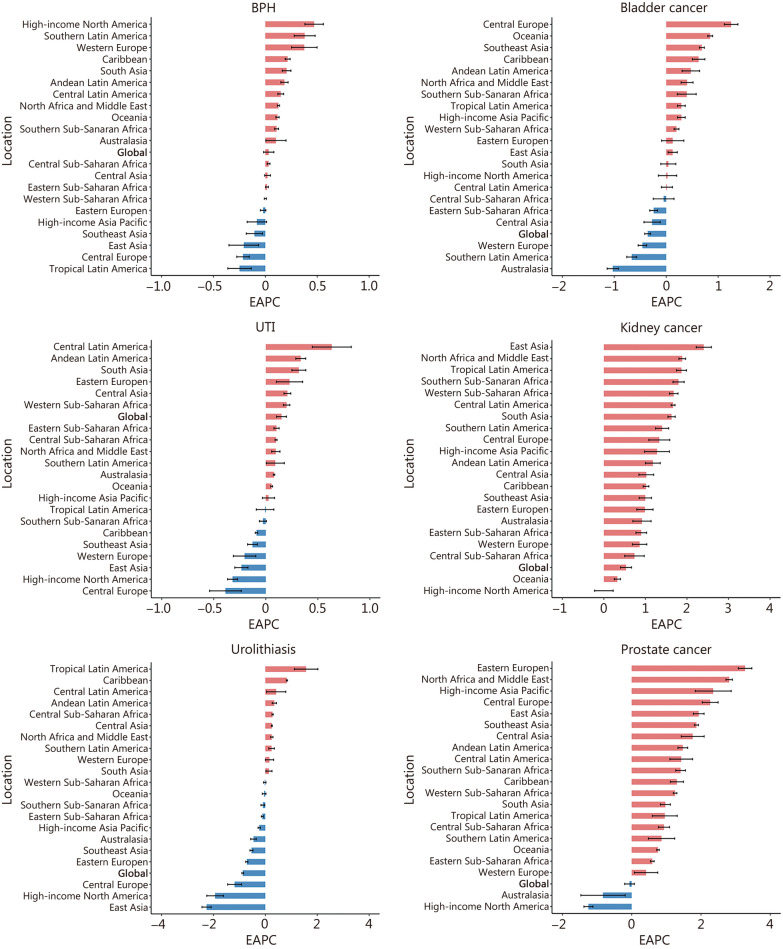
Methods: We obtained data on incidence, prevalence, mortality, and disability-adjusted life-years (DALYs) for the aforementioned urologic diseases by age, sex, location, and year from the Global Burden of Disease (GBD) 2021. We analyzed the burden associated with urologic diseases based on socio-demographic index (SDI) and attributable risk factors. The trends in burden over time were assessed using estimated annual percentage changes (EAPC) along with a 95% confidence interval (CI).
Results: In 2021, BPH and UTI were the leading causes of age-standardized incidence rate (ASIR) and age-standardized prevalence rate (ASPR), with rates of 5531.88 and 2782.59 per 100,000 persons, respectively. Prostate cancer was the leading cause of both age-standardized mortality rate (ASMR) and age-standardized DALYs rate (ASDR), with rates of 12.63 and 217.83 per 100,000 persons, respectively. From 1990 to 2021, there was an upward trend in ASIR, ASPR, ASMR, and ASDR for UTI, while urolithiasis showed a downward trend. The middle and low-middle SDI quintile levels exhibited higher incidence, prevalence, mortality, and DALYs related to UTI, urolithiasis, and BPH, while the high and high-middle SDI quintile levels showed higher rates for the three cancers. The burden of these six urologic diseases displayed diverse age and sex distribution patterns. In 2021, a high body mass index (BMI) contributed to 20.07% of kidney cancer deaths worldwide, while smoking accounted for 26.48% of bladder cancer deaths and 3.00% of prostate cancer deaths.
Conclusions: The global burden of 6 urologic diseases presents a significant public health challenge. Urgent international collaboration is essential to advance the improvement of urologic disease management, encompassing the development of effective diagnostic screening tools and the implementation of high-quality prevention and treatment strategies.
Keywords: Benign prostatic hyperplasia (BPH); Bladder cancer; Burden of disease; Disability-adjusted life-years (DALYs); Kidney cancer; Prostate cancer; Urinary tract infections (UTI); Urolithiasis.
© 2024. The Author(s).
Conflict of interest statement
The authors declare that they have no competing interests.
Figures


References
MeSH terms
Grants and funding
LinkOut - more resources
Full Text Sources
Medical
