


Caffeic acid phenethyl ester attenuates Enterococcus faecalis infection in vivo: antioxidants and NF-κB have a protective role against stomach damage
- PMID: 39296435
- PMCID: PMC11407487
- DOI: 10.25122/jml-2023-0544
Caffeic acid phenethyl ester attenuates Enterococcus faecalis infection in vivo: antioxidants and NF-κB have a protective role against stomach damage
Abstract
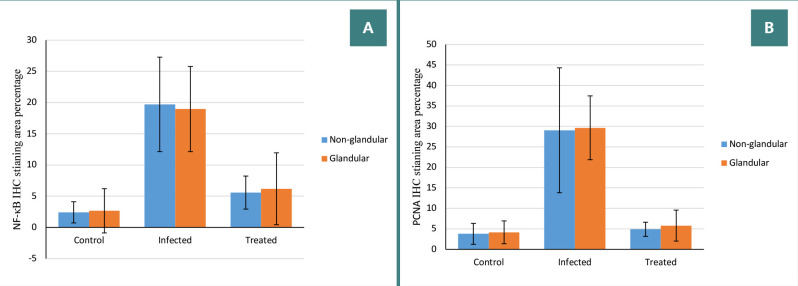
The mammalian gastrointestinal tract hosts a significant microbial symbiont community, an intriguing feature of this complex organ system. This study aimed to investigate the anti-inflammatory, antioxidant, and protective effects of caffeic acid phenethyl ester (CAPE) against Enterococcus faecalis infection in the stomach at a dose of 106 CFU in Swiss mice. A total of 30 mice were randomly assigned to three groups of ten mice each. Group I was the negative control, Group II was infected orally with E. faecalis for 18 days, and Group III was infected with E. faecalis and treated with CAPE orally at a daily dose of 4 mg/kg for 18 days. We assessed the antioxidant activities of stomach homogenate and the immunohistochemical expressions of the transcription factor nuclear factor kappa B (NF-κB) and proliferating cell nuclear antigen (PCNA). Histopathological examination was performed on the stomachs of all mice. Group II had decreased levels of antioxidant activity and positive expressions of NF-κB and PCNA. Histological observations revealed an increase in mucosal and glandular thickness compared with Group I. Group III, treated with CAPE, showed a significant increase in antioxidant activities and a significant decrease in NF-κB and PCNA immunoreactivities compared with Group II. In addition, Group III showed restoration of the normal thickness of the non-glandular and glandular parts of the stomach. Our results revealed that E. faecalis infection has damaging effects on the stomach and proved that CAPE has promising protective, anti-inflammatory, and antioxidant effects against E. faecalis. Further studies may investigate the potential therapeutic effects of CAPE against E. faecalis infection.
Keywords: CAPE; Enterococcus faecalis; NF-κB; PCNA; antioxidant.
© 2024 by the authors.
Conflict of interest statement
The author declares no conflicts of interest.
Figures



References
-
- Grudlewska-Buda K, Skowron K, Bauza-Kaszewska J, Budzyńska A, Wiktorczyk-Kapischke N, Wilk M, et al. Assessment of antibiotic resistance and biofilm formation of Enterococcus species isolated from different pig farm environments in Poland. BMC Microbiol. 2023 Mar 30;23(1):89. doi: 10.1186/s12866-023-02834-9. - DOI - PMC - PubMed
MeSH terms
Substances
LinkOut - more resources
Full Text Sources
Medical
Miscellaneous