


The Impact of Household Dysfunction on Dating Violence Perpetration Among Adolescents in the United States: A Scoping Review
- PMID: 39297448
- PMCID: PMC12145481
- DOI: 10.1177/15248380241277267
The Impact of Household Dysfunction on Dating Violence Perpetration Among Adolescents in the United States: A Scoping Review
Abstract
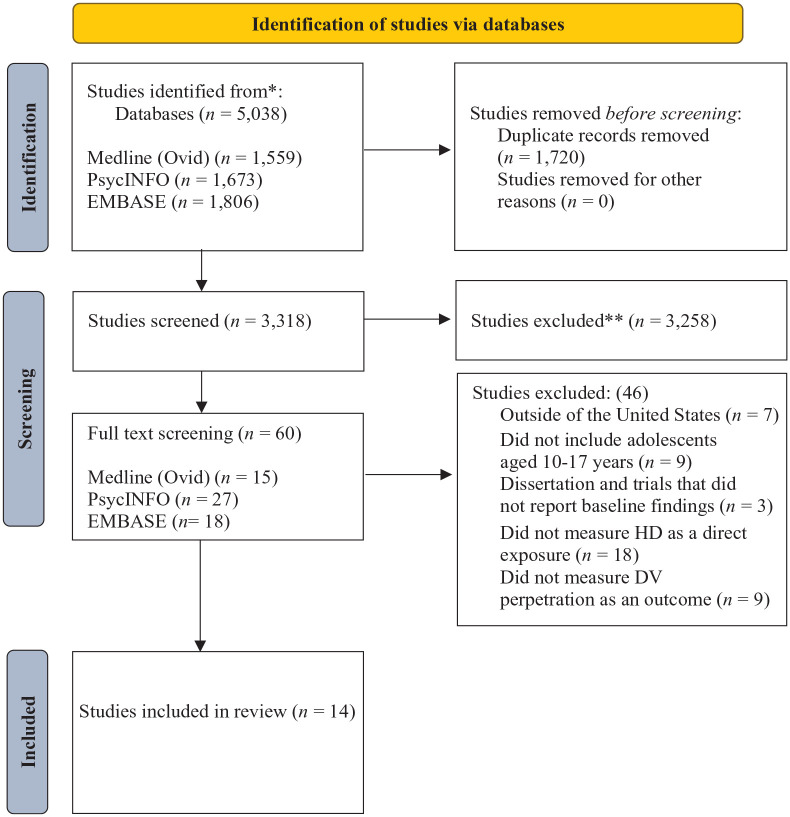
Adverse childhood experiences, such as household dysfunction (HD), play a central role in how adolescents establish, experience, and navigate the challenges of relationship formation, maintenance, and dissolution. HD exposures have been independently associated with dating violence (DV) perpetration in both adolescents and adults. However, research examining the association between the concurrent effect of HD on DV perpetration, especially among adolescents remains scarce. Thus, we conducted a scoping review to accumulate and summarize existing research regarding the impact of HD on DV perpetration among adolescents aged 10 to 17 years in the United States. We used three electronic databases, Medline (Ovid), PsycINFO, and EMBASE, to search for studies published in English between 2013 and August 2023. A total of 14 studies were retained for this review after full-text screening. Most of the included studies (64%) were longitudinal. Concerning HD measurement, 71% of studies evaluated witnessing intimate partner violence (IPV), and the remaining 29% assessed family conflict, both using different instruments. Regarding DV measurement, 43% of studies utilized the Safe Dates Abuse measures to assess various forms of DV perpetration. Findings from 3/4 (75%) studies that evaluated family conflict found it to be a significant predictor of DV perpetration. Additionally, 8/10 (80%) studies that assessed exposure to IPV reported significant associations with various forms of DV perpetration among adolescents. None of the included studies measured HD comprehensively; thus, measurement development is imperative. Findings from this review may help initiate the development of a more comprehensive HD measure, promote early intervention, and foster resilience among adolescents.
Keywords: adolescents; adverse childhood experience; dating violence; family conflict; household dysfunction.
Conflict of interest statement
Declaration of Conflicting InterestsThe author(s) declared no potential conflicts of interest with respect to the research, authorship, and/or publication of this article.
Figures
References
-
- Afifi T. O., Salmon S., Garcés I., Struck S., Fortier J., Taillieu T., Stewart-Tufescu A., Asmundson G. J. G., Sareen J., MacMillan H. L. (2020). Confirmatory factor analysis of adverse childhood experiences (ACEs) among a community-based sample of parents and adolescents. BMC Pediatrics, 20(1), 178. 10.1186/s12887-020-02063-3 - DOI - PMC - PubMed
-
- Arksey H., O’Malley L. (2005). Scoping studies: Towards a methodological framework. International Journal of Social Research Methodology, 8(1), 19–32. 10.1080/1364557032000119616 - DOI
-
- Basile K. C., Black M. C., Simon T. R., Arias I., Brener N. D., Saltzman L. E. (2006). The association between self-reported lifetime history of forced sexual intercourse and recent health-risk behaviors: Findings from the 2003 National Youth Risk Behavior Survey. Journal of Adolescent Health, 39(5), 752.e1–752.e7. 10.1016/j.jadohealth.2006.06.001 - DOI - PubMed
-
- Black M. C., Basile K. C., Breiding M. J., Smith S. G., Walters M. L., Merrick M. T., Chen J., Stevens M. R. (2011). The National Intimate Partner and Sexual Violence Survey (NISVS): 2010 Summary Report. National Center for Injury Prevention and Control, Centers for Disease Control and Prevention. https://www.cdc.gov/violenceprevention/pdf/nisvs_report2010-a.pdf
Publication types
MeSH terms
LinkOut - more resources
Full Text Sources
Medical
