


Vector competence of Aedes albopictus field populations from Reunion Island exposed to local epidemic dengue viruses
- PMID: 39298440
- PMCID: PMC11412507
- DOI: 10.1371/journal.pone.0310635
Vector competence of Aedes albopictus field populations from Reunion Island exposed to local epidemic dengue viruses
Abstract
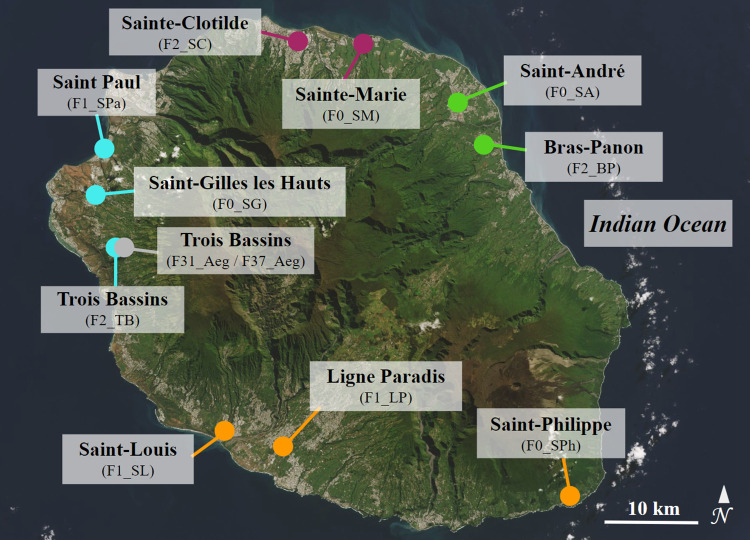
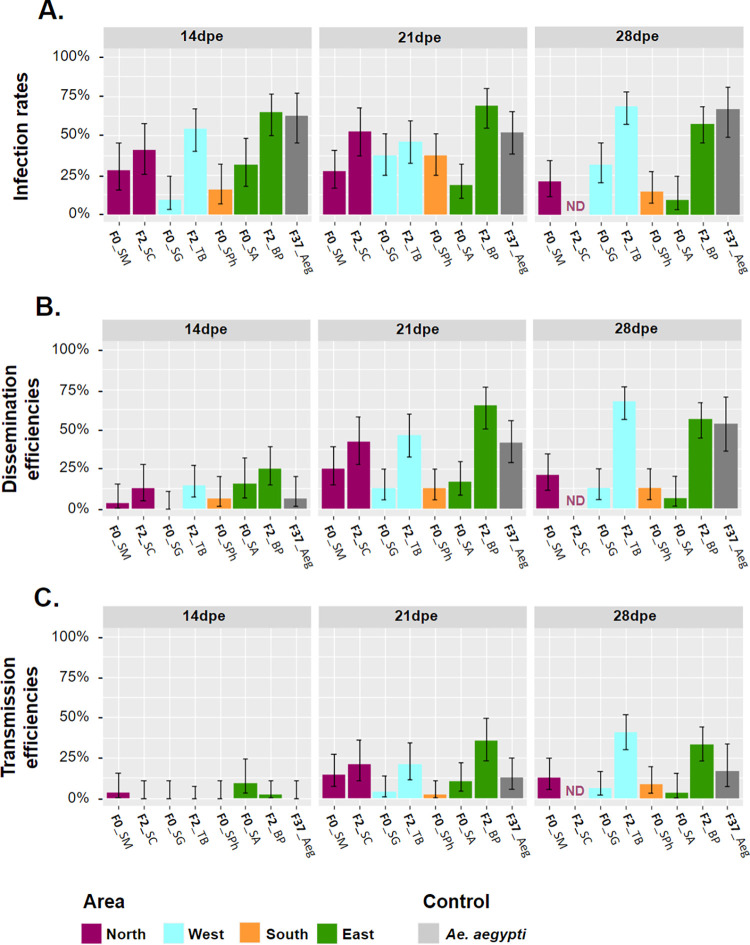
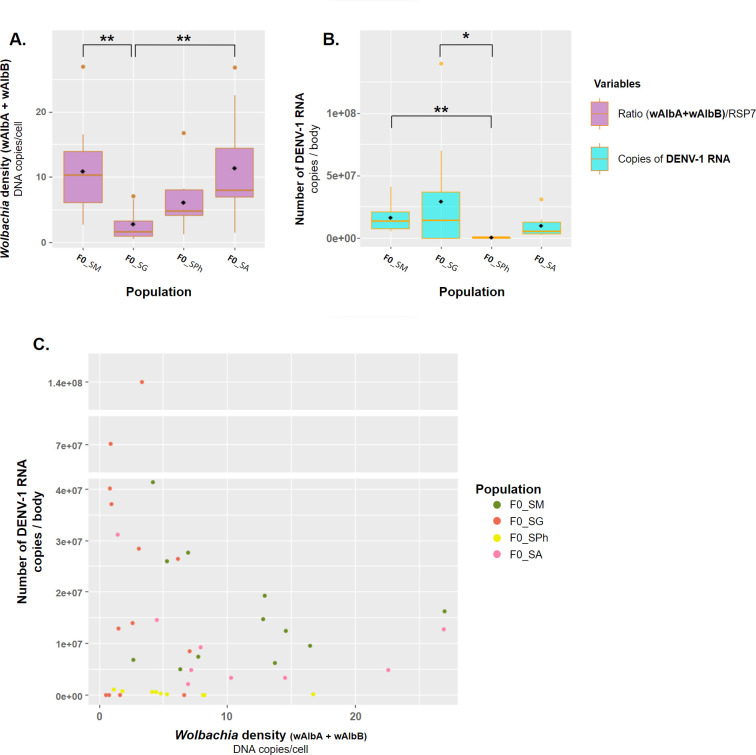
Dengue virus (DENV) is the most prevalent mosquito-borne Flavivirus that affects humans worldwide. Aedes albopictus, which is naturally infected with the bacteria Wolbachia, is considered to be a secondary vector of DENV. However, it was responsible for a recent DENV outbreak of unprecedented magnitude in Reunion Island, a French island in the South West Indian Ocean. Moreover, the distribution of the cases during this epidemic showed a spatially heterogeneous pattern across the island, leading to questions about the differential vector competence of mosquito populations from different geographic areas. The aim of this study was to gain a better understanding of the vector competence of the Ae. albopictus populations from Reunion Island for local DENV epidemic strains, while considering their infection by Wolbachia. Experimental infections were conducted using ten populations of Ae. albopictus sampled across Reunion Island and exposed to three DENV strains: one strain of DENV serotype 1 (DENV-1) and two strains of DENV serotype 2 (DENV-2). We analyzed three vector competence parameters including infection rate, dissemination efficiency and transmission efficiency, at different days post-exposition (dpe). We also assessed whether there was a correlation between the density of Wolbachia and viral load/vector competence parameters. Our results show that the Ae. albopictus populations tested were not able to transmit the two DENV-2 strains, while transmission efficiencies up to 40.79% were observed for the DENV-1 strain, probably due to difference in viral titres. Statistical analyses showed that the parameters mosquito population, generation, dpe and area of sampling significantly affect the transmission efficiencies of DENV-1. Although the density of Wolbachia varied according to mosquito population, no significant correlation was found between Wolbachia density and either viral load or vector competence parameters for DENV-1. Our results highlight the importance of using natural mosquito populations for a better understanding of transmission patterns of dengue.
Copyright: © 2024 Hafsia et al. This is an open access article distributed under the terms of the Creative Commons Attribution License, which permits unrestricted use, distribution, and reproduction in any medium, provided the original author and source are credited.
Conflict of interest statement
The authors have declared that no competing interests exist.
Figures
References
-
- Centers for Disease Control and Prevention. About Dengue [Internet]. 2023 [cited 2023 Oct 2]. Available from: https://www.cdc.gov/dengue/about/index.html
-
- World Health Organization. Dengue and severe dengue [Internet]. 2023 [cited 2023 Oct 2]. Available from: https://www.who.int/news-room/fact-sheets/detail/dengue-and-severe-dengue
MeSH terms
Supplementary concepts
LinkOut - more resources
Full Text Sources
Medical
