


Memory engram stability and flexibility
- PMID: 39300271
- PMCID: PMC11525749
- DOI: 10.1038/s41386-024-01979-z
Memory engram stability and flexibility
Erratum in
-
Correction: Neuropsychopharmacology Volume 50 Issue 1.Neuropsychopharmacology. 2025 May;50(6):1019-1020. doi: 10.1038/s41386-025-02087-2. Neuropsychopharmacology. 2025. PMID: 40108440 Free PMC article. No abstract available.
Abstract
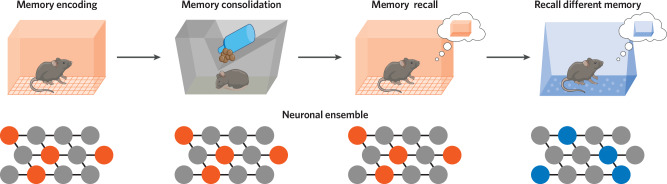
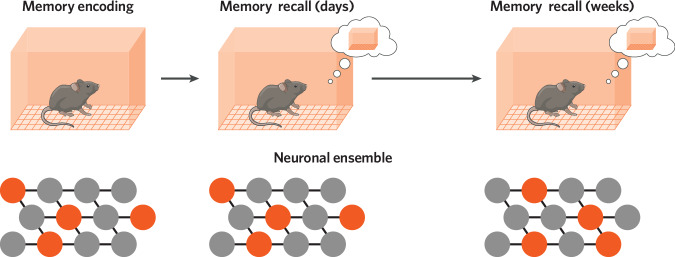
Many studies have shown that memories are encoded in sparse neural ensembles distributed across the brain. During the post-encoding period, often during sleep, many of the cells that were active during encoding are reactivated, supporting consolidation of this memory. During memory recall, many of the same cells that were active during encoding and reactivated during consolidation are reactivated during recall. These ensembles of cells have been referred to as the memory engram cells, stably representing a specific memory. However, recent studies question the rigidity of the "stable memory engram." Here we review the past literature of how episodic-like memories are encoded, consolidated, and recalled. We also highlight more recent studies (as well as some older literature) that suggest that these stable memories and their representations are much more dynamic and flexible than previously thought. We highlight some of these processes, including memory updating, reconsolidation, forgetting, schema learning, memory-linking, and representational drift.
© 2024. The Author(s).
Conflict of interest statement
The authors declare no competing interests.
Figures
References
-
- Borges JL. In praise of darkness 1st ed. Dutton: A. Lane.; 1974.
-
- Semon RW, Simon L. The mneme G. Allen & Unwin Ltd; The Macmillan Company 1921.
-
- Lashley KS. In search of the engram: In Physiological mechanisms in animal behavior. Society’s Symposium IV. Academic Press;1950. p. 454–82.
Publication types
MeSH terms
Grants and funding
LinkOut - more resources
Full Text Sources
Miscellaneous
