


The Role of Glucagon-Like Peptide-1 Agonists in the Treatment of Multiple Sclerosis: A Narrative Review
- PMID: 39301360
- PMCID: PMC11410460
- DOI: 10.7759/cureus.67232
The Role of Glucagon-Like Peptide-1 Agonists in the Treatment of Multiple Sclerosis: A Narrative Review
Abstract
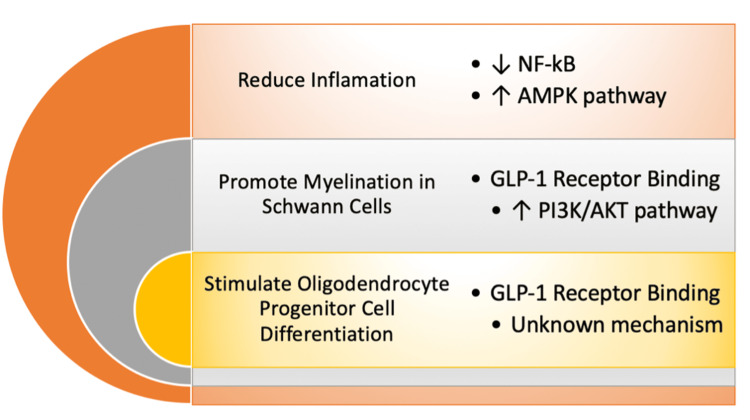
Multiple sclerosis (MS) is a chronic, progressive autoimmune disease modulated by autoantibodies that inflame and destroy the myelin sheath encasing neuronal axons, impairing proper axonal conduction and function. Glucagon-like peptide-1 (GLP-1) receptor agonists have been demonstrated to exert anti-inflammatory and neuroprotective effects, making these drugs particularly exciting prospects in the treatment of MS. While the exact mechanism remains unclear, GLP-1 receptor agonists may modulate inflammatory responses by targeting GLP-1 receptors present on immune cells such as macrophages, monocytes, and lymphocytes. In animal models, GLP-1 agonists have been shown to significantly delay the onset and severity of experimental autoimmune encephalopathy symptoms, as well as to increase nerve myelination and brain weight. In further experiments using animal models of nerve crush injury, specimens given GLP-1 agonists reported a significant increase in the rate and density of nerve regeneration compared to controls. Thus, GLP-1 agonists show promise as both prophylactic and symptomatic treatment for MS and may provide further utility in the treatment of other autoimmune, inflammatory, and neurodegenerative conditions.
Keywords: alzheimer’s; diabetes mellitus; glucagon-like peptide-1 agonists; liraglutide; metformin; multiple sclerosis; neurodegenerative disease; obesity; ozempic.
Copyright © 2024, Kaye et al.
Conflict of interest statement
Conflicts of interest: In compliance with the ICMJE uniform disclosure form, all authors declare the following: Payment/services info: All authors have declared that no financial support was received from any organization for the submitted work. Financial relationships: All authors have declared that they have no financial relationships at present or within the previous three years with any organizations that might have an interest in the submitted work. Other relationships: All authors have declared that there are no other relationships or activities that could appear to have influenced the submitted work.
Figures
References
-
- Multiple sclerosis: current pathophysiological concepts. Wingerchuk DM, Lucchinetti CF, Noseworthy JH. Lab Invest. 2001;81:263–281. - PubMed
-
- Pathophysiology of multiple sclerosis. Korn T. J Neurol. 2008;255:2–6. - PubMed
-
- Transcriptional analysis of targets in multiple sclerosis. Steinman L, Zamvil S. Nat Rev Immunol. 2003;3:483–492. - PubMed
Publication types
LinkOut - more resources
Full Text Sources