Meta-Analysis
. 2025 Jan;49(1):128-143.
doi: 10.4093/dmj.2024.0139. Epub 2024 Sep 20.

Identification and Potential Clinical Utility of Common Genetic Variants in Gestational Diabetes among Chinese Pregnant Women

Affiliations
Meta-Analysis

Identification and Potential Clinical Utility of Common Genetic Variants in Gestational Diabetes among Chinese Pregnant Women

Claudia Ha-Ting Tam et al. Diabetes Metab J. 2025 Jan.

Abstract

Backgruound: The genetic basis for hyperglycaemia in pregnancy remain unclear. This study aimed to uncover the genetic determinants of gestational diabetes mellitus (GDM) and investigate their applications.

Methods: We performed a meta-analysis of genome-wide association studies (GWAS) for GDM in Chinese women (464 cases and 1,217 controls), followed by de novo replications in an independent Chinese cohort (564 cases and 572 controls) and in silico replication in European (12,332 cases and 131,109 controls) and multi-ethnic populations (5,485 cases and 347,856 controls). A polygenic risk score (PRS) was derived based on the identified variants.

Results: Using the genome-wide scan and candidate gene approaches, we identified four susceptibility loci for GDM. These included three previously reported loci for GDM and type 2 diabetes mellitus (T2DM) at MTNR1B (rs7945617, odds ratio [OR], 1.64; 95% confidence interval [CI], 1.38 to 1.96), CDKAL1 (rs7754840, OR, 1.33; 95% CI, 1.13 to 1.58), and INS-IGF2-KCNQ1 (rs2237897, OR, 1.48; 95% CI, 1.23 to 1.79), as well as a novel genome-wide significant locus near TBR1-SLC4A10 (rs117781972, OR, 2.05; 95% CI, 1.61 to 2.62; Pmeta=7.6×10⁻⁹), which has not been previously reported in GWAS for T2DM or glycaemic traits. Moreover, we found that women with a high PRS (top quintile) had over threefold (95% CI, 2.30 to 4.09; Pmeta=3.1×10⁻¹⁴) and 71% (95% CI, 1.08 to 2.71; P=0.0220) higher risk for GDM and abnormal glucose tolerance post-pregnancy, respectively, compared to other individuals.

Conclusion: Our results indicate that the genetic architecture of glucose metabolism exhibits both similarities and differences between the pregnant and non-pregnant states. Integrating genetic information can facilitate identification of pregnant women at a higher risk of developing GDM or later diabetes.

Keywords: Diabetes, gestational; Genetic risk score; Genome-wide association study; Glucose intolerance; Pregnant women.


Conflict of interest statement

CONFLICTS OF INTEREST

Cadmon King-poo Lim, Juliana Chung-ngor Chan, and Ronald Ching-wan Ma are co-founders of GemVCare, a technology start-up initiated with support from the Hong Kong Government Innovation and Technology Commission and its Technology Start-up Support Scheme for Universities (TSSSU). The other authors declare that there is no duality of interest associated with this manuscript. Ronald Ching-wan Ma is a member of the international editorial board of Diabetes & Metabolism Journal.

Figures

Fig. 1.
Fig. 1.
Results for meta-analysis of genome-wide association study for gestational diabetes. (A) Manhattan plot. The y-axis represents the −log10 P value (adjusted for principal components and age), and the x-axis represents the 6,322,337 analyzed biallelic single nucleotide polymorphisms. The dashed red horizontal line corresponds to the genome-wide significance threshold for P<5×10⁻⁸. There are 4 points with P<5×10⁻⁸, and the arrow and labels localize the susceptibility loci to gestational diabetes mellitus (GDM) discovered in the present study. (B) Quantile-quantile (Q-Q) plot. The dotted line corresponds to the null hypothesis. TBR1, T-box brain transcription factor 1; SLC4A10, solute carrier family 4 member 10; CDKAL1, CDK5 regulatory subunit-associated protein 1-like 1; MTNR1B, melatonin receptor 1B; INS-IGF2, insulin-insulin-like growth factor 2; KCNQ1, potassium voltage-gated channel subfamily Q member 1.
Fig. 2.
Fig. 2.
Results for the two genome-wide significant loci for gestational diabetes. (A) Forest plot for the association between T-box brain transcription factor 1 (TBR1)-solute carrier family 4 member 10 (SLC4A10) rs117781972 and gestational diabetes mellitus (GDM) in all discovery and replication cohorts. Odds ratio (OR) and 95% confidence interval (CI) were reported according to the A-allele of rs117781972 (i.e., the GDM-associated risk allele). (B) Forest plot for the association between melatonin receptor 1B (MTNR1B) rs7945617 and GDM in all discovery and replication cohorts. ORs and 95% CIs were reported according to the C-allele of rs7945617 (i.e., the GDM-associated risk allele). A total of three studies (i.e., the Hyperglycemia and Adverse Pregnancy Outcome-Hong Kong [HAPO-HK] Study, the Tianjin Study, and the Treated GDM Cases vs. Non-diabetes Controls [TGDM-NDM] Study) were included in the “meta-analysis of discovery cohorts.” For the GENetics of Diabetes In Pregnancy (GenDIP) meta-analysis, the P values of the associations were obtained from the meta-regression implemented in Meta-Regression of Multi-AncEstry Genetic Association (MR-MEGA) and the combined OR and 95% CI was estimated by meta-analysis under a fixed effect model. (C) Regional plot of the TBR1-SLC4A10 locus. (D) Regional plot of the MTNR1B locus. The purple diamonds represent the sentinel single nucleotide polymorphisms (SNPs) rs117781972 and rs7945617 identified from the meta-analysis of genome-wide association studies. Other SNPs are colored according to their level of linkage disequilibrium, which is measured by r2, with the sentinel SNPs. The recombination rates estimated from the 1000 Genomes project Asian data are shown. The genes in the interval are indicated in the bottom panel. TANK, TRAF family member associated NFKB activator; PSMD14, proteasome 26S subunit, non-ATPase 14; AHCTF1P1, AT-hook containing transcription factor 1 pseudogene 1; FAT3, FAT atypical cadherin 3; CCDC67, coiled-coil domain containing 87.
Fig. 3.
Fig. 3.
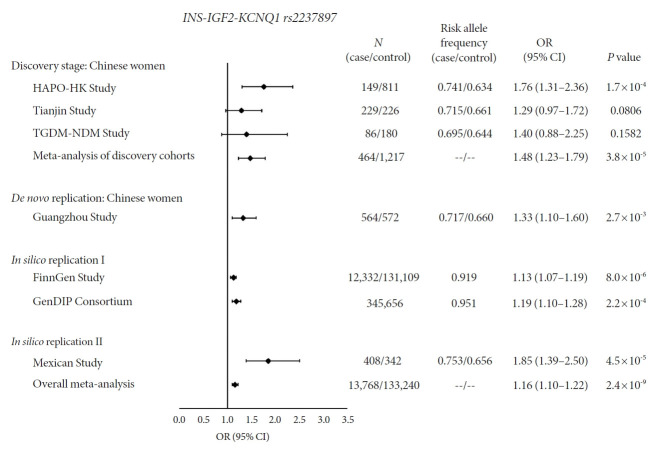
Forest plot for the association between potassium voltage-gated channel subfamily Q member 1 (KCNQ1) rs2237897 and gestational diabetes mellitus in all discovery and replication cohorts. Odds ratio (OR) and 95% confidence interval (CI) were reported according to the C-allele of rs2237897 (i.e., the type 2 diabetes mellitus-associated risk allele). For the GENetics of Diabetes In Pregnancy (GenDIP) meta-analysis, the P value of the association was obtained from the meta-regression implemented in Meta-Regression of Multi-AncEstry Genetic Association (MR-MEGA) and the combined OR and 95% CI was estimated by meta-analysis under a fixed effect model. A total of three studies (i.e., the Hyperglycemia and Adverse Pregnancy Outcome-Hong Kong [HAPO-HK] Study, the Tianjin Study, and the Tianjin Study and the Treated GDM Cases vs. Non-diabetes Controls [TGDM-NDM] Study) were included in the “meta-analysis of discovery cohorts.” A total of six studies (i.e., the HAPO-HK Study, the Tianjin Study, the TGDM-NDM Study, the Guangzhou Study, the FinnGen Study, and the Mexican Study) were included in the “overall meta-analysis.” We did not include the GenDIP samples in the overall meta-analysis because they overlapped with both the HAPO-HK and FinnGen Studies.
Fig. 4.
Fig. 4.
Association between quintiles of polygenic risk score (PRS) and gestational diabetes. (A) Meta-analysis of three discovery cohorts of Chinese women (the Hyperglycemia and Adverse Pregnancy Outcome-Hong Kong [HAPO-HK] Study, Tianjin Study, and Tianjin Study and the Treated GDM Cases vs. Non-diabetes Controls [TGDM-NDM] Study). (B) Guangzhou Study. (C) HAPO-Thai Study. (D) HAPO-Hispanic Study. Plinear is the P value testing for a linear trend across the quintile categories of PRS. Ptop is the P value testing for the association of a high PRS with gestational diabetes mellitus (GDM) by comparing the top 20% with the remaining 80% of the PRS distribution. Odds ratio (OR) and 95% confidence interval (CI) of GDM were stratified by quintile categories of PRS. Within each individual cohort, P values were obtained from logistic regression with the adjustment of principal components, age and body mass index, except for the Guangzhou Study which did not adjust for any covariates. Results from the three discovery cohorts were then meta-analyzed using a fixed-effects model.
Fig. 5.
Fig. 5.
Association between quintiles of polygenic risk score (PRS) and abnormal glucose tolerance (AGT) at 7-year postpartum in the Hyperglycemia and Adverse Pregnancy Outcome-Hong Kong (HAPO-HK) Study. (A) PRS derived based on four gestational diabetes mellitus (GDM)-related variants. (B) PRS derived based on 286 type 2 diabetes mellitus (T2DM)-related variants. The T2DM-related PRS was derived based on 286 T2DM-related variants reported by the Diabetes Meta-Analysis of Trans-Ethnic association studies (DIAMANTE) consortium [20]. Plinear is the P value testing for a linear trend across the quintile categories of PRS. Ptop is the P value testing for the association of a high PRS with AGT after pregnancy by comparing the top 20% with the remaining 80% of the PRS distribution. Odds ratio (OR) and 95% confidence interval (CI) of GDM were stratified by quintile categories of PRS. P values were obtained from logistic regression with the adjustment of principal components, age and body mass index.
None

References

    1. Wang H, Li N, Chivese T, Werfalli M, Sun H, Yuen L, et al. IDF Diabetes Atlas: estimation of global and regional gestational diabetes mellitus prevalence for 2021 by International Association of Diabetes in Pregnancy Study Group’s criteria. Diabetes Res Clin Pract. 2022;183:109050. - PubMed
    1. HAPO Study Cooperative Research Group. Metzger BE, Lowe LP, Dyer AR, Trimble ER, Chaovarindr U, et al. Hyperglycemia and adverse pregnancy outcomes. N Engl J Med. 2008;358:1991–2002. - PubMed
    1. Vounzoulaki E, Khunti K, Abner SC, Tan BK, Davies MJ, Gillies CL. Progression to type 2 diabetes in women with a known history of gestational diabetes: systematic review and meta-analysis. BMJ. 2020;369:m1361. - PMC - PubMed
    1. Lowe WL, Jr, Lowe LP, Kuang A, Catalano PM, Nodzenski M, Talbot O, et al. Maternal glucose levels during pregnancy and childhood adiposity in the Hyperglycemia and Adverse Pregnancy Outcome Follow-up Study. Diabetologia. 2019;62:598–610. - PMC - PubMed
    1. Lowe WL, Jr, Scholtens DM, Kuang A, Linder B, Lawrence JM, Lebenthal Y, et al. Hyperglycemia and Adverse Pregnancy Outcome Follow-up Study (HAPO FUS): maternal gestational diabetes mellitus and childhood glucose metabolism. Diabetes Care. 2019;42:372–80. - PMC - PubMed

Publication types

Supplementary concepts

LinkOut - more resources