


Promotion of order Bunyavirales to class Bunyaviricetes to accommodate a rapidly increasing number of related polyploviricotine viruses
- PMID: 39303014
- PMCID: PMC11494962
- DOI: 10.1128/jvi.01069-24
Promotion of order Bunyavirales to class Bunyaviricetes to accommodate a rapidly increasing number of related polyploviricotine viruses
Abstract
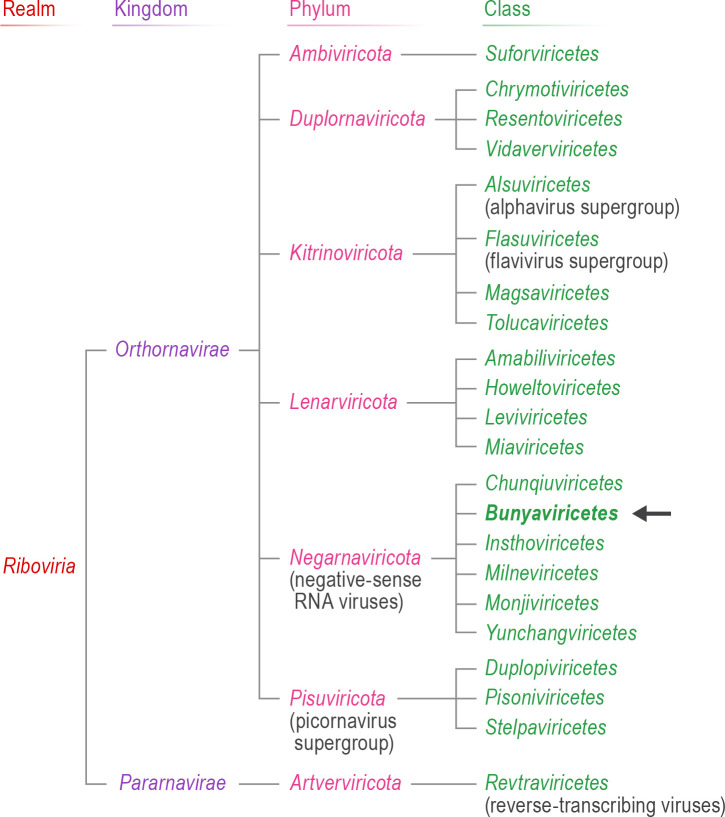
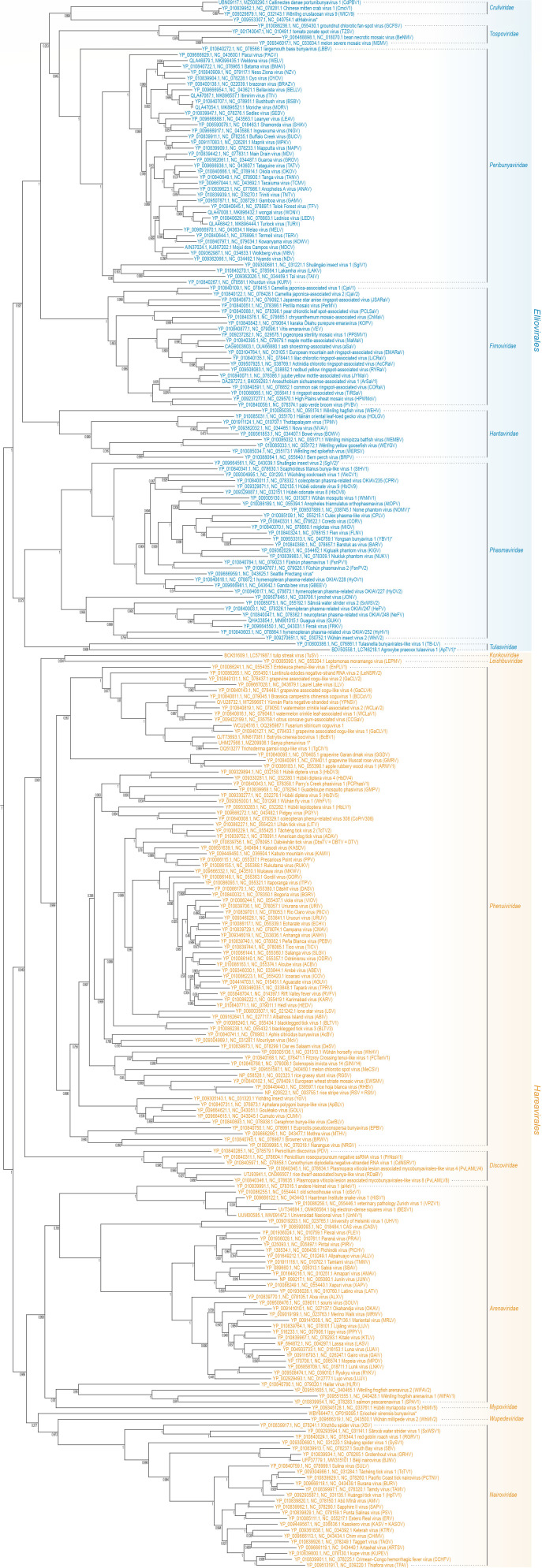
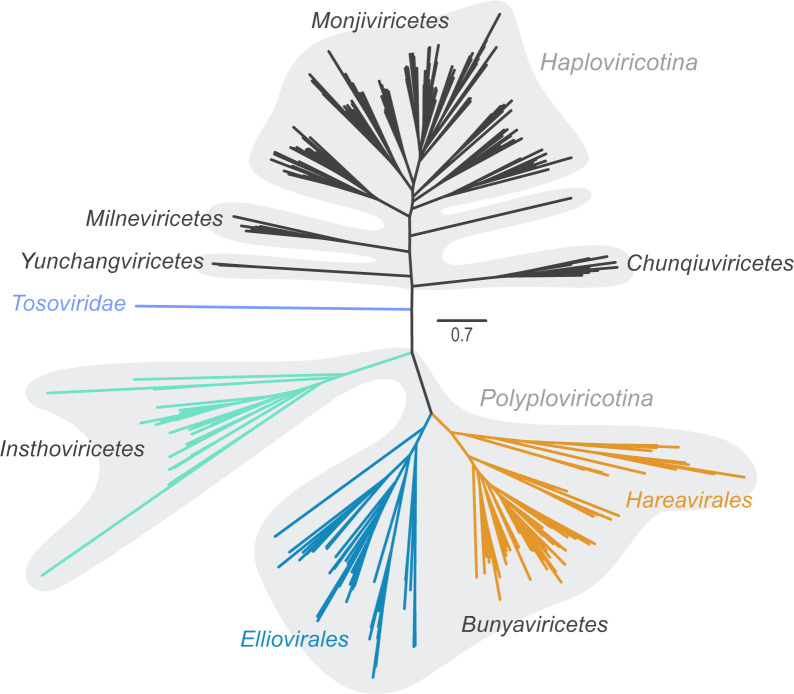
Prior to 2017, the family Bunyaviridae included five genera of arthropod and rodent viruses with tri-segmented negative-sense RNA genomes related to the Bunyamwera virus. In 2017, the International Committee on Taxonomy of Viruses (ICTV) promoted the family to order Bunyavirales and subsequently greatly expanded its composition by adding multiple families for non-segmented to polysegmented viruses of animals, fungi, plants, and protists. The continued and accelerated discovery of bunyavirals highlighted that an order would not suffice to depict the evolutionary relationships of these viruses. Thus, in April 2024, the order was promoted to class Bunyaviricetes. This class currently includes two major orders, Elliovirales (Cruliviridae, Fimoviridae, Hantaviridae, Peribunyaviridae, Phasmaviridae, Tospoviridae, and Tulasviridae) and Hareavirales (Arenaviridae, Discoviridae, Konkoviridae, Leishbuviridae, Mypoviridae, Nairoviridae, Phenuiviridae, and Wupedeviridae), for hundreds of viruses, many of which are pathogenic for humans and other animals, plants, and fungi.
Keywords: Arenaviridae; Bunyavirales; Bunyaviricetes; Cruliviridae; Discoviridae; Elliovirales; Ellioviricetes; Fimoviridae; Hantaviridae; Hareavirales; ICTV; International Committee on Taxonomy of Viruses; Konkoviridae; Leishbuviridae; Mypoviridae; Nairoviridae; Negarnaviricota; Orthornavirae; Peribunyaviridae; Phasmaviridae; Phenuiviridae; Polyploviricotina; RNA-dependent RNA polymerase; RNA-directed RNA polymerase; RdRp; Riboviria; Tospoviridae; Tulasviridae; Wupedeviridae; arenavirid; arenavirus; bunyaviral; bunyaviricete; bunyavirus; crulivirid; discovirid; ellioviral; fimovirid; fimovirus; hantavirid; hantavirus; hareaviral; konkovirid; leishbuvirid; megaclassification; megataxonomy; mypovirid; nairovirid; nairovirus; negarnaviricot; peribunyavirid; peribunyavirus; phasmavirid; phenuivirid; phenuivirus; polyploviricotine; ribovirian; tospovirid; tospovirus; tulasvirid; virus classification; virus nomenclature; virus taxonomy; wupedevirid.
Conflict of interest statement
The authors declare no conflict of interest.
Figures
References
-
- International Committee on Taxonomy of Viruses . 1975. Minutes of the third meeting of ICTV held in Madrid, 12 and 16 September 1975. Available from: https://ictv.global/ictv/proposals/Ratification_1975.pdf
-
- International Committee on Taxonomy of Viruses . 1981. Minutes of the 5th meeting of the ICTV. Strasbourg, 4 August 1981. Available from: https://ictv.global/ictv/proposals/Ratification_1981.pdf
MeSH terms
Substances
Grants and funding
LinkOut - more resources
Full Text Sources
Other Literature Sources
Research Materials
Miscellaneous
