


The development and structure of the HEALthy Brain and Child Development (HBCD) Study EEG protocol
- PMID: 39305603
- PMCID: PMC11439552
- DOI: 10.1016/j.dcn.2024.101447
The development and structure of the HEALthy Brain and Child Development (HBCD) Study EEG protocol
Abstract
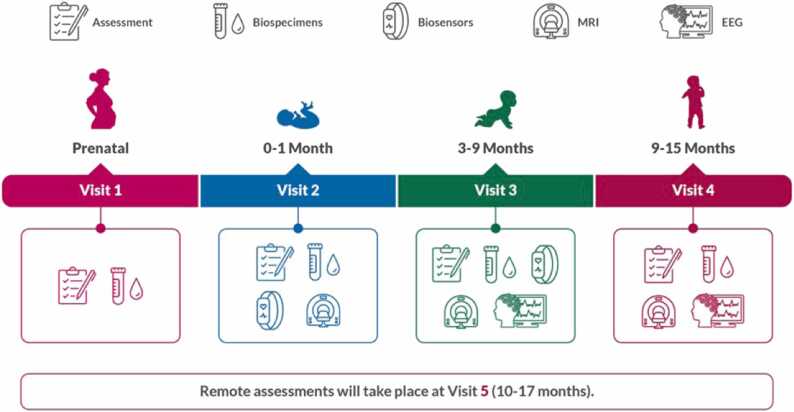
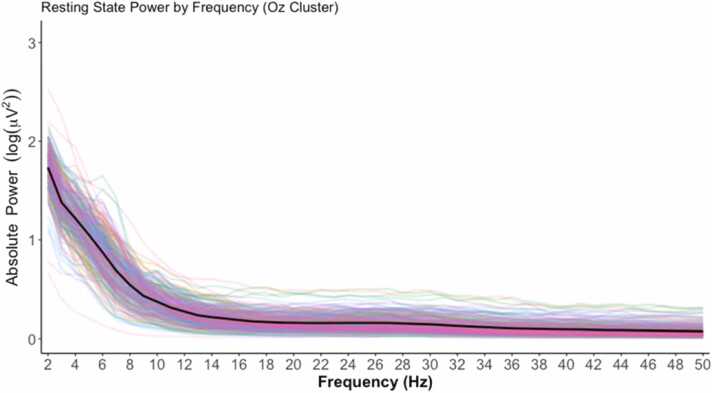
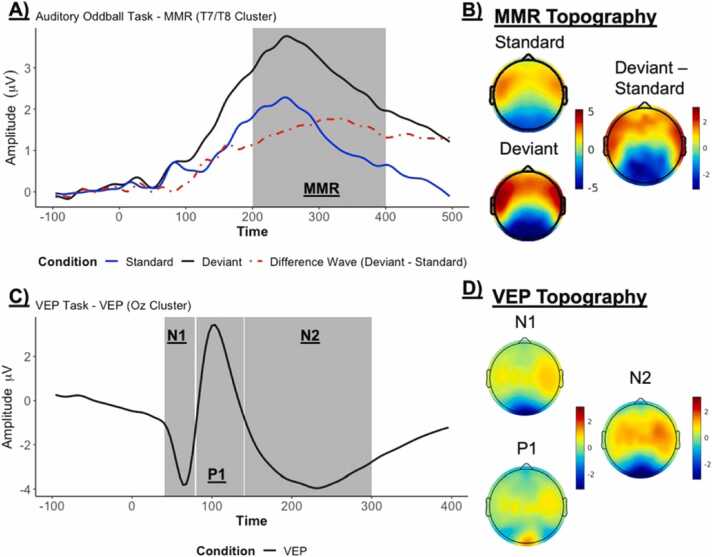
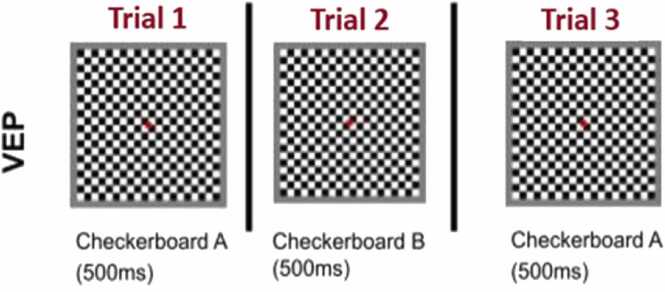
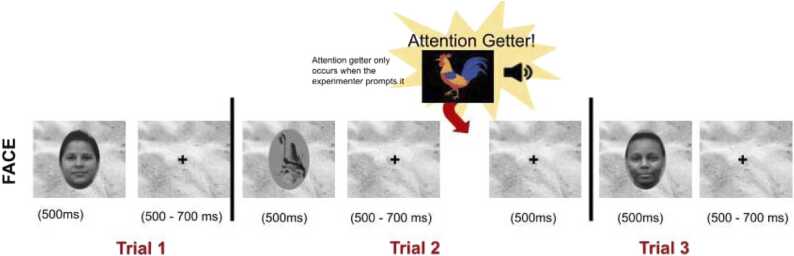
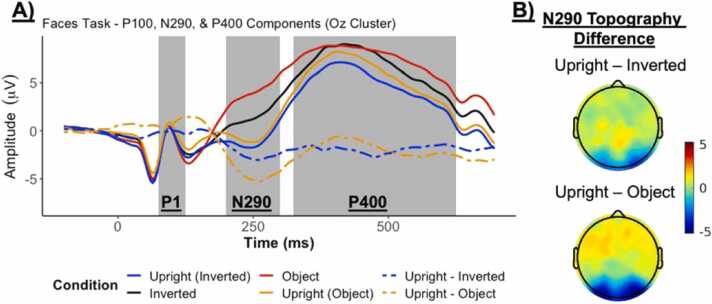
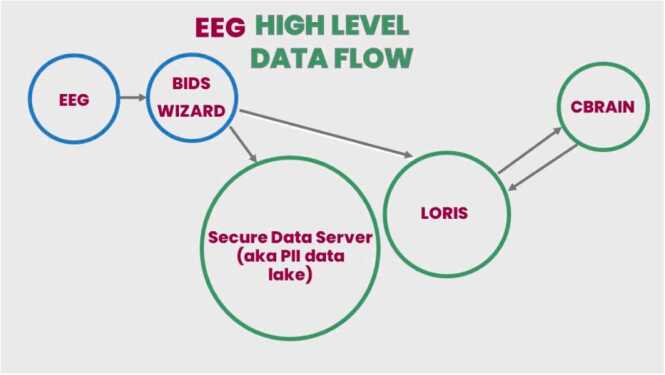
The HEALthy Brain and Child Development (HBCD) Study, a multi-site prospective longitudinal cohort study, will examine human brain, cognitive, behavioral, social, and emotional development beginning prenatally and planned through early childhood. Electroencephalography (EEG) is one of two brain imaging modalities central to the HBCD Study. EEG records electrical signals from the scalp that reflect electrical brain activity. In addition, the EEG signal can be synchronized to the presentation of discrete stimuli (auditory or visual) to measure specific cognitive processes with excellent temporal precision (e.g., event-related potentials; ERPs). EEG is particularly helpful for the HBCD Study as it can be used with awake, alert infants, and can be acquired continuously across development. The current paper reviews the HBCD Study's EEG/ERP protocol: (a) the selection and development of the tasks (Video Resting State, Visual Evoked Potential, Auditory Oddball, Face Processing); (b) the implementation of common cross-site acquisition parameters and hardware, site setup, training, and initial piloting; (c) the development of the preprocessing pipelines and creation of derivatives; and (d) the incorporation of equity and inclusion considerations. The paper also provides an overview of the functioning of the EEG Workgroup and the input from members across all steps of protocol development and piloting.
Keywords: Auditory oddball; EEG; Face processing; HBCD; Infants; Longitudinal cohort; Protocols; Resting EEG; Visual evoked potentials.
Copyright © 2024. Published by Elsevier Ltd.
Conflict of interest statement
Declaration of Competing Interest The authors declare that they have no known competing financial interests or personal relationships that could have appeared to influence the work reported in this paper.
Figures

References
-
- Anunziata F., Cisneros C., Castillo M.I.N., Perez A., Rodriguez V., De La Cruz S., Estrada K., Durbal A., Jaramillo M., Marquez L.E., Nunez J., Peralta-Carcelen M., Wisnowski J.L., the HEALthy Brain & Child Development (HBCD) Spanish Language Committee ¿Donde están? Hispanic/Latine inclusion, diversity and representation in the Healthy Brain and Child Development Study (HBCD) Dev. Cogn. Neurosci. 2024
-
- Barry-Anwar R., Riggins T., Scott L.S. Electrophysiology in developmental populations: Key methods and findings. Oxf. Handb. Dev. Cogn. Neurosci. 2020
Publication types
MeSH terms
Grants and funding
- P50 HD105354/HD/NICHD NIH HHS/United States
- U01 DA055344/DA/NIDA NIH HHS/United States
- R01 DA059415/DA/NIDA NIH HHS/United States
- U01 DA055338/DA/NIDA NIH HHS/United States
- U01 DA055355/DA/NIDA NIH HHS/United States
- U01 DA055359/DA/NIDA NIH HHS/United States
- U24 DA055330/DA/NIDA NIH HHS/United States
- U01 DA055354/DA/NIDA NIH HHS/United States
- U01 DA055358/DA/NIDA NIH HHS/United States
- U01 DA055369/DA/NIDA NIH HHS/United States
- U01 DA055316/DA/NIDA NIH HHS/United States
- U01 DA055366/DA/NIDA NIH HHS/United States
- U01 DA055367/DA/NIDA NIH HHS/United States
- U01 DA055360/DA/NIDA NIH HHS/United States
- U01 DA055350/DA/NIDA NIH HHS/United States
- U01 DA055347/DA/NIDA NIH HHS/United States
- U01 DA055352/DA/NIDA NIH HHS/United States
- U01 DA055370/DA/NIDA NIH HHS/United States
- U01 DA055357/DA/NIDA NIH HHS/United States
- U01 DA055349/DA/NIDA NIH HHS/United States
- U01 DA055371/DA/NIDA NIH HHS/United States
- U01 DA055342/DA/NIDA NIH HHS/United States
- U24 DA055325/DA/NIDA NIH HHS/United States
- U01 DA055353/DA/NIDA NIH HHS/United States
- U01 DA055363/DA/NIDA NIH HHS/United States
- U01 DA055322/DA/NIDA NIH HHS/United States
- U01 DA055365/DA/NIDA NIH HHS/United States
- U01 DA055362/DA/NIDA NIH HHS/United States
LinkOut - more resources
Full Text Sources
Medical
