


Systematic analysis of Fc mutations designed to enhance binding to Fc-gamma receptors
- PMID: 39306747
- PMCID: PMC11418285
- DOI: 10.1080/19420862.2024.2406539
Systematic analysis of Fc mutations designed to enhance binding to Fc-gamma receptors
Abstract
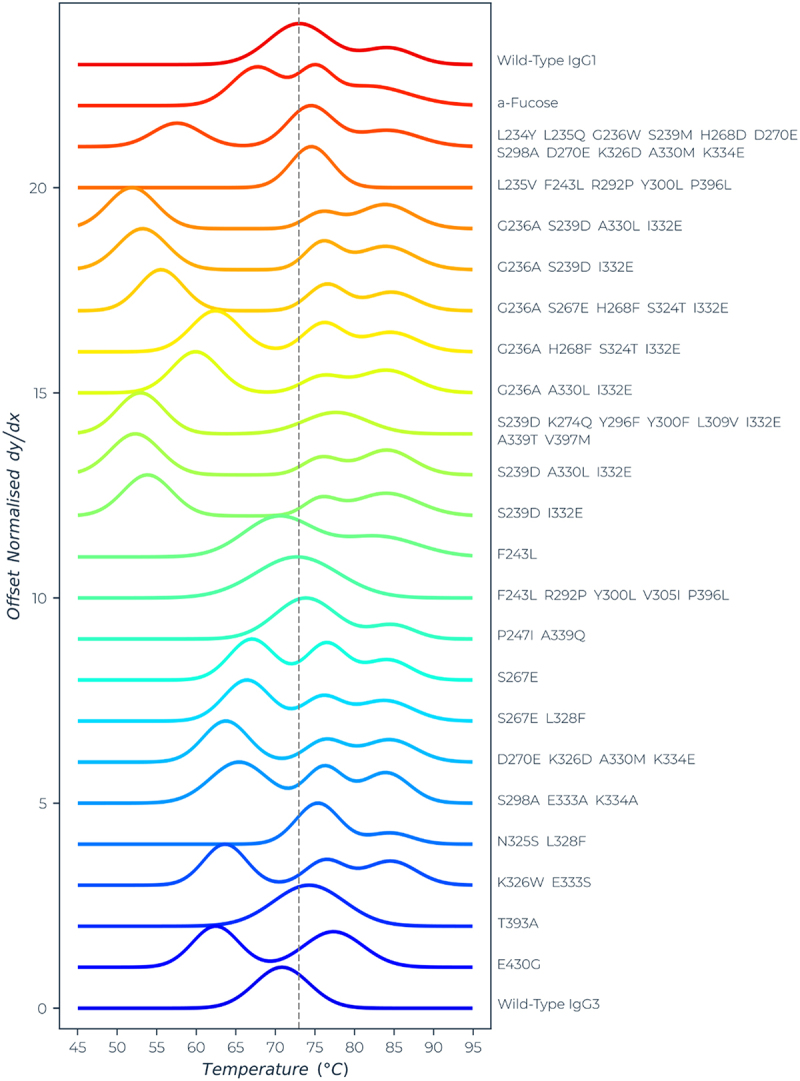
A critical attribute of therapeutic antibodies is their ability to engage with humoral or cellular effector mechanisms, and this depends on the ability of the Fc region to bind to complement (C1q) or Fc receptors. Investigators have sought to optimize these effects by engineering the Fc region to bind to a greater or lesser extent to individual receptors. Different approaches have been used in the clinic, but they have not been systematically compared. We have now produced a matched set of anti-CD20 antibodies representing a range of variants and compared their activity in cell-based assays for complement-dependent cytotoxicity, antibody-dependent cell-mediated cytotoxicity, and antibody-dependent phagocytosis using a range of individual Fc receptors. We have also compared the thermal stability of the variants by differential scanning fluorimetry (DSF). The results reveal a spectrum of activities which may be appropriate for different applications.
Keywords: C1q; CD16; CD32; CD64; DSF; Fc receptor; Fc region; FcγRI; FcγRII; FcγRIII; antibody effector function; antibody engineering; therapeutic antibody.
Conflict of interest statement
This research was sponsored by mAbsolve Limited. Geoff Hale and Ian Wilkinson have financial interests in mAbsolve.
Figures
References
-
- Shinkawa T, Nakamura K, Yamane N, Shoji-Hosaka E, Kanda Y, Sakurada M, Uchida K, Anazawa H, Satoh M, Yamasaki M, et al. The absence of fucose but not the presence of galactose or bisecting N-acetylglucosamine of human IgG1 complex-type oligosaccharides shows the critical role of enhancing antibody-dependent cellular cytotoxicity. J Biol Chem. 2003;278(5):3466–3473. doi: 10.1074/jbc.M210665200. - DOI - PubMed
-
- Ferrara C, Grau S, Jäger C, Sondermann P, Brünker P, Waldhauer I, Hennig M, Ruf A, Rufer AC, Stihle M, et al. Unique carbohydrate–carbohydrate interactions are required for high affinity binding between FcγRIII and antibodies lacking core fucose. Proc Natl Acad Sci USA. 2011;108(31):12669–12674. doi: 10.1073/pnas.1108455108. - DOI - PMC - PubMed
MeSH terms
Substances
LinkOut - more resources
Full Text Sources
Other Literature Sources
Miscellaneous
