Review
. 2024 Jun 9;6(10):101130.
doi: 10.1016/j.jhepr.2024.101130. eCollection 2024 Oct.

Immunotherapy for hepatocellular carcinoma

Affiliations
Review

Immunotherapy for hepatocellular carcinoma

Alexa Childs et al. JHEP Rep. .

Abstract

Hepatocellular carcinoma (HCC) is a major global healthcare challenge, with >1 million patients predicted to be affected annually by 2025. In contrast to other cancers, both incidence and mortality rates continue to rise, and HCC is now the third leading cause of cancer-related death worldwide. Immune checkpoint inhibitors (ICIs) have transformed the treatment landscape for advanced HCC, with trials demonstrating a superior overall survival benefit compared to sorafenib in the first-line setting. Combination therapy with either atezolizumab (anti-PD-L1) and bevacizumab (anti-VEGF) or durvalumab (anti-PD-L1) and tremelimumab (anti-CTLA-4) is now recognised as standard of care for advanced HCC. More recently, two phase III studies of ICI-based combination therapy in the early and intermediate disease settings have successfully met their primary end points of improved recurrence- and progression-free survival, respectively. Despite these advances, and in contrast to other tumour types, there remain no validated predictive biomarkers of response to ICIs in HCC. Ongoing research efforts are focused on further characterising the tumour microenvironment in order to select patients most likely to benefit from ICI and identify novel therapeutic targets. Herein, we review the current understanding of the immune landscape in which HCC develops and the evidence for ICI-based therapeutic strategies in HCC. Additionally, we describe the state of biomarker development and novel immunotherapy approaches in HCC which have progressed beyond the pre-clinical stage and into early-phase trials.

Keywords: adoptive cell therapy; biomarkers; checkpoint inhibitors; hepatocellular carcinoma; immunotherapy; tumour microenvironment.


Figures

Fig. 1
Fig. 1
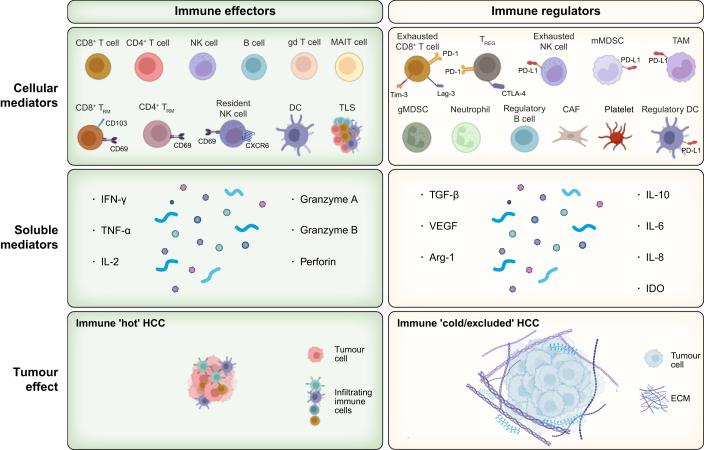
The local HCC immune landscape can be divided into immune effectors and immune regulators. The local HCC immune landscape can be divided into immune effectors that can respond to HCC by producing a variety of mediators with anti-tumour potential (e.g. tissue-resident T cells, left top and middle panel) and immune regulators that suppress and/or exclude these immune effectors through membrane-bound checkpoint inhibitors (e.g. PD-L1) and soluble mediators (e.g. TGF-b, right top and middle panel). The balance of these opposing activities results in tumour control or growth, respectively. The goal of immunotherapies is to overcome immune exclusion/cold tumours (right bottom panel) and block negative immune regulators to allow influx and function of immune effectors for tumour shrinkage (bottom left panel). Key cellular subsets, soluble mediators and structural elements contributing to these processes are shown. Immune hot tumour – red tumour, immune cold/excluded tumour – blue (bottom panels). CAF, cancer-associated fibroblast; DC, dendritic cell; gMDSC, granulocytic myeloid derived suppressor cell; IL-, interleukin; IDO, idoleamine 2,3 dioxygenase; IFN-y, interferon γ; MAIT cell, mucosal-associated invariant T cell; mMDSC, monocytic myeloid derived suppressor cell; NK cell, natural killer cell; TAM, tumour associated macrophage; TGFβ, transforming growth factor-β; TLS, tertiary lymphoid structure; TNF-α, tumour necrosis factor-α; Treg, regulatory T cell; TRM, tissue resident memory; VEGF, vascular endothelial growth factor.

References

    1. Dasgupta P., Henshaw C., Youlden D.R., et al. Global trends in incidence rates of primary adult liver cancers: a systematic review and meta-analysis. Front Oncol. 2020 Feb 28;10:171. - PMC - PubMed
    1. Vos T., Lim S.S., Abbafati C., et al. Global burden of 369 diseases and injuries in 204 countries and territories, 1990–2019: a systematic analysis for the Global Burden of Disease Study 2019. The Lancet. 2020 Oct;396(10258):1204–1222. - PMC - PubMed
    1. Llovet J.M., Montal R., Sia D., et al. Molecular therapies and precision medicine for hepatocellular carcinoma. Nat Rev Clin Oncol. 2018 Oct 30;15(10):599–616. - PubMed
    1. Finn R.S., Qin S., Ikeda M., et al. Atezolizumab plus bevacizumab in unresectable hepatocellular carcinoma. New Engl J Med. 2020 May 14;382(20):1894–1905. - PubMed
    1. Park E.J., Lee J.H., Yu G.Y., et al. Dietary and genetic obesity promote liver inflammation and tumorigenesis by enhancing IL-6 and TNF expression. Cell. 2010 Jan;140(2):197–208. - PMC - PubMed

LinkOut - more resources