


Association of Physical Fitness With the Work Ability of Aging Workers With Physically Demanding Jobs in a University Hospital in Thailand
- PMID: 39309286
- PMCID: PMC11410491
- DOI: 10.1016/j.shaw.2024.06.003
Association of Physical Fitness With the Work Ability of Aging Workers With Physically Demanding Jobs in a University Hospital in Thailand
Abstract
Background: A decrease in physical fitness with age can impact work ability. Exploring the role of physical fitness is important for identifying interventions to enhance work ability among aging workers. We sought to determine the association between physical fitness and physically demanding work ability in aging workers.
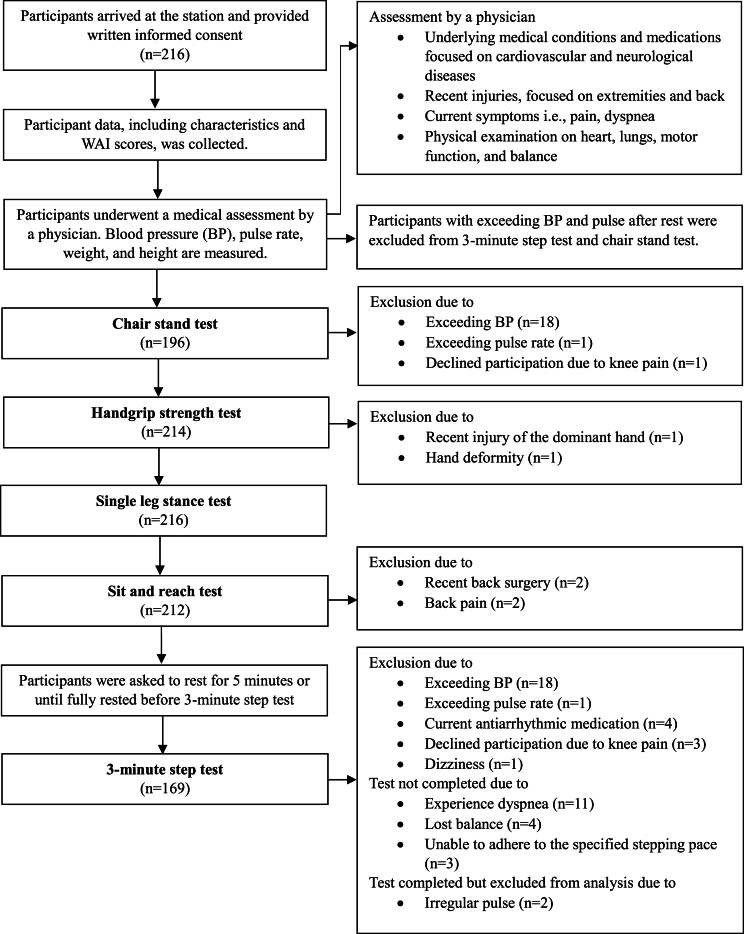
Methods: We recruited workers aged 45-65 years from eight departments of a university hospital in Bangkok, Thailand. Work ability was assessed using the work ability index (WAI), and physical fitness components were evaluated through various tests. Associations between work ability and physical fitness were examined using a multivariable regression analysis.
Results: The response rate was 46.4% (n = 216). The mean WAI score was 41.6. Participants with an overweight or obese body mass index (BMI) had 1.8 (95% CI -3.1, -0.4) points lower WAI scores than did those within a healthy BMI range. A handgrip strength test revealed that participants in the good/very good group had 2.5 (95% CI: 0.6, 4.3) higher WAI scores than did those in the very poor/poor group. For a single-leg stance test, participants in the above-average group had 2.1 (95% CI: 0.7, 3.5) points greater WAI scores than did those in the below-average group. No significant associations were found between work ability and 3-min step, chair stand, or sit-and-reach test scores.
Conclusion: The overall work ability of the participants was good. Body composition, muscle strength, and balance were associated with work ability. Promoting physical fitness is a viable strategy for enhancing work ability among aging workers.
Keywords: Aging; Physical fitness; Work ability.
© 2024 Occupational Safety and Health Research Institute. Published by Elsevier B.V. on behalf of Institute, Occupational Safety and Health Research Institute, Korea Occupational Safety and Health Agency.
Conflict of interest statement
The authors certify that they have NO affiliations with or involvement in any organization or entity with any financial interest (such as honoraria; educational grants; participation in speakers' bureaus; membership, employment, consultancies, stock ownership, or other equity interest; and expert testimony or patent-licensing arrangements), or non-financial interest (such as personal or professional relationships, affiliations, knowledge or beliefs) in the subject matter or materials discussed in this manuscript.
Figures
References
-
- Harasty C., Ostermeier M. 2020. Population ageing: alternative measures of dependency and implications for the future of work; pp. 5–8. ILO Working Paper 5.
-
- National Statistical Office Survey of the work of the elderly in Thailand 2021 [in Thai] [Internet]. 2021. 2021 [cited 2022 Oct 14]. Available from: https://www.nso.go.th/nsoweb/nso/survey_detail/cj?set_lang=en.
-
- Kenny G.P., Groeller H., McGinn R., Flouris A.D. Age, human performance, and physical employment standards. Appl Physiol Nutr Metab. 2016;41(6 Suppl. 2):S92–S107. - PubMed
-
- Ilmarinen J. The work ability index (WAI) Occup Med. 2007;57(2):160.
-
- World Health Organization . 1993. Aging and working capacity: report of a WHO study group; p. 3. Geneva. - PubMed
LinkOut - more resources
Full Text Sources
