


Validation of the Childhood Trauma Questionnaire - Short Form (CTQ-SF) for a French-Speaking Sample
- PMID: 39309339
- PMCID: PMC11413264
- DOI: 10.1007/s40653-024-00612-x
Validation of the Childhood Trauma Questionnaire - Short Form (CTQ-SF) for a French-Speaking Sample
Abstract
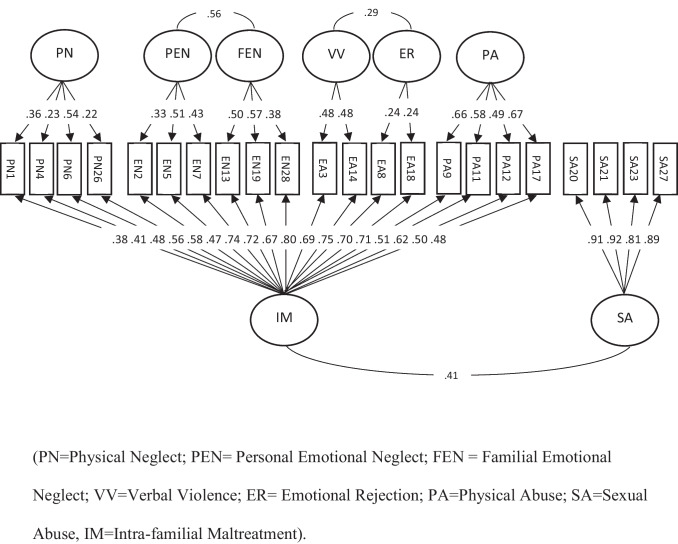
The Childhood Trauma Questionnaire-Short Form (CTQ-SF) is a widely used and standardized questionnaire designed to assess five types of childhood abuse. Despite the fact that the CTQ-SF demonstrates good validity and reliability, its internal structure presents some limitations and its original 28-item five-factor model has been contested. The present study assesses the reliability and the factor structure of a French version of the CTQ-SF for an alternative 25-item model and a bifactorial model, using confirmatory factor analysis (CFA). Participants were French-speaking females from two independent samples (N = 1903, N = 690). They completed an online sociodemographic questionnaire and the online version of the CTQ-SF. The new model proposed in this article demonstrated excellent fit indices in two independent samples. Our results support the fit of a bifactorial 25-item model, suggesting the presence of a general factor of intrafamilial maltreatment, from which only sexual abuse would be separated. Furthermore, the results support the fit of a solution with seven factors. This research proposes alternative models that address the limitations pinpointed by previous international studies and demonstrate good fit indices. Moreover, these findings provide support for the validity of a French version of the CTQ-SF.
Supplementary information: The online version contains supplementary material available at 10.1007/s40653-024-00612-x.
Keywords: Assessment; Child abuse; Child ptsd/trauma; Childhood maltreatment; Psychometrics.
© The Author(s), under exclusive licence to Springer Nature Switzerland AG 2024. Springer Nature or its licensor (e.g. a society or other partner) holds exclusive rights to this article under a publishing agreement with the author(s) or other rightsholder(s); author self-archiving of the accepted manuscript version of this article is solely governed by the terms of such publishing agreement and applicable law.
Conflict of interest statement
Conflict of InterestThe authors have declared that they have no competing or potential conflicts of interest.
Figures
References
-
- Allen, B. (2008). An analysis of the impact of diverse forms of childhood psychological maltreatment on emotional adjustment in early adulthood. Child Maltreatment,13, 307–312. 10.1177/1077559508318394 - PubMed
-
- Aloba, O., Opakunle, T., & Ogunrinu, O. (2020). Childhood Trauma Questionnaire-Short Form (CTQ-SF): dimensionality, validity, reliability and gender invariance among Nigerian adolescents. Child Abuse & Neglect,101, 104357. 10.1016/j.chiabu.2020.104357 - PubMed
-
- Arata, C. M., Langhinrichsen-Rohling, J., Bowers, D., & O’Farrill-Swails, L. (2005). Single versus multi-type maltreatment: an examination of the long-term effects of child abuse. Journal of Aggression, Maltreatment & Trauma,11(4), 29–52. 10.1300/J146v11n04_02
-
- Baiverlin, A., Gallo, A., & Blavier, A. (2020). Impact of different kinds of child abuse on sense of parental competence in parents who were abused in childhood. European Journal of Trauma & Dissociation,4(4), 100150. 10.1016/j.ejtd.2020.100150
-
- Bal, S., De Bourdeaudhuij, I., Crombez, G., & Van Oost, P. (2004). Differences in trauma symptoms and family functioning in intra-and extrafamilial sexually abused adolescents. Journal of Interpersonal Violence,19(1), 108–123. 10.1177/0886260503259053 - PubMed
LinkOut - more resources
Full Text Sources