


Revolutionizing Healthcare: The Emerging Role of Quantum Computing in Enhancing Medical Technology and Treatment
- PMID: 39310567
- PMCID: PMC11416048
- DOI: 10.7759/cureus.67486
Revolutionizing Healthcare: The Emerging Role of Quantum Computing in Enhancing Medical Technology and Treatment
Abstract
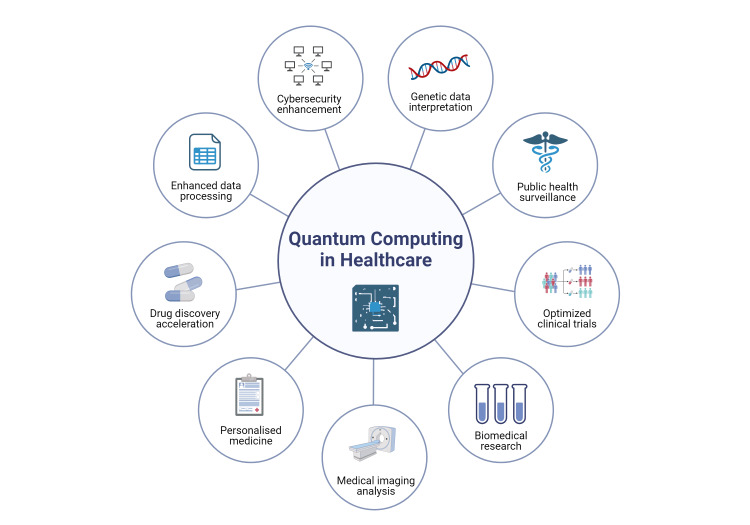
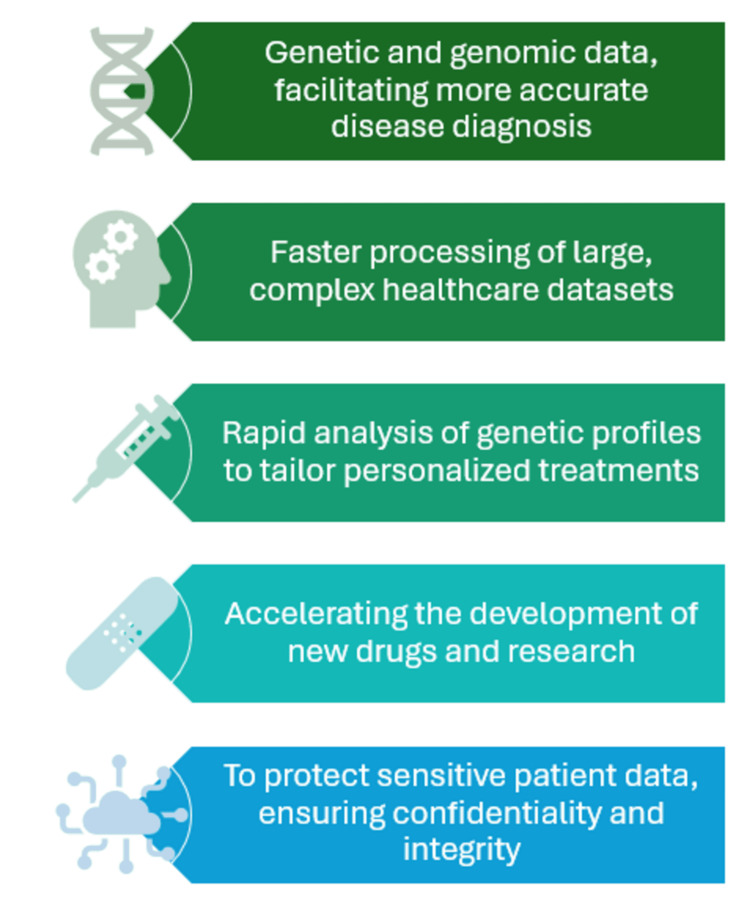
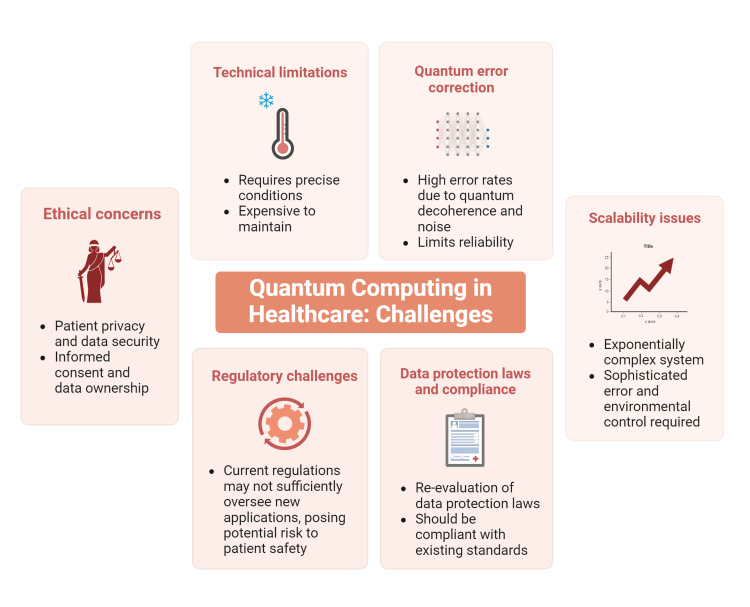
The healthcare sector faces complex challenges that call for innovative solutions to improve diagnostic accuracy, treatment efficacy, and data management. Quantum computing, with its unique capabilities, holds the potential to revolutionize various aspects of healthcare. This narrative review critically examines the existing literature on the application of quantum computing in healthcare, focusing on its utility in enhancing diagnostics, data processing, and treatment planning. Quantum computing's ability to handle large, complex datasets more efficiently than classical computers can significantly impact domains such as genomics, medical imaging, and personalized medicine. Quantum algorithms can accelerate the identification of genetic markers associated with diseases, facilitate the analysis of medical images, and optimize treatment plans based on individual genetic profiles. Moreover, quantum cryptography offers a robust security solution for safeguarding sensitive patient data, a critical need as healthcare increasingly relies on digital platforms. Despite the promising outlook, the integration of quantum computing into healthcare faces technical, ethical, and regulatory challenges. The delicate nature of quantum hardware, the need for error correction, and the scalability of quantum systems pose barriers to widespread adoption. Additionally, concerns around patient privacy and data security, as well as the need for updated regulatory frameworks, must be addressed. Ongoing research and collaborative efforts involving researchers, healthcare providers, and technology developers are crucial to overcoming these hurdles and realizing the full potential of quantum computing in transforming healthcare. As quantum computing continues to evolve, its impact on the future of healthcare could be profound, leading to earlier disease detection, more personalized treatments, and improved patient outcomes. For instance, quantum computing has already been applied to enhance drug discovery processes, with companies like D-Wave Systems (Burnaby, Canada) demonstrating faster molecular simulations for pharmaceutical research and IBM's (Armonk, USA) quantum systems being used to model chemical reactions for new drug development.
Keywords: data processing; diagnostics; drug discovery; healthcare; personalized medicine; quantum computing.
Copyright © 2024, Jeyaraman et al.
Conflict of interest statement
Conflicts of interest: In compliance with the ICMJE uniform disclosure form, all authors declare the following: Payment/services info: All authors have declared that no financial support was received from any organization for the submitted work. Financial relationships: All authors have declared that they have no financial relationships at present or within the previous three years with any organizations that might have an interest in the submitted work. Other relationships: All authors have declared that there are no other relationships or activities that could appear to have influenced the submitted work.
Figures
References
-
- An introduction to quantum machine learning. Schuld M, Sinayskiy I, Petruccione F. Contemporary Physics. 2015;56:172–185.
-
- Quantum computing: a taxonomy, systematic review and future directions. Gill SS, Kumar A, Singh H, Singh M, Kaur K, Usman M, Buyya R. Software: Practice and Experience. 2022;52:66–114.
-
- The utilization of perspective quantum technologies in biomedicine. Tarasov PA, Isaev EA, Grigoriev AA, Morgunov AF. J Phys: Conf Ser. 2020;1439:12040.
-
- The state of quantum computing applications in health and medicine. Flöther FF. Research Directions: Quantum Technologies. 2023;1:10.
Publication types
LinkOut - more resources
Full Text Sources
Research Materials
Miscellaneous