Strategies for effective high pressure germination or inactivation of Bacillus spores involving nisin
- PMID: 39311577
- PMCID: PMC11505639
- DOI: 10.1128/aem.02299-23
Strategies for effective high pressure germination or inactivation of Bacillus spores involving nisin
Abstract
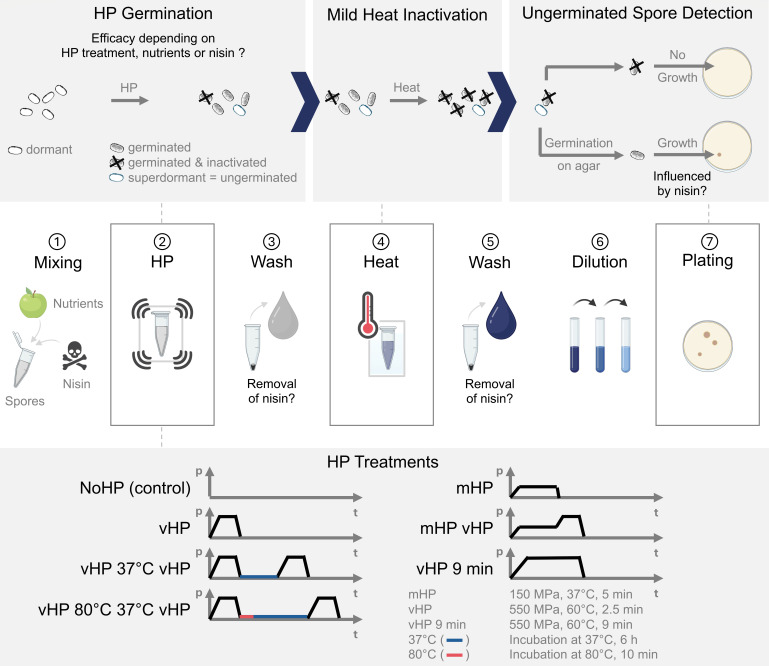
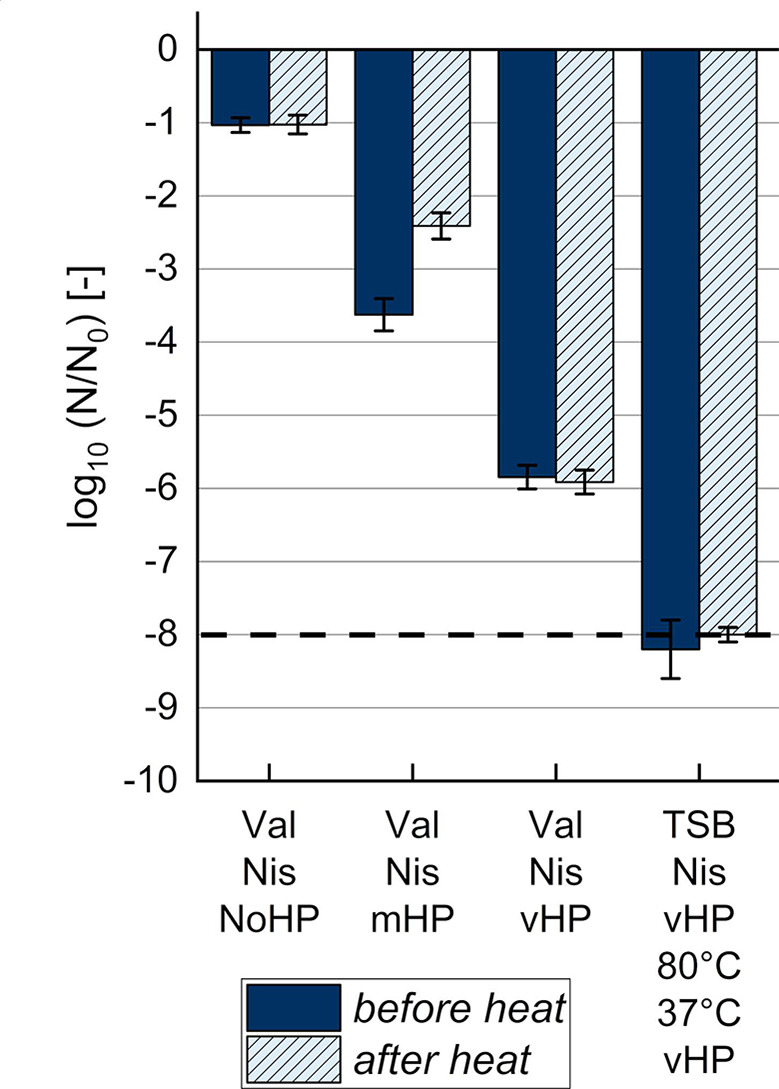
The major challenge in employing high pressure (HP) at moderate temperature for sterilization is the remarkable resistance of bacterial spores. High isostatic pressure can initiate spore germination, enabling subsequent inactivation under mild conditions. However, not all spores could be triggered to germinate under pressure at temperatures ≤80°C so far. In this study, germination treatment combinations were evaluated for Bacillus spores involving moderate HP (150 MPa, 37°C, 5 min), very HP (vHP, 550 MPa, 60°C, 2.5 or 9 min), simple and complex nutrient germinants [L-valine, L-alanine, and tryptic soy broth (TSB)], nisin, and incubation at atmospheric pressure (37°C). The most effective combinations for Bacillus subtilis resulted in a reduction of culturable dormant spores by 8 log10 units. The combinations involved nisin, a nutrient germinant (L-valine or TSB), a first vHP treatment (550 MPa, 60°C, 2.5 min), incubation at atmospheric pressure (37°C, 6 h), and a second vHP treatment (550 MPa, 60°C, 2.5 min). Such treatment combination with L-valine reduced Bacillus amyloliquefaciens spores by only 2 log10 units. B. amyloliquefaciens, thus, proved to be substantially more HP-resistant compared to B. subtilis, validating previous studies. Despite combining different germination mechanisms, complete germination could not be achieved for either species. The natural bacteriocin nisin did seemingly not promote HP germination initiation under chosen HP conditions, contrary to previous literature. Nevertheless, nisin might be beneficial to inhibit the growth of HP-germinated or remaining ungerminated spores. Future germination experiments might consider that nisin could not be completely removed from spores by washing, thereby affecting plate count enumeration.
Importance: Extremely resistant spore-forming bacteria are widely distributed in nature. They infiltrate the food chain and processing environments, posing risks of spoilage and food safety. Traditional heat-intensive inactivation methods often negatively affect the product quality. HP germination-inactivation offers a potential solution for better preserving sensitive ingredients while inactivating spores. However, the presence of ungerminated (superdormant) spores hampers the strategy's success and safety. Knowledge of strategies to overcome resistance to HP germination is vital to progress mild spore control technologies. Our study contributes to the evaluation and development of mild preservation processes by evaluating strategies to enhance the HP germination-inactivation efficacy. Mild preservation processes can fulfill the consumers' demand for safe and minimally processed food.
Keywords: Bacillus amyloliquefaciens; Bacillus subtilis; endospore; germination; high isostatic pressure; inactivation; nisin; superdormant.
Conflict of interest statement
The authors declare no conflict of interest.
Figures




References
-
- Setlow P, Johnson EA. 2019. Spores and their significance, p 23–63. In Food microbiology: fundamentals and frontiers. Wiley.
-
- Hu H, Balasubramaniam VM. 2024. High-pressure processing, p 531–551. In Encyclopedia of food safety, 2nd ed. Elsevier.
-
- Wells-Bennik MHJ, Eijlander RT, den Besten HMW, Berendsen EM, Warda AK, Krawczyk AO, Nierop Groot MN, Xiao Y, Zwietering MH, Kuipers OP, Abee T. 2016. Bacterial spores in food: survival, emergence, and outgrowth. Annu Rev Food Sci Technol 7:457–482. doi: 10.1146/annurev-food-041715-033144 - DOI - PubMed
MeSH terms
Substances
Grants and funding
LinkOut - more resources
Full Text Sources
Research Materials
Miscellaneous