


The effects of chicory inulin-type fructans supplementation on weight management outcomes: systematic review, meta-analysis, and meta-regression of randomized controlled trials
- PMID: 39313030
- PMCID: PMC11600113
- DOI: 10.1016/j.ajcnut.2024.09.019
The effects of chicory inulin-type fructans supplementation on weight management outcomes: systematic review, meta-analysis, and meta-regression of randomized controlled trials
Erratum in
-
Corrigendum to "The effects of chicory inulin-type fructans supplementation on weight management outcomes: systematic review, meta-analysis, and meta-regression of randomized controlled trials" [Am J Clin Nutr, 120 (2024), 1245-1258].Am J Clin Nutr. 2025 Jul;122(1):368-370. doi: 10.1016/j.ajcnut.2025.05.013. Epub 2025 May 24. Am J Clin Nutr. 2025. PMID: 40414749 Free PMC article. No abstract available.
Abstract
Background: Excess body weight and adiposity can adversely affect metabolic health. Prebiotics such as inulin-type fructans (ITFs) from chicory root are known to modulate gut microbiota and may improve body weight regulation.
Objectives: This study aimed to assess evidence for chicory ITF supplementation to support weight management.
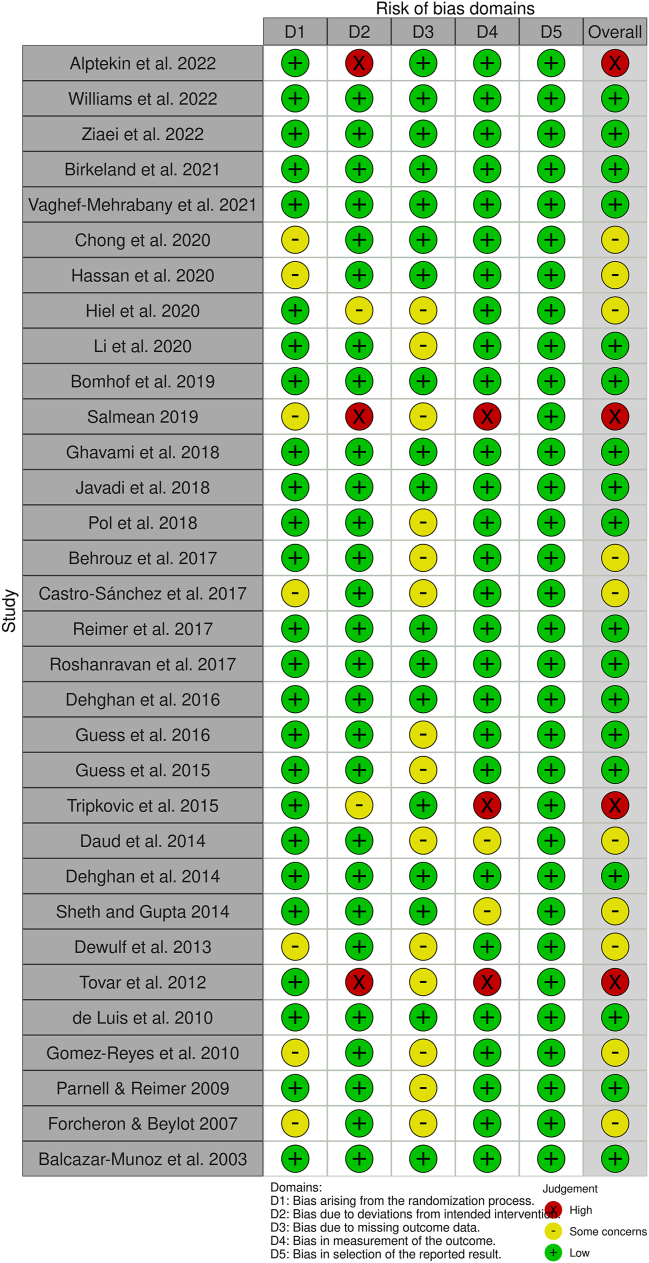
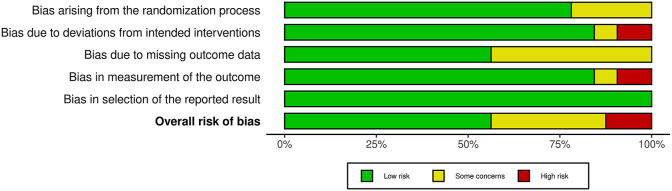
Methods: Eligible articles (initial search to 2021, updated to February 2023) were searched from EMBASE, MEDLINE (PubMed), and Cochrane Library. Data on primary (body weight) and secondary outcomes [body mass index (BMI), total fat mass, body fat percentage, and waist circumference] were extracted by 2 reviewers independently. Random-effects model using inverse-variance method was used. Subgroup analysis (health status and ITF type) and meta-regression (dose and duration) were evaluated.
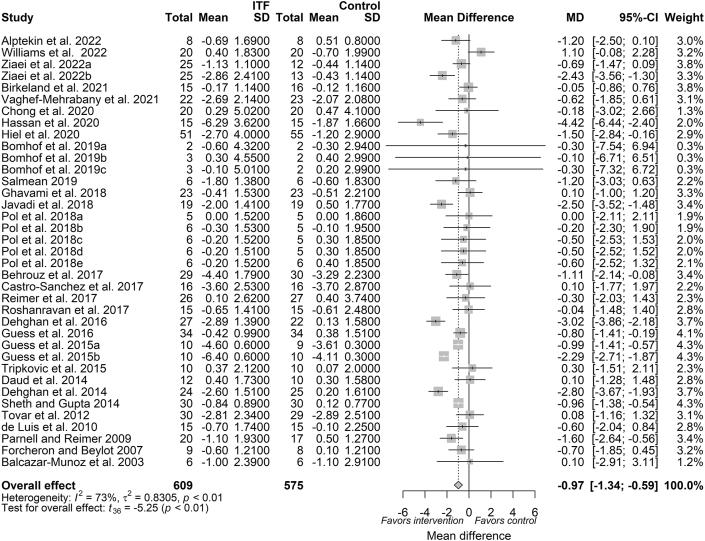
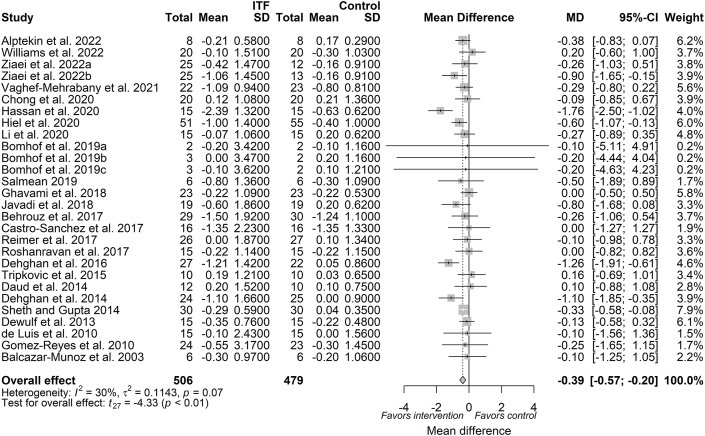
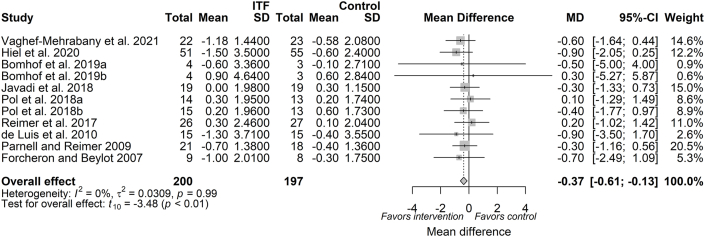
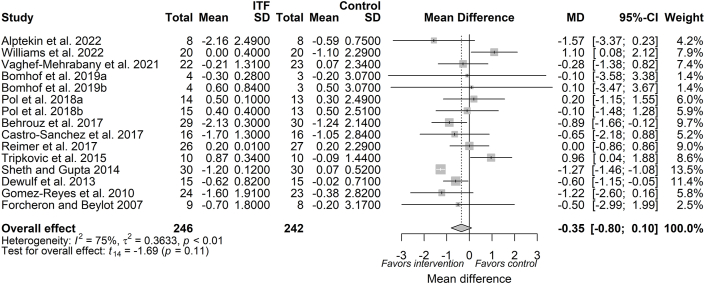
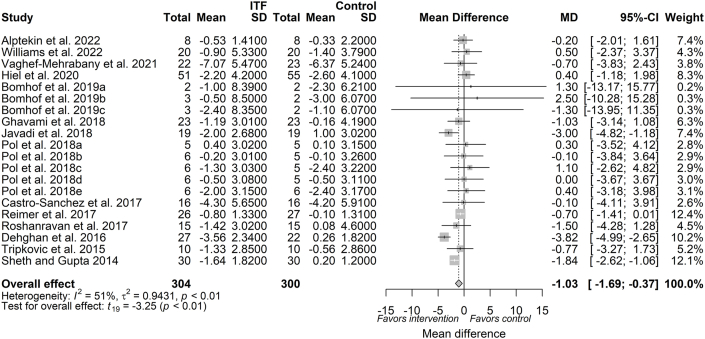
Results: A total of 32 eligible studies were included. Chicory ITF significantly reduced body weight [mean difference (MD): -0.97 kg; 95% CI: -1.34, -0.59); n = 1184] compared with placebo. ITF favored overall effects reduction in BMI (MD: -0.39 kg/m2; 95% CI: -0.57, -0.20; n = 985), fat mass (MD: -0.37 kg; 95% CI: -0.61, -0.13; n = 397), waist circumference (MD: -1.03 cm; 95% CI: -1.69, -0.37; n = 604), and for intervention duration of >8 wk, body fat percentage (MD: -0.78%; 95% CI: -1.17, -0.39; n = 488). Except for considerable heterogeneity in body weight (I2: 73%) and body fat percentage (I2: 75%), all other outcomes had negligible to moderate heterogeneity. Significant reduction in body weight, BMI, and waist circumference was evident irrespective of participants' health status. There was minimal evidence that dose, duration, or type of ITF influenced the magnitude of reductions in outcomes.
Conclusions: Chicory ITF supplementation may benefit weight management by reducing body weight, BMI, fat mass, waist circumference, and, to a certain extent, body fat percentage. This systematic review with meta-analysis was registered at PROSPERO as CRD42020184908.
Keywords: inulin; meta-analysis; meta-regression; oligofructose; systematic review; weight management.
Copyright © 2024 The Author(s). Published by Elsevier Inc. All rights reserved.
Conflict of interest statement
Conflict of interest YCZ and ST are employed by BENEO Institute, c/o BENEO GmbH, Obrigheim/Pfalz, Germany. BENEO is a company involved in production of food ingredients including prebiotic fructans and polyols. RAR has received consulting fees and speaker honoraria related to presentations on prebiotics.
Figures

References
-
- World Obesity Federation . 2023. World obesity atlas 2023 [Internet]. London.https://data.worldobesity.org/publications/?cat=19 Date cited: 7 March 2024, Available from:
-
- Hafida S., Apovian C. Physiology of the weight-reduced state and its impact on weight regain, Endocrinol. Metab. Clin. North Am. 2022;51:795–815. - PubMed
-
- Kokkorakis M., Katsarou A., Katsiki N., Mantzoros C.S. Milestones in the journey towards addressing obesity; past trials and triumphs, recent breakthroughs, and an exciting future in the era of emerging effective medical therapies and integration of effective medical therapies with metabolic surgery. Metabolism. 2023;148 - PubMed
-
- Ahmad J., Khan I., Zengin G., Mahomoodally M.F. The gut microbiome in the fight against obesity: the potential of dietary factors. FASEB J. 2023;37 - PubMed
Publication types
MeSH terms
Substances
LinkOut - more resources
Full Text Sources
Medical
